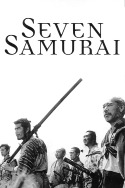
Review of Seven Samurai (1954) by Caesar M — 30 Sep 2013
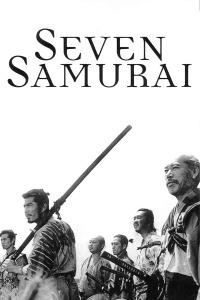
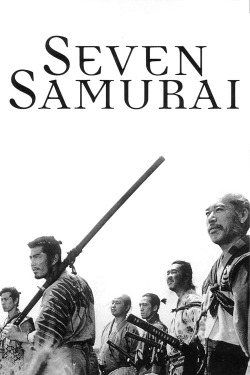
Seven Samurai is often categorized as the catalyst of Samurai films and that titled is well preserved since it release. It's not only an important piece of filmmaking in Asia, but in filmmaking in general. Its influence can still be seen today. It's one of the quintessential films of cinema very few can match in terms of importance and quality.
Seven Samurai is about a poor village attempting to recruit seven unemployed samurai to help them defend themselves against the attacking bandits. The plot of Seven Samurai was among the first to introduced several plot structural elements that are still used even to this day. The recruitment and gathering of heroes towards a specific goal, introducing the main hero with an undertaking unrelated to the main plot, a reluctant hero, romance between a local girl and the youngest hero, and the nervousness of the common citizens. Others film since it release have used these common plot devices, but "Seven Samurai" was among the first to combined them all. Yes it makes the film overly familiar yet despite how many times we have seen these specific plot elements "Seven Samurai" remains timeless.
In terms of writing "Seven Samurai" is one of few films that remains flawless and unmatched. It gradually develops the villagers and the samurai with such a profound depth. The villagers are among most dynamic exploring the common social class fearing the way and culture of the Samurai. Opposing at first due to their social status fearing for their livelihood if the Samurai will abuse and take advantage of them in their weak position. Debating the negatives and positives with either decision they choose go with. This simple dilemma in other films would have had a clear answer, but here there's allot more to it than wrong and right. Consequences and reward of such an action is debated until the villagers ultimately come to term accepting to go with the enemy they hate least. Scenes like this makes the village come to life and make you feel like you hold importance in the community. You'll end up wanting for everyone to make it out alive, but know such an outcome is inevitable making it even more compelling and heightens the tension.
Even more impressive is how every Samurai is three dimensional. Each having their own distinctive characteristic, their own motivations, their own morals, and their past. What bounds these Samurai together is their code. A code that has been thrust onto to them by society to performs the duty they are given. Bounded together to preserve a tradition that no matter the reward must help those in need. A code that the film is not afraid to challenge on several occasions. Like if it's honorable for a Samurai to work for the simple reward of being fed? Should a Samurai cut of his symbolic hairstyle showing his status to help aid a single person? If a warrior has experienced many battles does it necessarily mean he won any of them? It's not afraid to touch upon the Samurai culture in a negative light doing so without demonizing them nor moralizing the complex dilemma they face.
The bandits which are the villain of the film are never given a clear face. Alluding that evil has no common face, but is all common with reasoning behind their actions. The bandits aren't necessarily evil just for the sake of being cruel. They have no jobs, own no land, and divided among the rest of the world for their own lifestyle they adapted for survival. Hence why the introduction of these bandits is not a barbaric one showing the bandits attacking a village, but rather through dialogue as the bandits declare they will take another village resources for living. If we were to see the bandits of "Seven Samurai" commit a crime for our introduction they would have been no difference from your average antagonist. Leaving little or no impression upon the viewer lessening ideals presented in conflict. This demonstrates that despite their barbaric nature the bandits still carry common traits working together as a society to survive by all means. One could even say the villagers and the bandits are no different from each other.
The ending is also one worth touching upon. It's an ending so perfect that it rivals the like of "Casablanca" as one of the greatest ending ever filmed. The ending best personifies our heroes honor and the villagers view on the Samurai. Throughout their entire endeavors the Samurai turmoils and internal conflicts can be presented in this one scene. On looking on the aftermath of the experience. Losing the war despite winning so many battles and ultimately for no fame, no fortune, but because of their code of life bound to them. Teaching those who serve for the greater good in the end might not be rewarded for their good deed and even be forgotten no matter the size of the deed committed.
Akira Kurosawa hits all the right note with his masterful direction. Not once is the viewer ever lost in its complicated narrative under Kurosawa direction. He uses landscapes to create atmosphere going from a peaceful mood to states of depression letting no single image go to waste. The film battle scenes serve an equally dramatic purpose not just simply being a form of spectacles. Kurosawa highlights the pain and misery of excessive violence on reverse of heroism. In all the scenes of people running, the camera seems to speed up also to kick up the film's adrenaline. Kurosawa also help pioneered the use of slow motion in some scenes to underscore the moment brilliantly orchestrating the flow of the action. Fumio Hayasaka scores manages to capture the diversity of tones in Kurosawa's narrative sweeping you away with emotion with every note you hear.
In terms of acting you'll be hard pressed to find a single weak link. The actors in this film were outstanding as they each brought their character to life in an unbelievable way, as they delivered different humorous moments, exciting and gripping sequences and some very touching and emotional scenes. Of all the actor Toshiro Mifune is easily the standout among an all star cast with his oddball personality and huge dramatic change through the course of the film. Mifune accomplished no easy feat in film filled with numerous excellent actors and performances.
Seven Samurai is without a shed of doubt one of the greatest films ever made. It's more than tale of good versus evil, it's more than a epic, and it's more than a classic. "Seven Samurai" is a piece of filmmaking that forever changed it landscape, continue to serves as an inspiration for filmmakers to this day, and a film that holds many interpretation discovering a new meaning with every viewing.
This review of Seven Samurai (1954) was written by Caesar M on 30 Sep 2013.
Seven Samurai has generally received very positive reviews.
Was this review helpful?