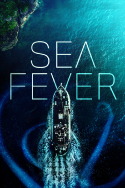
Review of Sea Fever (2020) by Bertaut1 — 13 Apr 2020
An impressive eco-thriller that could do with more clearly delineated characters.
The debut feature from writer/director Neasa Hardiman, Sea Fever examines such issues as humanity's disregard for the size of our ecological footprint, the knee-jerk argument that if something hitherto unknown can't be exploited for profit then it should be destroyed, and Mankind's utter insignificance in the face of the wonders of nature. Heavily influenced by Alien (1979), The Thing (1982), and David Cronenberg's body horror films, it could do with some refinement, especially in terms of characterisation, and the dénouement is a little anticlimactic, but Hardiman gets the atmosphere spot on, and overall, this is an impressive debut.
Siobhán (Hermione Corfield) is an all-work-and-no-play doctoral student studying marine biology who is told that she needs to get practical experience outside the lab and so her professor has organised for her to join a fishing boat - the Niamh Chinn-Óir. Owned by Freya (Connie Nielsen) and captained by her husband Gerard (Dougray Scott), the boat hasn't been doing too well recently and money is tight. However, Gerard has been tracking a huge shoal of fish and believes their luck is about to change. Upon sailing, Gerard sees that the shoal has moved into an exclusion zone, but without telling anyone, he too enters the zone. No sooner has he done so when the Niamh hits something and becomes entangled, and Siobhán is stunned to see huge bioluminescent tentacles arising from the deep and attached to the hull. Back on board, she's thrilled to announce they may have encountered a creature unknown to science, but when it becomes apparent that the tentacles are secreting dangerous microscopic parasites onto the Niamh, the crew find themselves in a fight for survival.
In a post-screening Q&A with Hardiman at the film's Irish première, she said that one of the main ideas behind the story was to offer a corrective for films which demonise or are critical of the scientific method. In this sense, there's a lot more hard real-world science than you might expect, including some fairly detailed discussions of the possible biochemistry of the creature and hypotheses as to why it behaves the way it does. In the latter half of the film, a lot of time is given over to discussions of whether the Niamh should head back to Ireland, with Siobhán trying to make the others understand the devastating ramifications that could result from introducing the parasites into a population centre. All of this doesn't quite position the film in the realm of science-fact, but it certainly helps to lend the narrative a stronger sense of real-world verisimilitude.
Science is also important thematically insofar as one of the main issues is that the creature may not be acting aggressively. In this way, Hardiman refuses to demonise it, and from the moment of its discovery, Siobhán consistently argues that the crew must protect it. On the other hand, Gerard sees it as something to be used for profit, and later as something to be destroyed.
Aesthetically, there's a merciful absence of jump scares and, apart from one scene, there's very little gore. Instead, the film's horror elements are based more in the intricate sound design, Ray Ball's production design, and Ruairí O'Brien's cinematography. The three work in tandem to make it impossible for the viewer to ever forget that we're on a ship isolated at sea – from the constant creaking and sound of lapping water to the claustrophobic quarters to the handheld and often dimly lit photography.
In terms of problems, the most significant is that even given the small cast, there isn't a huge amount of character differentiation, with the Niamh's crew largely interchangeable. One of the reasons films like Alien and The Thing are considered classics is because of how good the character individualisation is – every person in both of those films is a distinct individual with a clearly defined set of character traits that sets him or her apart from the others. Sea Fever's failure to do this makes it harder to care about these people, which makes them feel expendable. It's a shame, because with just a little more work on the screenplay, the film could really have been elevated into something special. Another small gripe I have is that the conclusion is anticlimactic; it works very well thematically, but it's weak in terms of drama or tension.
Mixing body-horror with elements of a creature-feature garnished with some eco-friendly themes, Sea Fever is a very enjoyable film and an impressive debut feature. Although its broader genre beats offer nothing we haven't seen before, it still manages to feel like its own thing with its own things to say. It could do with a better balance in terms of the plot/characterisation ratio, but the unexpected focus on science and ecological themes mean it rises above the monster movie clichés you might expect.
This review of Sea Fever (2020) was written by Bertaut1 on 13 Apr 2020.
Sea Fever has generally received mixed reviews.
Was this review helpful?