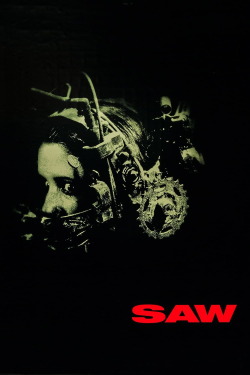
Review of Saw (2004) by Zingaro P — 23 Oct 2012
Starring: Cary Elwes, Leigh Whannell, Danny Glover, Ken Leung, Monica Potter, Michael Emerson.
Director: James Wan.
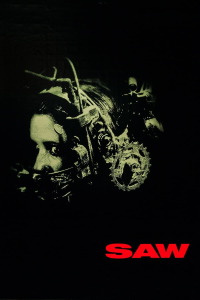
The directorial debut from filmmaker James Wan, this psychological thriller comes from the first screenplay by actor Leigh Whannell, who also stars. Whannell plays Adam, one of two men chained up in a mysterious chamber. The other, Dr. Gordon (Cary Elwes), like Adam, has no idea how either of them got there. Neither of them are led to feel optimistic by the man lying between them dead of a self-inflicted gunshot wound. Together, Adam and Dr. Gordon attempt to piece together what has happened to them and who the sadistic madman behind their imprisonment is. Also starring Danny Glover and Monica Potter, Saw premiered at the 2004 Sundance Film Festival.
Saw opens with one of those classic conundrums guaranteed to grip an audience from the start. Two strangers wake up in a dank, squalid room, chained to opposite walls. Between them is a blood soaked body with a tape recorder in one hand and a gun in the other. Neither man knows why or how they got there. All they do know are things don't look good.
Their fears are well founded. Each finds a tape planted in their pocket. When surgeon Lawrence (Cary Elwes) hands his to photographer Adam (Leigh Whannell) to play, they discover that Lawrence's wife and daughter are also being held captive and the only way to secure their release is if Lawrence kills Adam before six o'clock. As the clock on the wall ticks, the captor's voice on the tape declares, "Let the game begin." With his gravelly proclamation the tension mounts and for the next hour and a half it doesn't let up as Saw builds to its harrowing and surprising climax.
Made for a reputed million dollars, Saw proves a good idea doesn't require a big budget. First time director James Wan makes smart use of his resources and even manages to secure some recognized actors, though ironically it's the performances that are the film's weakest element. In addition to playing Adam, Whannell wrote the screenplay. On this evidence, he is clearly a better writer than an actor. The script, based on a story by Whannell and Wan, is absorbing, if not so much for the dialogue as the plotting. Its twists and turns are allied with some creative methods of torture. Dealing with the exploits of a particularly macabre serial killer, Saw bears many of the hallmarks of Silence Of The Lambs, to which it compares favourably.
The film's title comes from the name the Jigsaw Killer, given to a renowned serial killer for his distinctive methods which are shown in a series of gruesome flashbacks. Rather than actually murder people, he creates elaborate psychological set ups that force the victims to challenge themselves to escape or die trying. The subjects are strategically picked based on some fundamental weakness or flaw. Finding out the reasons for their capture is one of the issues facing Lawrence and Adam as they question each other and themselves in an effort to find an escape. But their inherent suspicions about one another, fuelled by their captor's cleverly devised plan, hamper their efforts to collaborate.
The story, which also involves a vengeful detective (Danny Glover) who has his own reasons to capture the killer, unveils by cutting between Lawrence and Adam in their sadistic tomb and the circumstances that led them there. In a cinematic world already over populated with mass murderers, coming up with an original and memorable new one gets tougher, but in the Jigsaw Killer, Wan and Whannell have done just that.
This review of Saw (2004) was written by Zingaro P on 23 Oct 2012.
Saw has generally received positive reviews.
Was this review helpful?