Review of Satantango (1994) by Donovan D — 15 Jul 2008
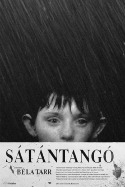
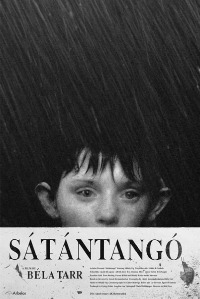
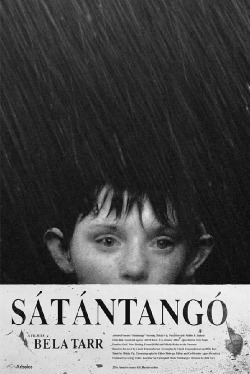
The films on the '1001 Films You Must See Before You Die' List vary quite greatly in difficulty and artistic value, from common everyman classics like 'Beverley Hill Cop' to avant-garde masterpieces like 'Wavelength' and 'Dog Star Man'. Perhaps the most difficult, most obscure and most daunting film of all on the list is Hungarian master-director Bela Tarr's rarely-scene 7 hour long, black and white 'Satantango' (Satan's Tango): made over two years and released to critical acclaim (and little else) in 1994. Largely due to the totally, uncompromisingly uncommercial nature of his ouevre, Tarr is a filmmaker more known to western audiences for his influence on Gus Van Sant's not entirely satisfying 'Gerry' and the Palme D'or winning 'Elephant' - as well as being held in almost universal high regard amongst elitist critics like Jonathan Rosenbaum and J. Hoberman - than for his challenging but rewarding body of work. Having limited cinematic distribution in the English-speaking world, Tarr's films has found a wider viewership in recent years thanks to the more arthouse film-friendly DVD format, and it is through the Region 2 Artificial Eye release that I was able to finally see this challenging film.
If a black and white film consisting of 7 hours of peasants sounds like the most excruciatingly painful film experience possible, you're quite right - it IS excruciating. I'm a patient viewer - having sat through and enjoyed difficult films like 'Dog Star Man', 'Wavelength', 'INLAND EMPIRE'and 'Mouchette'- and I've attended marathon screenings of 'Lord of the Rings' and 'Star Wars', but little could prepare me for the punishing combination of slow pacing and extreme running time that is 'Satantango' - and I've even seen and loved Tarr's later, more economical 'Werckmeister Harmonies', too. To get an idea of how slow paced this film can get, look no further than the third chapter of the movie. Lasting over an hour, the scene depicts - with very little in the way of cuts - an old doctor, peering out of his window at the drama unfolding outside (which we've already seen I might add), very ... slowly ... speaking ... his ... words ... as ... he ... writes ... them ... down, falling over drunk, falling asleep and even urinating. When Jonathan Rosenbaum says 'It's a tribute to Tarr's singularity of purpose that at no point does this sequence...seem tedious or self-indulgent' I can't help but think of such a statement as, frankly, pretentious fanboy hipsterism. For me anyone who says this film is not taxing is not being entirely honest, and is quite possibly missing the point. I think Tarr knows that such sequences are going on for way too long based on the standards of cinematic convention, and such scenes - while highlighting everyday life - are stretched to such breaking point that there is actually a certain perverse humour to them. I know personally in this scene with the doctor that I felt heavy-lidded and could have used the relief of a toilet break intermission. That the character did both within the one scene so close to the first interval made me think of Tarr as giving us an entirely self-aware Godardian wink.
So why would one subject themselves to a film that is so long that it is excruciating to even sit through? Because, thankfully, Tarr - in his adaptation of collaborator Laszlo Karsznahorkai's novel - has fleshed out his sprawling 7-hour canvas with more allegorical meaning and purpose than your average 8 hour nine-to-fiver. Most people have probably worked a lousy job, content enough for the pay even if it is empty and unfulfilling or spent weeks reading an epic but disappointing novel. So giving seven hours over to a film that is filled with deep meaning is really not all that hard if you put it into perspective. In essence, every element in Tarr's film stands in for the greater story of Eastern European history and the betrayals of communism's utopian dream. The film is a sad, heartfelt lamentation for the unstable and tragic past of Eastern Europe throughout the centuries, and the seeming salvation of the promise of communism that only lead to more heartbreak and misery for its people. The most shocking statement of pre-communism infighting and self-destruction comes in the celebrated chapter involving a young girl and a cat - coming as it does after the slow-paced doctor scene the horror is all the more palpable. Speaking of slow-paced; in the context of the film's allegory, even the long takes stand for the Eastern European experience - monotonous scenes and the constant waiting make us feel the frustrating stagnation of entire lands that never shared in Western Europe's affluence and development. This is only heightened by a bravura sound design that highlight the repetition and slow pacing in ways that show Tarr and Co. to be filmmakers of the highest order - so often sound design can seem so non-descript and lacking in arthouse films, yet here sound's role in film as an audio/visual medium is fully realized. My one disappointment here however is that while there are several scenes of immense beauty, the extended takes here were nowhere near as balletic and ingenius as they are in Werckmeister Harmonies but I suppose the later film is only a third of the length and was made a decade later so this is a minor quibble.
So where does this film sit amongst the thousands I've seen, and how do I rate it as a piece of cinema? There is no doubt in my mind that Satantango is a very good work of literary narrative cinema, but I would find it very hard to exactly recommend this film to just about anyone to see. While there are moments of great humour throughout, Satantango is a dark and bleak film that is as far away from an entertainment as you can get. Tarr is the anti-Michael Bay - filled with as much of a leftist spirit as Bay's films are pretty much advertisements of right-wing capitalist thought. And while this might sound inviting to critics of Bay, many will probably come out of this film thinking seeing Bay's director's cut of Pearl Harbor is preferable. In my mind, Satantango is a few steps behind the better Werckmeister Harmonies. I'm a sucker for formalism, and Werckmeister Harmonies has many long takes that would make Orson Welles smile, and features a lead character far more likeable and charismatic than anyone in the earlier film. At the very least Werckmeister Harmonies has a certain accessibility that is lacking here. The effect of the monotony in Satantango is often achieved in half the time Tarr keeps shots on screen, so the film certainly wins no prizes for economy and in my mind lowers its stature slightly. Nevertheless, for those adventurous few looking for a meaningful slice of literary narrative and a test of their endurance, Satantango is a frustating, excruciatingly long movie - but one that is highly rewarding as well.
This review of Satantango (1994) was written by Donovan D on 15 Jul 2008.
Satantango has generally received very positive reviews.
Was this review helpful?