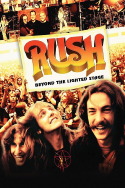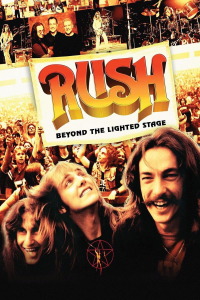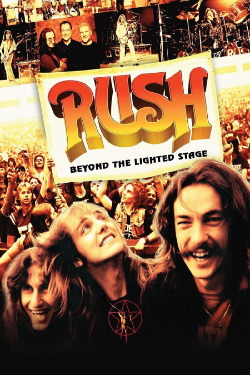
Review of Rush: Beyond the Lighted Stage (2010) by David C — 05 Jul 2010
Reviewing a documentary about Rush almost seems like a waste of time, since Rush is such a love-it-or-hate-it band that if you're familiar with their music, you will know immediately whether or not this film is of interest to you. It's definitely of interest to me, as Rush is one of my favorite bands of all time, hell, they probably are my favorite band ever, so let's just say they are for the purposes of this review.
Sam Dunn & Scot McFadyen have pretty much made themselves the chroniclers of heavy metal in the documentary form, making films well-received by fans like METAL: A HEADBANGER'S JOURNEY, GLOBAL METAL, and IRON MAIDEN: FLIGHT 666. Most metalheads are fans of Rush, so it seems natural that they would pick them as a subject. What's so neat about this documentary is that Rush as a band are a pretty private bunch, so seeing their story and watching them evolve musically from their self-titled debut to SNAKES AND ARROWS is really something, as they bounce from Zeppelin-esque riffs, to progressive rock, to new wave pop, and to a more heavy, modern sound. Famous fans such as Billy Corgan, Jack Black, Vinnie Paul, Kirk Hammett, and Sebastian Bach offer their insights (Corgan and Black being the two highlights), as well as members of bands they toured with, such as Gene Simmons of KISS. Other subjects include the band's bizarre fashion sense (Geddy Lee's kimono phase was something else), their die-hard fanbase, the venomous ire they draw from rock critics and taste-makers, and the personal tragedy Neil Peart suffered in the late nineties that nearly caused the band to fall apart.
The most interesting bit is when the film muses on their popularity as a band, as Rush is an enormously popular act, and yet the media has actively dismissed them for the duration of their career. I remember the music editor for the Flyer told me that not only does he dislike Rush, but their popularity is baffling to him. Really, on paper a band like Rush should not have found a large audience, and for a band to have a breakthrough album like 2112 is truly strange, as 2112 features a twenty-plus minute sci-fi opus with an Ayn Rand twist. Yet, people not only dug it, they obsessed over it. Music nerds love to analyze and map the time signatures in "La Villa Strangiato" the way kids picking up a guitar try to nail Van Halen's "Eruption". Entertainment Weekly described Rush as "rock without the roll," as Rush is a rock band that is largely asexual, their music doesn't obsess over cliche, tired rock subjects girls, fast cars, alcohol, drugs, or any form of debauchery. Instead their songs were more literary, the subjects usually pertaining to whatever Neil Peart was reading at the time. Peart's lyrics are an acquired taste, he was listed quite high up on Blender magazine's "worst lyricists of all time" list (Rush seems to have a special place in the "worst" lists from rock critics) and yet you can't deny that his words stay in your head and make you think about what he's saying. That's not to say he isn't easy to make fun of sometimes ("For I have dined on honey dew!"), but songs like "The Spirit of Radio", "Closer to the Heart", "Dreamline", and "Limelight" are a few examples of tunes with words that have a magical touch that stay with you. The quirks of Rush as a group are all analyzed here and the documentary really brings to light why they are the world's biggest cult band. If you've never seriously listened to their music, you might be inclined to after seeing this, if you're a fan already, you don't need me to tell you to see it, and if you don't like them, I don't need to tell you not to.
This review of Rush: Beyond the Lighted Stage (2010) was written by David C on 05 Jul 2010.
Rush: Beyond the Lighted Stage has generally received very positive reviews.
Was this review helpful?