Review of Run Lola Run (1998) by Yasmeen A — 16 Apr 2018
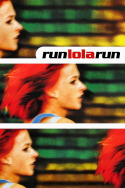
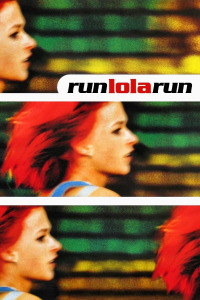
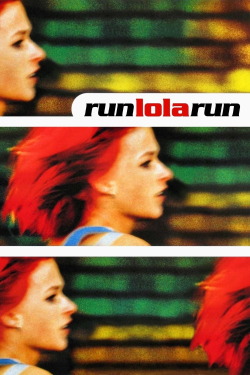
The film Run Lola Run is about a character, Lola, who needs to find 100,000 Deutsche marks in 20 minutes to save her boyfriend's life. The film is cut into three 20 minute missions, and in each mission, Lola decides to do certain things differently. This film primarily speaks about the concept of time and challenges the reality of this concept through Lola's character. The fact that it draws the viewer's attention to the means of production through symbolism, transgression of boundaries, and false consciousness, is what makes the film stand out.
In the beginning of the film, the animation of Lola running as fast as she can and breaking obstacles while constantly being surrounded by clocks, illustrates that life is a game. We are constantly repeating our day to day routine with minor changes, and time is always running the same exact way. So, we, humans, are imprisoned by time in some space in life and the events that take place go round and round, except that they go in spirals and not in circles. Therefore, the choices we make at a certain time influences the future or rearranges it in some way, affecting what stages we reach to in life, much like the butterfly effect. As a viewer watching the film, you feel as though Lola has been given much more than just 20 minutes. It gives a perception that Lola manipulates time or tries to create it, which specifically makes the film transgress the boundaries of time in the realistic world.
Lola's physical appearance in the beginning of the film leads us to think that she is careless, but that perspective changes when the film shows that she wholeheartedly cares and is actually full of intelligence. This is meant by the director to address the false consciousness within the viewers. Moreover, in the first two attempts, Lola always chooses to seek help from her father figure, but on the third attempt she never asks anyone for help, especially a man. Only then does she succeed in winning the money all by herself. This cinematic idea is demystifying the fact that one, a female in particular, does not need a male figure to succeed in life. Therefore, the false consciousness of society's perspective on this matter is challenged by the director through her final attempt.
The symbolism in this film is very obvious, in which it metaphorically speaks to the audience. Lola's character is associated with red; her hair is red, her telephone is red, and her personality represents the color red. Red is the color of her desperation and passion to accomplish her 'mission' and stick by her promise to her boyfriend Manni. It is also the color that shows her fierceness or wildness. Red is also the color of 'emergency' in the film. It is evident in the scene where Lola runs alongside the emergency car, that similar to the driver of the car, Lola also has an emergency. Spirals are also a repetitive theme in the film that emphasizes the loop we go through in life, which is constricted by time.
The fast paced extra diegetic sounds where Lola runs emphasizes on the fact that time is running and she has an emergency. It further allows the transfer of boundaries in which the audience can feel the anxiety that Lola feels. A song called "Believe" by Franka Potente is played in all the three times Lola runs. The lyrics of the song contradict how Lola is framed in the film. The song repeats "I don't believe in promise, I don't believe in chance... I don't believe in panic, I don't believe in fear." However, while Lola runs, she delivers the impression that she does believe in promise and chance, and that she is in panic and fear at the same time. She promises Manni that she will find the money, she takes the chance of gambling in the casino, and throughout it all she is anxious and fearful about the future. This ironic distance between her thoughts and her actions creates another form of false consciousness, in which she knows that she does not believe, but she does not want to know that she does not believe, so she does not know to be able to get through her attempts and 'win the game'.
Run Lola Run is also a film in between modernism and post-modernism. It follows a modern world, in a sense that it portrays how people are constantly pressured by time without exaggeration as her 20-minute attempt in each of the three times is actually 20 minutes long in the film, so the audience is able to feel her anxiety and take her place in the film. It can also be seen as a post-modern world, where Lola gets to stop and repeat time to go back to the same exact setting and make new, different choices. This is something beyond our capabilities, which gives the film its element of the supernatural world. Not only does the film fulfill the audience's excitement from the beginning to the end, but it also succeeds in generating innovative approaches towards time.
This review of Run Lola Run (1998) was written by Yasmeen A on 16 Apr 2018.
Run Lola Run has generally received very positive reviews.
Was this review helpful?