Review of Rosewood (1997) by Edith N — 01 Jan 2010
Happy New Year!
This is not the happy holiday movie I could be reviewing, but due to circumstances which prevented my holiday from being as happy as it could have been, my other option with a New Year's scene is trapped behind furniture which had to be moved into the living room to escape the floodwaters from my overflowing washing machine. Frankly, I had to shift things to get to this one. Still, Our Story is set around the beginning of the year, and there is an actual happy celebration early in the film, before things go so horribly wrong. Besides, New Year's Day should also be a time of looking back at the past and knowing what to change. The true events on which this film is based happened a long, long time ago, and things this extreme do not happen in the United States anymore. However, a lot of the underlying attitudes still exist, and things like this do happen other places. Ask Don Cheadle--he can cite you chapter and verse. He would also like you to make a resolution to help stop it, I'm sure.
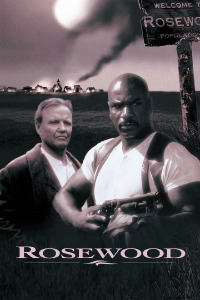
On New Year's Day, 1923, Rosewood, Florida, was a peaceful, prosperous town--with the distinction of being both primarily black and primarily middle class. A former soldier named Mann (Ving Rhames) has ridden into town and is rapidly falling in love with schoolteacher Beulah (Elise Neal), called Scrappie by those who know her. Mann intends to buy five acres which are on sale and settle down. The problem is that, in nearby Sumner--mostly white; mostly working class--Fanny Taylor (Catherine Kellner) has had a falling out with her (white) lover (Robert Patrick), who beats her up. She lies to all concerned and tells people that a black man beat her up, and some automatically assume he raped her as well. As it happens, a man named Jesse Hunter had escaped from a chain gang, and everyone assumes it was him. Since Mann is new in town, he must therefore also logically be Hunter. Soon, though, the locals are not content to merely look for Hunter; they go on a rampage and start burning the town, killing many black citizens and forcing the rest into hiding, some with the help of John Wright (Jon Voight), the storekeeper and only white business owner in the town.
So look. I know a little bit about John Singleton. I know, for example, what the town he grew up in is like and what the high school he attended was like. I know a little bit about his academic career, specifically how things went for him at that aforementioned high school. And, you know, okay. He did spend some time in South Central. On the other hand, he graduated from Blair High School, Pasadena, California. (We used to refer to him as one of the surviving members of the class of '86; three, as I recall, of the four honorary scholarships named for students were named for members of that class.) Now, South Central is tough, and I'm sure as hell not going to pretend it isn't. Come to that, racial conflicts are not exactly unknown at Blair--or at least weren't when I graduated from that selfsame high school in '95. But for the love of Gods, by the time of the riots, he was already a double Oscar nominee and therefore not exactly "street" anymore. Certainly not Southern!
This may be one of the reasons for, let us say, the historical touchiness of the film. It is true that Mann is fictionalized from several historical figures, one of whom cannot be documented and therefore may be fictional himself. It is true that Singleton presents us with far more deaths, both of blacks and whites, than the official history states. Singleton has turned the events up to eleven, presenting us with such a surfeit of violence that, by the end, it's hard to take it seriously anymore. He presents us with a borderline happy ending--those who consider it completely happy need to take a look at that last shot, of a town as burned out as any of Sherman's Sentinels. Yes, his Sylvester Carrier (Cheadle) meets a very different fate from the one history records for him, but there were rumours that this really was his fate, unto how he avoided the one intended for him. Besides, at least some of it is historically sound. Where it isn't, it isn't because of the fictional Mann, who changes the story around him on account of being Ving Rhames, whose job is to shoot people.
This is, though, a powerful film. Parts of it are a little hamhanded, a little too much, but so many of the characters in it are seemingly trapped by fate. There is a tragic nature to Sheriff Walker (Michael Rooker), who loses control of the situation faster than he could have possibly imagined. Now, frankly, he shouldn't have called up a posse. On the other hand, it doesn't seem as though much of anything could have stopped events from unfolding as they did. Some of the scenes which seem most overblown are historically accurate--if not to Rosewood, than to any number of other places. We are shown men posing for pictures in front of burned, hanged, mutilated bodies, but a Google image search will inevitably turn those up. Dave, one of the professors who first showed me this movie in college, didn't find out until adulthood that his hometown of Tulsa, Oklahoma, had been the site of an enormous race riot. Over the course of the twentieth century, events such as these went from festive occasions to dark secrets to things which should be brought back into the light. A more horrifying film could be made about Tulsa, and it may well be time.
This review of Rosewood (1997) was written by Edith N on 01 Jan 2010.
Rosewood has generally received very positive reviews.
Was this review helpful?