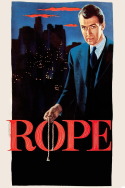
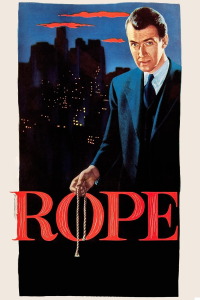
Review of Rope (1948) by Gary T — 04 Jan 2015
WOW.....WOW....WOW....WOW....STUNNING....GENIUS......FANTASTIC....AMAZING.....BRILLIANT.....JUST PURE BRILLIANT BRILLIANT, MAN I HAVE JUST SEEN THIS MOVIE 4 THE 1ST TIME N THINK THAT THIS IS SUCH A GREAT MOVIE 2 WATCH......its got a good cast of actors/actresses throughout this movie.....I think that james stewart (.R.I.P.), john dall (.R.I.P.), Farley granger (.R.I.P.), joan chandler (.R.I.P.), Sir Cedric Hardwicke (.R.I.P.), play good roles/parts throughout this movie.....I think that the director of this drama/mystery/suspense/classics movie had done a great job of directing this movie because you never know what 2 expect throughout this movie....
The original play was said to be inspired by the real-life murder of 14-year-old Bobby Franks in 1924 by University of Chicago students Nathan Leopold and Richard Loeb.
It is the first of Hitchcock's Technicolor films, and is notable for taking place in real time and being edited so as to appear as a single continuous shot through the use of long takes.
The film is one of Hitchcock's most experimental and "one of the most interesting experiments ever attempted by a major director working with big box-office names", abandoning many standard film techniques to allow for the long unbroken scenes. Each shot ran continuously for up to ten minutes without interruption. It was shot on a single set, aside from the opening establishing shot street scene under the credits. Camera moves were carefully planned and there was almost no editing.
The walls of the set were on rollers and could silently be moved out of the way to make way for the camera and then replaced when they were to come back into shot. Prop men constantly had to move the furniture and other props out of the way of the large Technicolor camera, and then ensure they were replaced in the correct location. A team of soundmen and camera operators kept the camera and microphones in constant motion, as the actors kept to a carefully choreographed set of cues.
The extraordinary cyclorama in the background was the largest backing ever used on a sound stage. It included models of the Empire State and the Chrysler buildings. Numerous chimneys smoke, lights come on in buildings, neon signs light up, and the sunset slowly unfolds as the movie progresses. Within the course of the film the clouds-made of spun glass-change position and shape eight times.
Long takes.
Hitchcock shot for periods lasting up to 10 minutes (the length of a film camera magazine), continuously panning from actor to actor, though most shots in the film wound up being shorter. Every other segment ends by panning against or tracking into an object-a man's jacket blocking the entire screen, or the back of a piece of furniture, for example. In this way, Hitchcock effectively masked half the cuts in the film.
However, at the end of 20 minutes (two magazines of film make one reel of film on the projector in the movie theater), the projectionist-when the film was shown in theaters-had to change reels. On these changeovers, Hitchcock cuts to a new camera setup, deliberately not disguising the cut.
Alfred Hitchcock's cameo is a signature occurrence in most of his films. In this film, Hitchcock is considered by some to make two appearances, according to Arthur Laurents in the documentary Rope Unleashed, available on the DVD. Laurents says that Hitchcock is a man walking down a Manhattan street in the opening scene, immediately after the title sequence.
At 55:19 into the film, a red neon sign in the far background showing Hitchcock's profile with "Reduco", the fictitious weight loss product used in his Lifeboat (1944) cameo, starts blinking; as the guests are escorted to the door actors Joan Chandler and Douglas Dick stop to have a few words, the sign appears and disappears in the background several times, right between their visages, right under the eyes of the spectators.
Rope included a homosexual subtext between the characters Brandon and Phillip, even though homosexuality was a highly controversial theme for the 1940s. The movie made it past the Production Code censors, however; during the film's production, those involved described homosexuality as "it". However, many towns chose to ban the film independently, memories of Leopold and Loeb still being fresh in some people's minds. Dall and Granger were actually homosexual in real life, as was screenwriter Arthur Laurents; even the piano score played by Granger (Mouvement Perpétuel No. 1) was the work of a homosexual composer, Francis Poulenc.
More recent reviews and criticism of the film explicitly note its homoerotic subtext.
Man this is such a thrilling movie 2 watch.....I think that this is such a really well written/acted/directed movie 2 watch. ...
Hitchcock told François Truffaut in the book-length Hitchcock/Truffaut (Simon & Schuster, 1967) that he ended up re-shooting the last four or five segments because he was dissatisfied with the color of the sunset.
Hitchcock used this long-take approach again to a lesser extent on his next film, Under Capricorn (1949) and in a very limited way in his film Stage Fright (1950).
I think that this is such a cult classics movie 2 watch, I think that this is such a really enjoyable movie 2 watch, it is so beautifully directed movie 2 watch.....I think that this is such a fantastic piece of movie work 2 watch, it is such a great classics movie 2 watch with a fantastic cast throughout this movie......
This review of Rope (1948) was written by Gary T on 04 Jan 2015.
Rope has generally received very positive reviews.
Was this review helpful?