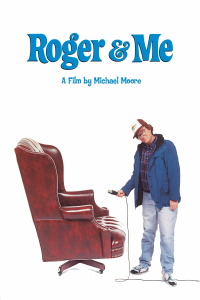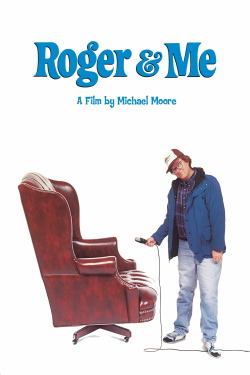
Review of Roger & Me (1989) by Dong Jae L — 29 Oct 2013
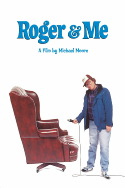
The 1980's American economy was defined as the Reaganomics era. The government reduced spending and taxes, and controlled capital regulation to address stagflation that prevailed during 1970s. Although the supply-side economics brought overall positive change to the economy, the tactic in some aspects was criticized for making the rich richer and the poor poorer. Michael Moore's documentary Roger & Me sardonically depicts the devastating corporate influence on ordinary working class during the Reaganomics era, with the usages of various stylistic elements to emphasize the sarcastic and acerbic nature of Moore's criticism. The contrasting mise-en-scene of the high and the low class of people, and the use of elaborate editing techniques to emphasize the contrast between them stimulate the audience to become more absorbed into Moore's idea, despite some idiosyncrasies in chronological alignment of the events. Overall, Moore effectively criticizes General Motor's careless decision to put ordinary workers into the predicament, and Roger Smith and government's inept ability and nonchalant attitude to address the economic and social issues experienced by the working class.
The plotline of Roger & Me includes intricate combination of introduction and interchanging scenes between Moore's search for Roger Smith and realistic display of Flint, where figures such as Pat Boone and Bob Eubanks become part of the General Motor's ineffective effort to relieve the issue. Released in 1989, Roger & Me involve the direct participation of the director Michael Moore, and other important figures such as Roger Smith, Pat Boone, and Bob Eubanks. The basis for the plot in Roger & Me is the alternation between display of Moore's attempt to locate and meet Roger Smith and the lives of people in Flint, Michigan, where thousands of workers were dismissed from the General Motors factories. Preceding the alternation between Flint, Michigan and the chase for Roger Smith is the introductory part of the movie where Michael Moore focuses on telling his childhood and hometown from personal perspective. Using archival 8mm film and picture footages of his own, Moore does an effective job in providing the information regarding his personality and background. Also, Moore efficiently portrays the significance the General Motors industry carried in Flint by elaborating on his family members' tie with the company. The introductory part enables audience to connect more easily with the background setting of Flint since Moore, as a credible source, elaborates on the economic dependence of Flint on General Motors. After the introduction, the setting oscillates between Flint and Moore himself on quest. The scene where Flint is the background involves various people and topic: people on eviction, factory during shutdown, governments' inept effort to rebuild Flint economy, rising crime rate, and the nonchalant wealthy population. Moore himself visits General Motor's headquarters several times, in which he always fails to meet Smith. After numerous fruitless efforts to track down Roger Smith, Moore finalizes the documentary with the scene of rather short encounter with Smith at the Christmas ceremony.
The mise-en-scene applied in Roger & Me accentuates the contrast between wealth and poor and between towns' past and present. In the scene where Moore visits the closing down factory, the ordinary working class people are dressed in jeans and t-shirts are speaking in dialect. However, at the dress up party of General Motors, people are playing costly sport polo and flamboyantly dressed in suits and tuxedos. The sardonic attempt in this scene was people who were acting as standing statues, which ordinary people who had lost their jobs in Flint were asked to do for money. The countenance of the people who were standing as statues expressed numb and dejected figure of someone who did not know where to gain fiscal resource for tomorrow's essential need. Also, not only the visual aspect of the people, but also the contrast between Flint's past and present, and between Flint and San Francisco accentuated Moore's attempt to satirically portray the plight that Flint was experiencing. When Moore displays the peaceful and lax atmosphere of the San Francisco, he mentions that everyone had a job, but no one seemed to be working in San Francisco. However, following the scene was the CBS news footage of the scene where it announces that General Motors had laid off 30,000 workers in Flint. Tragic scenes following the news provides a huge contrast from the Flint the audience witnessed couple minutes earlier in the film where the place prospered in wealth and fame due to General Motor's success. Within the film, rich portion of the people are depicted with nice clothing, yacht club, golfing, polo, and extravagant parties, whereas poor people are generally unhappy, in poor clothing, and are being evicted from their home. Also, later in the film when Moore shows his high school classmate from being evicted from his house, he displays a scene of Buick Headquarters with the sound of a bird singing. However, the scene rapidly changes to showing shabby neighborhood where there exist no signs of prosper and peace. Ironically, the city that burgeoned under the influence of General Motor was hit by devastating breakdown due to the same institution. As film critic Cohan and Crowdus mentions, the Roger and Me successfully 'juxtaposes the grotesque antics of the wealthy and the desperate situations of the unemployed to provide graphic illustrations of the gap between rich and poor' (Cohan, and Crowdus 27). Overall, Moore effectively shows contrasting mise-en-scene of the rich and poor, providing audience with sympathy and rhetorical question that helps them to agree with Moore's idea and intent.
Michael Moore's technique used in editing highly dramatizes the sardonic attempt he desires to create in order to get the message across. In the combinations of the scenes, he uses a continuity editing technique, although the contrast rather than the continuity was used in completion of logical coherence; in other words, by putting logically contrasting scenes in continuity, the audience obtains a good sense that events that comes in parallel are put to incite audience to contrast them in context. In the scene where Moore describes Smith's plan to close down the factories as a 'brilliant plan', he soon after shows the clip where Smith makes a comment that employees have a new emphasis on a 'job security'. Then, the scene is followed by the clip of laid off workers coming out of the factory responding to the question 'what do you think about Roger Smith?' with negative answers. In short, by combining scenes of contrast that does not match, Moore tries to emphasize the fact that General Motors and Roger Smith's actions were nonsense and inconsiderate. The scene where Ronald Reagan visits Flint also involves element of ironic contrast. Reagan promised that people would be back in jobs, yet in the end, only one who actually benefited from the luncheon was an individual who 'borrowed' a cash register of the restaurant out the door. The scene of Great Gatsby Party which ended with the interview on the 'good aspects of Flint' answered by the hollow answer of 'ballet, hockey... it's a good place to live' is followed by a scene where people are being evicted from their home. The government's effort to attract tourists by building luxurious hotel, theme part, and a plaza starts with ambitious beginning yet is soon followed by the tragic ending where the auto theme part is left with an ironic statue of 'me and my buddy'. People who used to work together are now in relationship of a prisoner and jail guard, where the jail guard says that current job is much better and comforting than the previous one, which the scene is soon followed by scene in which one of the prisoner curses in the background. The scene where Tom Kay, General Motors representative, tries to assert that lint-rolling company could be the solution to the layoff is followed right after by the scene where audience could hear sound of the dog barking. Then, there is a scene where women is butchering and killing rabbits to pay for her rent. The elaborate combinations of these contrasting scenes both directly and indirectly convey Moore's message: the direct portion containing incompetent and careless solutions to layoff and harsh reality of Flint, and the indirect portion containing directors' sardonic and sympathetic attempt to create ironic combination to keep the audience more immersed into the film. The final scene that came before the short interview was an interchanging scene between Smith's speech and harsh reality of a fatherless family being evicted on Christmas Eve. The final scene highlights Moore's use of ironic and contrasting scenes to get the concept across, in which the scene ends with the rabbit butcher women saying 'I should care about the animals'.
Michael Moore tries to criticize General Motors and the government for their nonchalant attitude to address the economical issues confronted by the laid off workers. Consequently, he tries to address the central theme that criticizes the Reagan Administration for making the 'American Dream' more 'inaccessible' (Cohan, and Crowdus 29). Michael Moore, coming from the middle class that has intimate connection with the auto industry and the corporate General Motors, stands for the perspective of ordinary working class citizens in Flint. He believes that General Motors is responsible for radical transition of economic and social circumstance in Flint. He also believes that the Republican government and Flint Conventions' ways to address the issues in Flint was superficial and inept, since they did nothing but to increase the deficit. In a supply-side economics where government regulation of corporate economy is reduced to minimum, Moore believes that people who are working for the lower spectrum of economy has more to lose than those at the upper spectrum. The results of such phenomena is evident in the film, as working class of people struggles to spend holiday at home, whereas wealthy people are living a lavish lifestyle without much knowledge of people who are struggling economically. In terms of the economy, the gap between rich and poor is inevitable, yet Moore focuses more on the individual named Roger Smith and his attitude towards the economy issue. Michael Moore's focus is not much on solving the gap between rich and poor, but is on how richer people who are responsible for some of the poor people going to respond to the problem. Moore, nevertheless, does not gain any fruitful answer by putting Smith under the spotlight to ask for response. As his document proceeds to a direction where extreme effort results in rather futile outcome, the audience finds ease in feeling sympathetic and desperate about the predicament in Flint.
As Moore is not from an elite background, he tries to reach audience in seemingly lighthearted tone using satirical and ironic elements to induce a chuckle. However, behind the jocular tone is rather a heavy message being shouted out to the society, which makes the film powerful than it seems. Such element makes the film influential and powerful among public, because it is easy to understand and follow. Michael Moore's films, including Oscar winner Bowling for Columbine, Fahrenheit 9/11, and SiCKO, have similar stylistic elements into the films where satirical devices helps readers to face the film with open attitude, then to consider the actual message afterwards. Consequently, Michael Moore succeeds in helping the wide range of audience to understand seemingly opaque and difficult topic with ease and entertainment; however, the exact element leaves cautionary measures to be taken by the audience. As proven in Roger & Me, much chronological sequence was ignored and the movie was edited accordingly by Moore to enhance the emotional effect. These were simply done to increase the dramatic effect of the film, which Moore was able to do since his intention was to make participatory documentary. Different from an observatory mode of documentary where the audience has more room for individual interpretation and analysis of the film, the participatory mode of the documentary can have stronger effect on audiences' interpretation. In other words, the audience walks on the path that director has paved in participatory mode of documentary. It is audiences' responsibility to look for different surroundings when walking on this path, and to see if any wrong shortcuts were taken during the journey. Ultimately, the audience is left with a significant responsibility of penetrating through the camouflage that Moore had installed to conceal his 'fear of alienating his audience with too much information or analysis' (Cohan, and Crowdus 30).
This review of Roger & Me (1989) was written by Dong Jae L on 29 Oct 2013.
Roger & Me has generally received positive reviews.
Was this review helpful?