Review of Roger & Me (1989) by Chelsi C — 30 Oct 2013
Roger & Me: His Money, My Sarcasm.
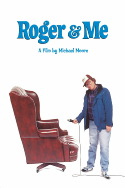
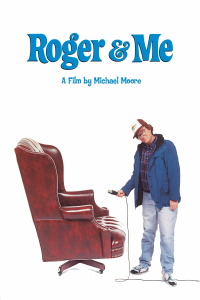
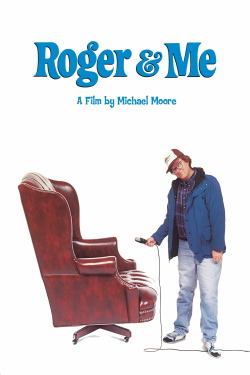
Roger & Me is an 1989 expository and interactive documentary filmed and directed by Michael Moore. The film presents the aftermath of General Motor's plant closures in the town of Flint, Michigan in the late 1980s. Moore describes the effects on the town of Flint as over 30,000 citizens lose their jobs and the economy rapidly declines.
Shops are boarded up, houses become rundown, and hundreds of family's lose their homes because they cannot pay the rent. Most of Flint's working class citizens have lost their jobs at General Motors. Moore narrates the story and conducts interviews of Flint's citizens. He inserts news footage and speeches by Roger Smith, the chairman of General Motors, and films himself on a pursuit to find and interview Roger Smith himself. Moore uses irony to show his negative view toward large corporations, and he emphasizes the economic inequality its social and economic policies and attitudes cause.
Roger & Me opens with fast, cheerful music and a silly title frame which is itself ironic because the nature of the film is not cheerful; it reflects upon a rough economic time for Flint. After the title, Moore begins to introduce himself and his age old connection with General Motors through his family. His hometown of Flint, Michigan is the birthplace of General Motors, and he goes on to explain how more people worked for GM in Flint than in any other city. GM was the primary source of economic income and social interaction. When Moore returns from California after losing a journalist position, he discovers that GM plans on closing its factories in Flint causing thousands of workers to lose their jobs. Moore discovers the attitudes of the former GM workers and sets out on a mission to interview Roger Smith to find out his motives for shutting down the plants. Moore visits several places, including Smith's corporate office in Detroit, but he is rejected by security or managers every time. Later in the film, Moore discusses Flint's attempt to turn the economy around with tourism. Flint, however, does not attract many tourists. Moore attempts to confront Smith by sneaking into a shareholder's meeting and later into the company Christmas party.
Moore is disgusted that the American government would allow a corporation to remove the largest source of income from an entire town. The film targets General Motors, but in the bigger picture, Moore is upset with corporations in general; he doesn't think the smaller businesses and individual families get enough protection, and GM should be responsible for its hometown, Flint.
When Moore talks to lobbyist Tom Kay, the shot is almost humorous. Kay consistently says what he should say as a GM lobbyist, not as a middle class, working individual. For instance, when Moore asks what Kay thinks of Roger Smith, he says he is a "warm man." Moore decides then that he should confront Smith and find out the truth.
Moore uses cross-cutting, an element of editing which depicts two separate instances happening at the same time, to emphasize the gap between the rich and the poor. For example, near the end of the movie, Roger Smith gives his annual Christmas address while Deputy Fred Ross evicts a temperamental family on Christmas Eve. The cross-cutting between the two shots emphasize the irony of the situation. Smith rambles on about Christmas being full of holiday cheer and goodwill, but Moore cross-cuts to a woman screaming obscenities at Ross, because she supposedly already paid the rent. The scene adds humor to the film because of the huge contrast between the two events. The cross-cutting suggests that the two events occur simultaneously; however, Moore's presence at both suggests otherwise. Moore uses the artistic abilities of film to strengthen his point. Moore attempts to show how large the gap between the rich and the poor has gotten because of the closed GM plants.
Moore intended the film to be a humorous take on Flint's economic downfall, but it is no secret that unemployment is no joke. Critic Crowdus agrees, and writes:
It's not easy to turn the human tragedy of unemployment into a laff-fest, but Moore has come perilously close to doing just that by offering his viewers a caricature of corporate power and a colorful gallery of real-life `characters' portrayed with a distasteful level of condescension. This is not to suggest that Roger & Me is all cheap laughs or is entirely lacking in anger and compassion. A sequence near the end of the film, for example, when Roger Smith's Dickens-inspired Christmas Party speech to GM managers and their families is intercut with the Christmas Eve eviction of a Flint family -- with their furniture, Christmas tree and all, deposited on the curb--is powerful stuff. (29-30).
Moore exposes the hypocrisy of GM; his use of humor, irony, and cross-cutting is an effective and powerful technique to get his point across.
Moore uses non-diegetic music, an element of sound which includes music that is not part of the story itself, to emphasize the separation of prosperity and ruin. For instance, after Moore visits his friend Ben Hamper at a mental institution for having a mental breakdown at a GM plant, the happy, upbeat song "Wouldn't It Be Nice" by the Beach Boys plays during a montage of rundown houses and news clips about crime and a rat infestation. The song is the last song that one would expect to be playing during said montage, thus Moore includes the montage ironically. In other words, the scene of chaos and ruin obviously is not as "nice" as the song suggests. The irony mirrors the hypocrisy that GM exhibits when Roger Smith says his workers should have more job security than ever.
The film has been discredited by numerous critics, primarily Harlan Jacobson, for disregarding chronological order. Moore edits clips of various events which have no direct relation to the economic crisis caused by GM. The viewer would not detect the out of order events unless he or she knew the date of that particular event. For instance, Moore says that Flint adopts a tourism strategy in order to fix the low economic status of the city; however, this actually took place in the early 1980s, several years before the closure of the GM plants. I believe that despite the slight distortion of the truth, the film is a form of art and aims to entertain and educate its viewers. Journalist Berstein agrees, and writes, "Michael Moore, himself a journalist, defended Roger and Me by appealing to our sophisticated understanding of how knowledge is produced in the contemporary media: 'All art, listen, every piece of journalism manipulates sequence and things'" (3). Moore simply tries to express his opinion about the GM closures, not necessarily state facts as they happened.
Overall, Roger & Me is a delightful, well done movie. Moore's irony and humor throughout is entertaining to watch but also informs its audience about the real life problems of large corporations. Furthermore, Moore himself can be annoying sometimes, because he pesters the person until he gets the information he wants which usually does not happen. I recommend the film to anyone who is looking to not only laugh, but learn about the true economic crisis in Flint through the humorous eyes of Michael Moore.
This review of Roger & Me (1989) was written by Chelsi C on 30 Oct 2013.
Roger & Me has generally received positive reviews.
Was this review helpful?