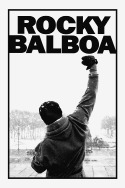
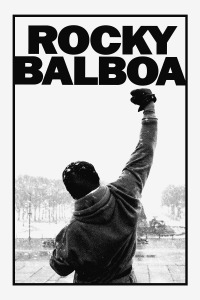
Review of Rocky Balboa (2006) by Deborah H — 20 May 2012
Rocky, the original 1976 film, that is, is still considered to be an American film classic, telling the timeless story of the determined underdog, getting his first and possibly only shot at glory. And while the first sequel managed to keep the underdog feel, the series, around the time of Rocky III, eventually devolved into increasingly unrealistic boxing and ridiculous plotting, before finally bottoming out in Rocky IV, with robots, overzealous jingoism, implausible Soviet crowds, and a steroid-infused cyborg-boxer.
Rocky V did attempt to ground things a bit and bring them back to the original themes, but instead came off as a neutering of the series, that took away its soul and left you with the message "No matter how hard you work, you could eventually end up with nothing, but hey, at least your kid kind of likes you".
And for some reason, Sylvester Stallone decided to dust off the boxing gloves one more time, for one final film, the aptly titled Rocky Balboa. And much to my surprise, not only does Stallone manage to leave the franchise on a fitting note, but he crafts a nostalgic and loving tribute to one of America's greatest cinematic icons.
The story of Rocky takes on a new tone; one of loss and mourning, for his wife Adrian, and for his career gone by. The legacy of Rocky is made into a very mythical story, in which he decides to take on the world one more time, in a fight not unlike his one against Apollo Creed 30 years earlier, in which he fights an unchallenged champion.
This movie knows that Stallone is 60 years old, and he's not afraid to show it, as Rocky struggles to get back on his feet once again. Stallone, directing his first film in over 20 years (ironically, his last film was my much-maligned Rocky IV), shows an assured man behind the camera, very aware of the story he is trying to tell, and his script is a perfect counterpoint to his breakout screenplay from 30 years ago.
And despite his age, he still remains the only man who could play Rocky Balboa. Burt Young returns for one more go-around as Paulie, as does Tony Burton as Creed's former trainer. Milo Ventimiglia succeeds Sage Stallone as Rocky's son, and brings much more pathos to the role, making Robert a man in pain, struggling in his own life while overshadowed by his father's accomplishments.
Geraldine Hughes takes over the minor role of Marie from the original film, and expands her to become a new confidante and focus for Rocky, as her son serves as another potential chance to be a father figure.
Boxer Antonio Tarver plays his opponents, Mason "The Line" Dixon, and does well with his minimal acting time. Bill Conti wisely reuses his old tunes, bringing back to iconic Rocky theme for the first time in three films, and Clark Mathis' cinematography lends a grittier, more modern aspect to the picture helping represent the changing times in Philadelphia.
Rocky Balboa is indeed a fitting end for the series, and while it still falls before the original, it at least justifies all the films since.
This review of Rocky Balboa (2006) was written by Deborah H on 20 May 2012.
Rocky Balboa has generally received positive reviews.
Was this review helpful?