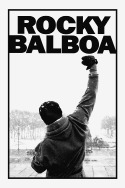
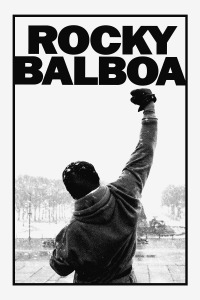
Review of Rocky Balboa (2006) by Cole P — 22 Aug 2011
It ain't about how hard you hit. It's about how hard you can get hit and keep moving forward, how much you can take and keep moving forward--that's how winning is done, and that's how Rocky Balboa (the sixth of this legendary but bygone anthology) manages to stand its ground as the finest follow up since the original. In this day and age, it's hard to find an original sports movie. There's a lot of sports out there to depict, but not many filmmakers succeed in translating the grit into a movie that is both compelling to all audiences and loyal to the sport whence it's based. Thankfully, Sylvester Stallone dove deep into his hat and mustered out every last ounce of fist-pounding, blunt-force trauma from the heroic Rocky Balboa. We're all very happy to see him.
The story picks up about thirty years after the first film (forget citing its timeframe after Rocky V--even Stallone disowns that monstrosity). The Italian Stallion is alive and well--or maybe not so alive and well; he's spouseless, continues to frequent his brother-in-law's company, and has an estranged relationship with his son, Rocky Jr. But knowing Rocky, the three times ex-champ searches for the upsides of life--running a flourishing Italian restaurant in the neighborhood and embellishing his life in the ring to customers, brandishing the past like an old war hero. It's hard not to acknowledge Balboa's (or for that matter, Stallone's) genuine character. He's no Brando but he seamlessly portrays the character with an air of immaculate wisdom. He's friendly yet still tougher than nails--although in this installment, one could argue the accumulation of rust starting to corrode his musculature.
The Rocky movies have always dramatized the protagonist's inner struggle with himself, and here is no different. In this last installment, the aging Balboa wonders if he still has the fire within himself to stand toe-to-toe with the current heavyweight champ, Mason Dixon (who has received worldwide criticism for glamorizing the sport). While this may sound cliche', because it's a Rocky film, the perspective is always true, earnest, and gritty. We're compelled by the sincerity with which Stallone delivers the story, and furthermore immersed into the drama whenever Balboa succumbs to pessimism. His is a constant, lifelong man vs. himself conflict that never fails to enlighten the viewer.
Along the way, new and old characters are introduced, including Spider Rico and Little Marie (from film one) and Mason Dixon and Steps. The presence of these older but familiar faces brings the series to a full circle, and Stallone doesn't use them just for nostalgic sake. Marie actually became that corner-house whore Balboa warned she would become, and her son Steps (a bastard) is written to show the constant fluctuation of society's contemporary adolescents. And of course, Stallone facetiously recognizes the earlier encounter with Balboa and Marie, but through this film, we see her more than just a one-sided character. On the other hand, not everybody may receive Antonio Tarver's performance as the champ with equal warmth; he's no actor, but Stallone didn't require one. Tarver, a real boxer, was cast for his naturalistic attitude towards the sport itself, and this greatly adds to the drama in the film.
Overall, Rocky Balboa is perhaps the best sequel of the franchise. It's highly recommended for those who wish to skip over movies 2-5 (and save their dignity along the way). The fact that the character of Rocky can still entertain in this day and age proves a point about the fame and legacy of his character; "if you stay in one place long enough, you become that place.".
This review of Rocky Balboa (2006) was written by Cole P on 22 Aug 2011.
Rocky Balboa has generally received positive reviews.
Was this review helpful?