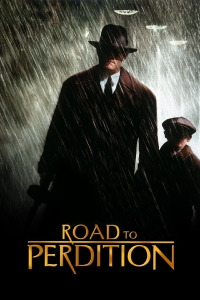
Review of Road to Perdition (2002) by Andy P — 04 Feb 2014
There have been a lot of gangster films since the 1930's, and it is difficult to create a film that is unique or different within this genre anymore, as it has mostly been tackled before. This film is an example of bringing something new to a genre that appears to have lost it's touch.
The film's screenplay was written by David Self, and it was based on a graphic novel by Max Allan Collins and Richard Piers Rayner. Road To Perdition is a story of revenge, a father-son relationship, and innocence. On the surface, the film could simply be seen as a revenge story and that could have easily already got me hooked but instead it adds layers and insight to it by combining it with the father-son relationship. But the aspect that made me admire this film is the exploration of the innocence of Michael Sullivan Jr. Innocence is something that is needed in order to keep ourselves pure, the young boy in this film has lost that and the film acts as kind of a journey of how he deals with it and whether or not it would consume him. The father and son relationship that supports most of the film could have easily been a victim of feeling campy or forced, but the film avoids that by making the relationship feel genuine. The revenge part of the film keeps the film from feeling too sappy, as this gave the opportunity for the film to get gritty and dark. The characters written in this film are wonderful to watch as they are so well written, and again Self was able to give them some sort of depth that was needed to have us look beyond the surface of these people. Self has written Michael Sullivan as this man who has chosen this occupation because he feels responsible to the man who has taken care of him, and his son (Michael Sullivan Jr.) is this child who have been burdened by the vision of death, which has fractured his innocence. Maguire is a fun antagonist, though he does feel a little tamed, and his hobby is so darkly hilarious that I cannot help but be intrigued by this man. Road to Perdition also successfully doesn't employ campy and outdated dialogue that was found in classic gangsters, instead it incorporates both the old and the new and splashing it with humor. Though the speech at the end felt a little too obvious, and I think it would have been more effective if it just used the power of imagery to conclude the story.
The film was directed by Sam Mendes, and this would be his second film. Mendes wanted to give this film depth, similar to what he did for American Beauty, and not let the film be too obvious and force-fed. The film is not a dialogue driven film, instead Mendes relies on the silent moments, when the actors just subtly expresses their emotions, even if it's only for a second. Road to Perdition can be seen as a noir film, but Mendes adds this sense of sentimentality that is not commonly found in films within this genre. This is definitely a bold move, and he executes this in such a way that it doesn't overbear the film. I did wish that the film would be a bit more cynical like with American Beauty, but the sentimental tone still hits it marks. Mendes has chosen for the film to have a complete shift in tone from the first half and the second half. The first half of the film, takes a more darker and serious tone that is definitely more reminiscent of it's noir influences. The second half moves to the more sentimental side of the film, exploring the father-son relationship and the child's coping with his loss of innocence. During these moments, Mendes does have a tendency to touch on Spielberg territory, but it doesn't reach to a point of irritation. Mendes wanted it to be perfectly clear that there is no redemption for the life of a gangster. Mendes made sure that his themes were clear but not forced. Mendes has not been afraid to show off blood in his films, in American Beauty he wanted it to be so red that it reached to a point of disturbing. In Road to Perdition, he is much more merciless, allowing us to really see each shot hitting the person, and he doesn't treat it as a scratch or just something one can shrug off as we can really feel the pain that they experienced. Mendes uses these opportunities to flesh out the characters rather than using it to promote a sense of style and finesse.
Conrad L. Hall comes back to collaborate with Mendes to handle the film's cinematography. Hall has shot this film to be reminiscent of the classic gangster films of the past but making sure it doesn't reach to a point of parody. The photography looks lifeless and seems to convey this sense of depth whenever the film takes place in the city. During these scenes, his use of shadows is breathtaking, using it as a tool of conveying tension and style but also corresponding with the themes of the film. When they are outside of the city, Hall and Mendes wanted to give this opposite look from the streets of Chicago, peace. Mendes likes his film to be more cinematic rather than natural, which is why this film never takes a handheld approach, except for a scene where they just got out of the diner scene. The film uses more of tracking shots and slow zooms to move the scene along and also to show us more layers of the characters. Road to Perdition would be the last feature film he would work on, and if he to this day was still alive, he would have kept that collaboration with Sam Mendes and would have been a partnership that would rival the top director-cinematographer collaborations in cinema.
The film's score was composed by Thomas Newman. The first thing I noticed, was the minor areas that feels very similar to American Beauty and The Shawshank Redemption's scores. It's not a big issue because I think it works for this film. It truly hits at the right moments, and haves you feeling sad or happy depending on the scene. Newman's score is definitely one of the biggest film's highlights as it's so well written. It's not afraid to reach the strings of sentimentality, which for some films may seem overly dramatic. As Mendes was able to balance the film reasonably well, Newman's score was also able to balance his score. The composer's use of violins truly hits you in areas where it hurts, and arises on scenes like the ending which will have you feeling with so much emotion due to the right timing and composition of the score. The composer plays this piano tune that could easily have you tearing up. In short, the score is beautiful.
The film stars Tom Hanks as Michael Sullivan. Hanks plays this character who has seen and done the most horrific things, and he can accept to himself that he will never be redeemed. Tyler Hoechlin plays Michael Sullivan Jr., and he plays this character still undecided about his path. He clearly is still being shaped by the world around him, which is why he brings this sense of innocence and purity, especially in the first few minutes of the film. The relationship and chemistry between Hoechlin and Hanks was fantastic, I really bought them as father and son, and the perception that Sullivan Jr. had towards his father was even more convincing. Paul Newman plays as John Rooney, as he isn't the film's main star and only appears in a couple of moments throughout the film, mostly at the beginning. Newman is playing a man who is clearly wise and has experienced many things in his life, and so he gives off this aura of respect and but also vulnerability (particularly during the speech under the church). Jude Law as Maguire was great, he brought this psychopathic layer to it. Though the way his character was written was quite tame, so Law couldn't go all out and instead creates this comedic quality to it. But at the end of the film, he was quite frightening to watch. Daniel Craig was actually really fun to watch here, playing someone who hasn't grown up. There is this boyish quality that Craig gives off here, and at times we do buy his impassivity and recklessness. Though, his accent was a bit spotty at times.
Road to Perdition may not have appealed to me on the same heights as American Beauty but it's still a damn good picture. If you are looking for a gangster film that brings something new to the genre, then this is the film to watch. It boasts fantastic performances from it's cast and it consists of beautiful cinematography and a stellar score. The film has the potential to grow on me over time and who knows, I may even include this as one of my favorites.
This review of Road to Perdition (2002) was written by Andy P on 04 Feb 2014.
Road to Perdition has generally received very positive reviews.
Was this review helpful?