Review of Road to Perdition (2002) by Cameron J — 30 Mar 2014
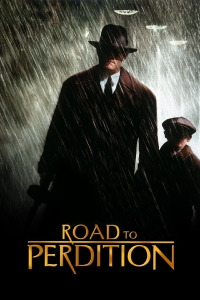
"We're off on the road to Perdition, we're certainly going in style!" That was for you "Family Guy" fans out there, although, all kidding aside, as out of "Family Guy" as I've been the past couple of years, even I know that they're getting so indulgent in Brian's and Stewie's "Road to..." series that it's only a matter of time before they pay a visit to Hell. Yes, people, in case you didn't know, Perdition is a place of eternal torment in Christian mythology-I mean, "theology", yet Max Allan Collins and Richard Piers Rayner, the guys who wrote the novel upon which this film is based, still thought that it fit as the name for a town where people go to seek refuge from punishment at the hands of gangsters. Shoot, it kind of does, because this Perdition place is supposed to be located along Lake Michigan, and any place touching Illinois and Michigan must be a little messed up, so don't reckon Tom Hanks' character in this film has great decision-making skills when it comes to refuges or, well, facial hair. Cracks at Hanks' moustache aside, Sam Mendes must have good decision-making skills, because with his second film, he's already working with Tom Hanks, Jude Law, Daniel Craig and Stanley Tucci, while reminding people that Paul Newman... was still alive in 2002. We were missing the guy badly enough back then, and this film must not have helped, because it got the guy an Oscar nod that probably would have been a win if Newman did, in fact, pass around that time, seeing as how the Oscars were apparently on such a big high for posthumous awards that they gave Conrad Hall Best Cinematography about two months after he passed. Forget the Oscars for not even nominating Newton Thomas Sigel for his efforts on "Confessions of a Dangerous Mind", although that's not to say that this film's cinematography isn't as good as the film itself, and make no mistake, this film is good, even with some bumps along the road.
I don't suppose this film's narrative concept is especially beefy, or at least it doesn't seem to be when story structuring comes out undercooking its full depths a smidge, and yet, this script still manages to layer its story enough to, well, jar between segments, albeit not too glaringly, but ultimately surely enough to distance through a sense of focal unevenness, something that could have easily been avoided if there was more tightness to each segment. As the final product stands, much too much goes bloated time and again, and while the film still falls short of two hours, when it drags, as it often does, it really goes drawn out with excess in do-little material that shakes a sense of momentum, not exactly augmented by thoughtful atmospheric pacing. Sam Mendes' trademark subtly atmospheric storytelling is controlled enough to entertain adequately, perhaps even transcend many of the near-countless lapses in material bite found in David Self's script, yet, whether it be because there are so many lapses in material or whatever, there are times where Mendes fails to keep the pacing realized, resulting in genuine bland spells. Pacing issues are ultimately major, dragging scripted plotting to the point of unevenness, if not overall loss to focus, backed by cold spells in Mendes' atmospheric direction, yet as much as I criticize the film for the slow spells, pacing problems also see a thinning of development that is compensated for by highlights in characterization, and certainly by inspired direction and acting, but still gives you only so firm of a grip on character motivations and traits that, if reinforced, would make the drama more well-rounded. With its narrating young Michael Sullivan, Jr. character ironically unevenly played upon, and its conflicts' depths given only the bare minimum of dramatic attention, this film has some very problematic underdeveloped attributes, yet it's not like you don't still recognize this story, which is ultimately too formulaic for you to easily disregard all of the pacing problems which shake substance that, quite frankly, is limited enough in concept. Again, the story is far from simple, but it's a little too minimalist to comfortably withstand unevenness, dragging, developmental shortcomings and familiarity that are near-miraculously compensated for enough to make the final product consistently compelling and ultimately rewarding, but by no means as outstanding as it would have been if the strengths of this narrative were easier to detect over the limitations. Of course, if consequential shortcomings aren't enough to drive the final product into underwhelmingness, then the natural shortcomings certainly won't do the job, as this is still a worthy story whose execution, while flawed, is much more inspired than anything, even artistically.
Returning for the first of many times as a collaborator of Sam Mendes, Thomas Newman delivers a score that may not be particularly unique, but is haunting in its atmospheric sparseness, and biting in its more lively moments, as surely as Conrad Hall's final cinematographic performance haunts, with a subtle bleakness that, through lighting that is reportedly inspired by the atmospheric tastes of painter Edward Hopper, stresses shadows and dry visuals in a fashion which is not only handsome, but reflective of this neo-noir's gritty tone and themes. A study on coming of age in a hard world, as well as on the depths taken to protect and even endanger family, this very thematic film's dramatic depth even thrives on stylistic influence on storytelling which is effective by its own aesthetic right, and complimentary to the depths of a narrative which is rich with depths. Well, perhaps "rich" is a strong word, because, as I said earlier, there's only so much meat to this intentionally somewhat minimal narrative, but for every area of limited broadness, this story boasts an aspect that, despite its familiarity, is worthy, intertwining a subtly dynamic adventure with human depths in a concept that is done justice by highlights in an overblown script by David Self that range from sharp dialogue, to convincing characterization, further sold by strong performances. Working with an outstanding cast of talents, Sam Mendes doesn't give his performers too much to do, yet just about everyone has a time to shine, with Jude Law, Daniel Craig and the Oscar-nominated Paul Newman delivering in the supporting cast as a charismatic hit man, a ruthless and unloved-feeling heir to a criminal business, and a usually unbreakable mob boss faced with the burden of threatening loved ones' lives, respectively, while young Tyler Hoechlin, as a quiet boy who blames himself for family tragedy, and Tom Hanks, as a man seeking vengeance and to protect the last person he has in the world, carry the film, with moving individual layers, and an endearing father-son chemistry. Characterization shortcomings are glaring, but the performances, while underwritten, do a lot to drive the sense of intimacy to this subtly layered character drama, and that, combined with highlights in writing, all but drive the final product through its underwhelming shortcomings. What ultimately firmly secures this drama as rewarding is, of course, the efforts of Mendes, whose trademark thoughtful directorial storytelling has its bland spells, but is much more often than not realized enough to overpower slowness with an intriguing bite that makes the noirishly tense aspects chilling, and the more emotive dramatic moments pretty powerful. It ultimately comes down to a final act that might not be particularly outstanding, but sees Mendes' justly acclaimed dramatic direction in full, admittedly throat-catching form, rounding out this affair with a power that I really wish was more consistent in this uneven, overdrawn and undercooked drama, but satisfyingly punctuates a rewarding showcase of inspired modern noir storytelling.
Once the road has ended, uneven focus, excessive dragging, some serious developmental shortcomings, and familiarity to the telling of a slightly thin narrative should threaten the final product with underwhelmingness that is ultimately firmly overpowered by the haunting score work and cinematography, intelligent scripting, thoroughly immersed performances, and thoughtful, often powerful direction by Sam Mendes that make "Road to Perdition" a tense, tasteful and all around worthy crime drama.
3/5 - Good.
This review of Road to Perdition (2002) was written by Cameron J on 30 Mar 2014.
Road to Perdition has generally received very positive reviews.
Was this review helpful?