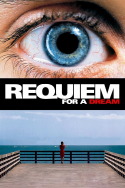
Review of Requiem for a Dream (2000) by Olaolu A — 11 Sep 2013
A powerful, disturbing motion picture that is an easy candidate for one of the best films of the decade and perhaps of all time. I saw this several years ago and I haven't forgotten it since. I can't think of another film I've seen (including excellent candidates such as Basketball Diaries and Trainspotting) that has made as forceful of an anti-drug statement as this one does. In its depiction of the often catastrophic consequences of addiction, this film pulls no punches and shows no mercy; it simply tells it like it is, with no concern for the weaker constitutions of some of the audience members (a point that was duly noted by the MPAA when they thoughtlessly slapped this film with an NC-17 rating upon its initial release). And while Requiem for a Dream is hardly what one would call subtle, it doesn't ever turn didactic or resort to the kind of sermonizing that can be the undoing of a movie like this. Director Darren Aronofsky (who also co-wrote the screenplay along with Hubert Selby, who adapts this from his novel of the same title) understands that a film of this sort works best when the characters are vividly-drawn and multidimensional; he puts that philosophy to use here and presents us with a quartet of likable albeit deeply-flawed people, each of whom has his or her own hopes and aspirations in life before the cycle of addiction engulfs them. By the time the movie reaches its end game, we have grown to care deeply about these individuals; consequently we have a vested interest in their circumstances even though we're fully aware that their lives are speeding trains on a collision course with the bleakest, most nightmarish reality possible. Watching these individuals implode and finally hit rock bottom is nearly impossible but we've made it this far with them and having come to regard these people as nearly and as dearly as our closest friends and family, we can't peel our eyes - and our hearts - away from their ordeals as much as we might wish we could. More than anything, this is the reason why the final 15 or so minutes of this film represent one of the most harrowing and emotionally draining final acts in recent film history - and the exemplary editing job during this closing sequence only amplifies the impending doom.
That's not to say that the rest of the film isn't expertly crafted. Visually, Aronofsky brings his considerable prowess to bear on the proceedings by employing a variety of camera tricks to draw us further into the mindsets of the protagonists and thus heighten our emotional attachment to them. It's as if the audience is thrust into the throes of drug addiction alongside Harry (Jared Leto), Marion (Jennifer Connelly), Tyrone (Marlon Wayans) and Sara (Ellen Burstyn). Luckily, Aronofsky shows just the right amount of restraint to where he doesn't draw attention away from the characters and their struggles - and visually, this is one helluva a busy picture with some of the scenes being sped up while others are slowed down. There is also one scene involving a split screen approach as well as several repeated quick clips that are interspersed with the main action.
A lesser director would have let all of this overwhelm the story and take focus away from the actors but that is not the case here. From top to bottom, there is nary a weak performance to be found. Ellen Burstyn was the only one to get an Oscar nomination for her acting (the only nomination in the entire film no less) and in many ways, her performance is the most heartbreaking but it is no more assured than the work of the other performers in the film. All four of the top-billed actors deserve recognition for allowing themselves to be put through the emotional and physical rigors of their parts and for embracing the degradation that their characters must endure throughout the film. Jennifer Connelly in particular goes out on a limb and has to appear nude in several scenes, including a two-girl sex-show that she has to perform in a room filled with middle-aged perverts, when her character has finally hit rock bottom.
The two main male performers in the cast are just as mesmerizing. As the central character in the drama, Leto's Harry is in many ways the glue that holds everything together and the actor steps up to the plate and hits a home run. This performance, along with his work in the equally masterful Fight Club, shows that Leto has considerably more talent than he's often credited for. Finally, Marlon Wayans proves that he has the ability to do far more than the outrageous comedies that have been his bread-and-butter throughout his career. Any humor that he provides here is almost too low-key to be worth mentioning. Perhaps, it takes a strong director like Aronofsky to keep such a wild personality in check, but whatever the case, Wayans has proven his dramatic chops here.
Finally, there's the musical score by Clint Mansell and the Kronos String Quartet, which perfectly accentuates the gloominess of the proceedings. I may never forget the closing musical score for as long as I live. As the saying goes however, this is most definitely one film where the whole is far more than the sum of its parts. Requiem for a Dream may not have the most triumphant story to tell but the movie itself is a triumph of film-making on every level.
This review of Requiem for a Dream (2000) was written by Olaolu A on 11 Sep 2013.
Requiem for a Dream has generally received very positive reviews.
Was this review helpful?