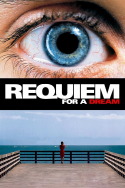
Review of Requiem for a Dream (2000) by Joshua M — 09 Aug 2013
This is one of those pictures I've meant to see for a long time, with many a film student to remind me. I didn't hear a single negative thing about it, so naturally I figured it would be overrated. Unanimous praise is a sign of either a movie of divine quality rarely achieved by man, or one that doesn't challenge its audience in any profound way (would Citizen Kane be a masterpiece if people didn't bitch about how boring it is?). Requiem for a Dream is one of those interesting cases that manages to be both, leaving me happy to see pure artistic vision executed with such finesse but also frustrated that its shining moments reveal the tarnishes.
Like all complex story telling, its beauty isn't on the surface. Really, the synopsis sounds like something they'd show you in DARE. Various people try to find happiness in drugs but end up falling victim to them in different ways. But in no way do I see that as unintentional. It starts at a low point in the characters lives and knows damn well it only intends to go lower. The movie is more or less what the title says it is, a lyrical morning of the death of hope. In that sense, it succeeds historically. It's rare you see pain and misery stitched together this well. Every line of every character plays a part in the thesis, and their fates unfold with sobering believability. Every character has a different motivation for chasing their high, coupled with a different fate. Aronofsky pulls off a juggling act I rarely see in ensemble movies, making each character unique and valuable. Now that's not to say some characters are more unique and valuable than others, but we'll get to that.
And perhaps I should specify that when I say "unique" I mean to the movie, not the genre. You can put lipstick on a pig but when it comes down to it, druggies falling victim to their fix is a story we've heard a thousand times and this doesn't offer a huge spin on the concept (with one exception, but we'll get to that!). Darren Aronofsky makes Disney movies for depressed people. Their execution is impeccable and their writing archetypal at its best, cliché and down right silly at its worst. But for some reason it seems to be more hip to trip on Disney's shortcomings, like the preteen Power Ranger fan saying Barney sucks. But anyways, this is the best quintessential Aronofsky film I've seen. I prefer The Fighter, but I tend to prefer the results of artists with recognizable styles trying something different.
The movie is so cool that it often becomes too cool for the room and the misery stops falling victim to seemingly real people, but to characters. That's because its flourishes, such as its now iconic flashing imagery and breakneck editing, sometimes end up hogging the spotlight from those very characters. These little vignettes of stylish misery that make up the movie do a great job of creating a brand for itself, but do little for getting into the heads of these people, much less under their skin. I don't really know why Harry and Tyrone thought they could/wanted to make it as drug dealers, or why Harry and Marion loved each other. And when looking back on it their reasons for failure are pretty simple, because drugs and dummies don't mix. The film does wisely include elements of society as an additional culprit for perpetuating their misery, but this is where the seams of the picture start to show. The crooked doctor ignores Sara's worsening condition with just a little too much calculated apathy. The old white businessman yells "ass to ass!" with just a smidge too much maniacal glee. Every police officer with a line was either racist or an asshole. We're thrown the worst humanity has to offer at a recreational pace.
Horror is the experienced emotion more so than sympathy, like watching a zeppelin crash down in glorious spectacle. I found myself searching for a "so what" after the movie took me through such a stressful journey. Drugs are bad? I already knew that. There's no shame in a simplistic message told profoundly, but to imply something is profound is to say it has the power of change, which I'm not sure Requiem has. As it stands, I see it as the Kids of the 2000's. It's a canvas painted brilliantly with black and grey that I wouldn't mind passing by in a museum.
Now that all that's out of the way, lets talk Ellen Burnstyn. Her performance is so brilliant it'll make you want to call your mom, no matter how much you may hate that bitch. Every complaint I have about the movie being impersonal melts away when she's on screen. Every nuance of the performance reveals some vital detail about herself, from the tone she uses to talk with her son, to the sparkle in her eye when watching her favorite show, to the fetishistic attention she pays to each bite of food. She must've rubbed off on Aronofsky, because her segments also seem to contain the most compelling filmmaking the movie has to offer. Not only do we get an intimate view of a genuinely sympathetic person, but we are given a reason to truly mourn their downfall, by giving her hope. It's a hope we see blossom vibrantly and I'll be damned if my heart wasn't broken when she didn't get the dream she deserved. I felt I knew her better than anyone else on screen, and her spiral was the only I truly found devastating. If they released an "only Ellen" cut of Requiem, it would be the best short film on drug addiction ever made.
This review of Requiem for a Dream (2000) was written by Joshua M on 09 Aug 2013.
Requiem for a Dream has generally received very positive reviews.
Was this review helpful?