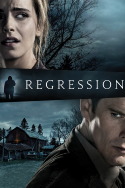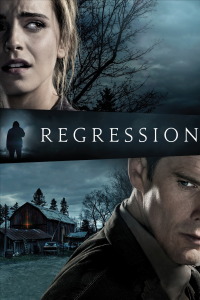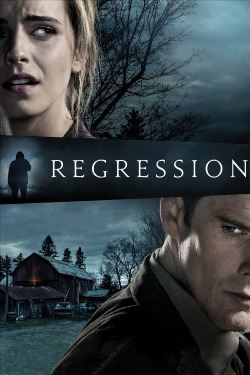
Review of Regression (2015) by Crim — 17 Aug 2016
While "based on real events" doesn't come with any expectations for anyone but the most naive and hopeful, I fell into this trap due the fact that this is more than an event; it's a phenomenon that was plenty researched and written about, with larger implications for psychology (regression therapy was fortunately a fad, but false memories are human, forever), counseling, and good practices, and there is something to be said about the vulnerability of society when panic can spread out for years and be taken seriously on a professional level, even with a lack of objective evidence. In the year of Concussion, Spotlight, The Experimenter, The Standford Experiment and so on, I expected this movie to be more of the same ilk. It is not, but it didn't have the good will to firmly, explicitly step away from it either.
As the events unfold, the accusations get wider and wilder and there are more shots of mass hysteria on the media, it seems that what the movie is going for is a modern day The Crucible. For awhile, this stands. Emma Watson is a one-note whispering waif, all tears and broken heart, Ethan Hawke is the agnostic turned raging believer, the psychologist does his regression shtick in good faith, and the suspects pile up. But this is mostly a set up, a crescendo, and when the movie has to really go somewhere with it, it embarrassingly falls apart.
To get straight to the point, then come back to the smaller things, to tell a story like this, there could have been a focus on the big picture (the real life satanic hysteria of the time, how regression therapy made it possible, how it was finally debunked) or just on the particular case. Sadly for "Regression", you need good script and characterization for the second, most of all a realistic progression, and some depth. Emma Watson's part is ok, but it is very small - she is believable in everything she does, keeping it in minor key all the way till the end. However, Ethan Hawke's detective is a series of missteps - not his acting, which follows the script and direction. Everything the detective goes through, thinks and says is guided by the heavy hand of the plot, cliched writing, and is equally broadly acted. Some things grate more than others, but more on this later. Similarly, when some supporting character needs to pop in just to say some line to indicate that They Believe Now, the movie goes precisely for the laid back skeptic; this kind of economy - one character is enough because "yes, even him" - works only a superficial level, and is transparent and in poor form.
Secondly, the movie takes a turn towards horror, with the detective "seeing" the narrated events, then having nightmares, and with one character having hallucinations. Thankfully, the potential turn into actual supernatural happenings does not occur (it would have been genuinely awful, from an ethical point of view too), so it seems like this would be a good thing, making the movie more engaging for a broader audience... Yeah, no. For one thing, Ethan Hawke seeing the scenes only makes it more apparent that a police investigation would disprove them (this isn't the 50s, there were forensics), then the nightmares are repeated as a flashback, which is stupid, and also it's not like we forgot them in the 10 minutes since we saw them.
Thirdly, the detective realizes one of the faces in his nightmare was a drawing from an ad, and from this infers an entire critique towards regression therapy, which he rants to the psychologist, who acts like he hadn't ever heard it before! The whole scene is unrealistic and pointless, and included for lip service to being about the larger issue instead of a random false accusation in a small town. It is incredibly tone deaf and could have been handled much better: someone bringing up an article with objections to regression therapy, one of the FBI reports consulting another expert, any way to introduce a professional opinion instead of making it seem like (1) it was so easy to see the faults of the procedure, regression itself, and the contribution of the police investigators and the media, and (2) despite this fact, there was no wide official controversy.
This review of Regression (2015) was written by Crim on 17 Aug 2016.
Regression has generally received mixed reviews.
Was this review helpful?