Review of RED (2010) by Shiira — 20 Oct 2010
Sarah(Mary-Louise Parker) likes to curl up in bed with a book, and not for nothing does she read trashy pulp fiction("Love's Savage Secret"), instead of something literary like, say, Susan Choi's "American Woman".
After another day of drudgery in her cubicle, all the beautiful woman wants is a little romance and political intrigue before she turns out the lights. Who has time for meta-fiction? The popular/literary novel binary forged by the reading habits of this federal pensions benefits worker, propagates another binary, a filmic one: mainstream/independent(and foreign) movies, where "Red", a pulp movie, indirectly questions our preconceptions about literature, in which a paperback novel denotes that Sarah isn't well-read, that "Love's Savage Secret" is junk.
Our scrutinizing begins the very moment when the reader discovers Frank Moses(Bruce Willis) in her house, as if the ex-CIA hitman stepped out of the pages from Sarah's book. After bounding and gagging her, Frank, in a sense, kidnaps this woman from ordinary life.
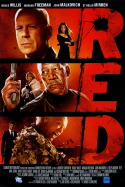
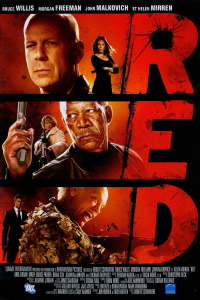
Will she spy? Will she kill? Will she fall in love? As the old adage goes: Don't judge a book by its cover, so likewise, don't judge a movie from its poster. Due to its first-rate cast, "Red" is the perfect candidate to fight for the legitimacy of populist art, as John Malkovich, Morgan Freeman, and Helen Mirren help take aim at the identically titled Krzysztof Kieslowski masterpiece, aspiring to be what Elmore Leonard is to popular fiction, "the fillet of the genre"(described as so by the Jeff Daniels character in Noah Baumbach's "The Squid and the Whale"), the implication being that the so-called art house-side of cinema doesn't necessarily have absolute hegemonic control over movies for the masses.
It was an assertion that the late film critic Pauline Kael(the democratization of art was her pedagogy) would make time and time again in the pages of The New Yorker, cognate to Stephen King's disdain for the literary novel/writer, the diffuse story, and its tyranny over the story well-told.
(The EW columnist would champion Scott Smith's "The Ruins" over, for example, Paul Auster's "New York Trilogy", just as Kael hated Alain Resnais' "Hiroshima Mon Amour" as much as she loved Michael Schultz's "Car Wash".
) So does it make a difference that its Helen Mirren blasting away at the bad guys, as opposed to some lesser actress with half her talent, and being half her age? Hell, yes, it makes a difference. She was the Queen of England, for god's sake; she was also the wife in Peter Greenaway's "The Cook, The Thief, The Wife and Her Lover", who in the most kabuki of gestures, cooks "her lover" and serves him to "the thief", her husband.
Killing is serious business, and Mirren(as Victoria), wields her machine gun with a steely concentration which suggests that she doesn't know the difference between Quentin Tarantino and William Shakespeare.
In superlative genre fiction, the author is able to take a stock situation and make it, if not wholly original, then at the very least, not wholly routine. After a bullet catches Victoria on her thigh, the spot of blood that sullies the hit woman's pristine white outfit, somehow manages to look elegant, like a spot of tea on this venerable lady of stage and screen's garb.
By far, Victoria is the most compelling character in "Red", and yet Sarah doesn't truly identify with her, because if this paperback reader did, she would pick up a gun and start shooting alongside the lethal femme.
The contemporary reader, in general, lives vicariously through its characters, because as a whole, they are usually written with the anti-modernist sensibility of having to be identified with. Sarah just wants to observe, not participate, so since she never turns into a contract killer, neither "Love's Savage Secret", nor its transmogrifying adaptation, "Red", must be any good.
This review of RED (2010) was written by Shiira on 20 Oct 2010.
RED has generally received positive reviews.
Was this review helpful?