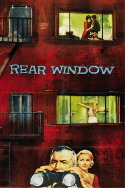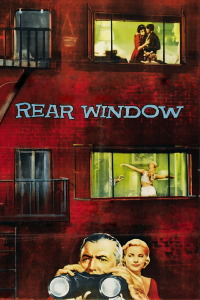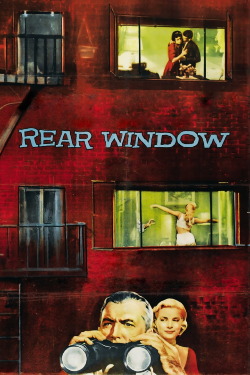
Review of Rear Window (1954) by Omar K — 16 Sep 2015
Alfred Hitchcock. One of the greatest directors in cinematic history for both his endless creation of filmic classics and his importance in influencing the course of cinema, not to mention every successive generation of filmmakers. His artistry culminated in a handful of masterpieces, but his most peculiar creation, and one of those masterpieces of his, is the transfixing Rear Window. Released in 1954, Rear Window comes after some of his early greats such as Rebecca and Strangers on a Train, but this film instigated a new dawn for his career as the popular classics consisting of the likes of Psycho and Vertigo arrived a few years later. Hitchcock exerts great control over the making of his films and thatâ??s why the final package is always recognisable of his suspenseful style. With Rear Window, Hitchcock is in full command of his material, timing each scene and placing each object to the finest margin, whilst pushing his actors and the filmâ??s script to the limits of their potential.
Rear Window revolves around the professional photographer L.B. â??Jeffâ?? Jefferies, who after breaking his leg on his previous assignment is confined within the four walls of his Manhattan apartment. During a summer heat wave and bored out of his mind, Jeffâ??s begins to peer out of his rear window and onto a small courtyard where each of the surrounding houses have left their windows open, providing Jeff with a chance to simply watch his neighbours. The main focuses of Jeff are the nimbly figured dancer, a pianist, a middle-aged sculptor, a lonely woman, several married couples and Lars Thorwald, a jewellery salesman with a bedbound wife. As Jeff hears a woman scream â??Donâ??t!â?? one evening, he begins to become intensely attached to his newfound interest, in particularly Thorwald who mysteriously lives alone now with no sign of his bedridden wife anywhere. As a budding curiosity burns with Jeff, his personal investigation of Thorwaldâ??s wifeâ??s disappearance begins to take shape and only a more closer look will bring him closer to solving the mystery that only he sees within his neighbourhood.
James Stewart stars as Jeff with such a raw naturalism it brings an aura of reality to the story. Stewartâ??s talent in Rear Window is that his acting is suspenseful in itself. We spend most of the time watching his curious face, and this forces us to mould our own face into a pensive one, aligning our reactions with that of Stewart and further drawing us in to this fascinating tale. Stewart is such a natural actor that his expressions and manner of speaking appear so effortless, thus moulding the tale with an immense realism. And Grace Kelly stars as his much younger girlfriend Lisa, the innocent yet lovely socialite. She seems almost like a daughter to Stewart at first, for there is a naivety to her character that it is not hard to initially form an odious impression of her. But, as she joins Stewart in his curiosity, her bravery and impenetrable morality of knowing right from wrong and doing something about it endears herself to you greatly. Kelly was such a talented actress, but left the greatest business on Earth to become a royal of Monaco at the premature age of 26.
The filmâ??s special structure of detached investigating makes Rear Window feel fragmented into short episodes of clues that lead onto a lot of observing, which finally reveal a piece of factual evidence. The film is literally layered with these mini episodes of detecting and deduction, essentially forming a sandwich of suspenseful investigations.
Rear Window finds the â??Master of Suspenseâ?? living up to his title, whilst also setting a higher bar for himself. The use of the subjective camera is Rear Windowâ??s biggest success, and possibly its only problem. The camera watches constantly from the same place, meaning we are watching the other characters live their lives. We never leave the house, even when Grace Kelly goes to another apartment across the street we are never in her shoes, merely watching from the rear-view window. It is such an excellent way to develop dread and detach the viewer, like the protagonist, from what is really going on, which further immerses us within the tale because we want to know the unknown. The subjective camera, along with the suspenseful script, forces a powerful attentiveness to take hold of you, which keeps you hooked for long periods, but because some parts are so interesting, others lose you as youâ??ll find yourself relaxing your eyes from the previous moment of pure gawking. It effectively is a slow step-by-step examination of the problems within society that can go unnoticed, and the manner of filmmaking has brought heightened awareness to what goes on around us. What is interesting is that not once do Stewartâ??s neighbours ever acknowledge his glaring observances, emphasising a whole lot creepier idea that if you arenâ??t aware of your surroundings, someone will is always be watching.
Hitchcock in Rear Window is at his suspenseful best, but he can be forgiven for being perhaps just a bit too suspenseful for his own good. There is a tendency for Stewart to go over the details of the mystery like a list and it draws you in to the point where we are aligned with the characters and the story, which builds and builds to the point where our curiosity becomes insatiable, and we want this revelation to live up to its mystery billingâ?¦ and although it is perfectly crafted, there is a niggling feeling the revelation lacked a spark.
One thing Rear Window can be is extremely confining as the whole story is set firmly around Stewartâ??s neighbourhood, and more so the camera never leaves his apartment, allowing us only one viewpoint that merges us with the protagonists and further embeds us within the tension of the mystery. We canâ??t ever leave the room, and this is quite claustrophobic on the eye and at times can test your patience, but this is without a doubt a lacklustre excuse for the suspense is excessively balanced to perfection. This symbolically represents that we canâ??t fix society and solve problems ourselves â?? only is it possible if you attentively gather enough evidence of the situation and withdraw enough courage to legally pursue justice. Rear Window may be captivating simply through the mysteriousness of the unknown, but the technical aspects of the film are extremely specific for a reason; to emphasise the surroundings and bring awareness to the situation of the event, not simply the event itself.
We never really do know who our neighbours really are, their life in the past what they are doing presently. But, Rear Window is the perfect film that captures the essence of community but twists it into a murder mystery. Yes, you may be thinking what an exaggeration this is because we like to think of ourselves as comfortable in our own homes, but do we really know what our attached-house-companions are really doing, right at this moment, huh? Well, what Iâ??m trying to say is that I guess the saying â??love thy neighbourâ?? no longer seems safe to throw about once you get a dose of what Mr Hitchcockâ??s offering.
The Verdict:
Hitchcock is the master of suspense, so it comes as no surprise that Rear Window is infectiously riddled with it to the point where our neighbours are emphasised as unbridled threats.
â??â??â??â??â??â??â??â??â??â?? 8/10.
This review of Rear Window (1954) was written by Omar K on 16 Sep 2015.
Rear Window has generally received very positive reviews.
Was this review helpful?