Review of Pulp Fiction (1994) by Mark W — 06 Jan 2015
"Just because you are a character doesn't mean that you have character".
By the time that Quentin Tarantino's sophomore effort reached us in 1994, he had already been heralded as the new wunderkind of American cinema. His debut Reservoir Dogs recaptured the magic of the heist thriller and his screenplay to the bold and brilliant True Romance opened up a real desire to see more of his fast-talking low life's. Pulp Fiction is no different and is now widely considered a cinematic classic. It received 7 Oscar nominations, including Best Picture, Director and one for each of it's leading trio of actors in Travolta, Thurman and Jackson. It walked away with the Best Screenplay award and it won the coveted Palme d'Or at the Cannes Film Festival. On this evidence alone, it's hard to argue that Tarantino not only delivered on, but surpassed, his early promise.
In L.A.'s criminal underworld, the lives and stories of the inhabitants intertwine. There are two hitmen with very different outlooks, a boxer forced to take a dive for the money, a gangster's moll who likes to dance and do drugs and many others who play a part in shaping their redemptive paths.
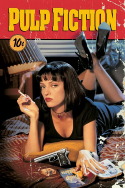
"...a shapeless mass of matter" or "a magazine or book containing lurid subject matter...". These are the definitions of the word "Pulp" which we are provided with before the film even begins. As a result, Tarantino's masterpiece is self-referential from the opening title card. What follows is only proof of his intentions to recreate the trashy and hardboiled pulp novels of the early 20th century. Even the film's poster reflects the sensational cover art of these novels and it's this attention to detail that's often overlooked in Tarantino's homage to a bygone age. I suppose it's understandable that these details are overlooked considering Tarantino's highly stylish approach. He employs his (now common) nonlinear storylines and chapters, his abundantly original cast of characters and his dialogue has rarely been sharper. Quite honestly, he takes great pride in making pop-cultural references but the film itself has nowhere red the very pop-culture it revels in. To this day, it's endlessly quoted and few, if any, will ever frown at you inquisitively if you were to make a Pulp Fiction reference.
It's not just the one-liners, the observant monologues or the endless back and forth, intelligent and philosophical discussions between the characters, it's the fact that snippets of dialogue actually matter in terms of the overall structure. Something can be flippantly mentioned one minute only for it to resurface with relevance at a later part in the film. Ultimately, it's the dialogue that brings every strand together and it's, quite simply, masterfully assembled.
To embody his colourful characters, Tarantino assembles his most impressive cast yet. Considering his relative obscurity at the time, it was a bit of a gamble to have John Travolta headline the whole affair as hitman Vincent Vega (the brother of Michael Madsen's Vic Vega from Reservoir Dogs) but I don't think I'd be alone in saying that it was a welcome return to scintillating form. Uma Thurman also impresses as Mia, the coke snorting gangster's moll who seems ill at ease with all the violence and whispers that surround her no-nonsense kingpin husband Marsellus Wallace (a brilliant Ving Rhames). Even the limited acting skills of Bruce Willis are all but forgotten as the self-important, ageing pugilist, Butch Coolidge (a role originally offered to Mickey Rourke and Matt Dillon) but the real prize possession would have to be Samuel L. Jackson's Jules Winnfield, Vincent's unhinged partner who likes to quote passages from the bible and believes in divine intervention.
There are so many great performances that it's hard to mention them all. From top to bottom, the whole cast bring Tarantino's dialogue to life; from the aforementioned main performers to the supporting likes of Christopher Walken's Captain Koons who hid an uncomfortable watch "up his ass" for 2 years to Zed and Maynard - Peter Greene and Duane Whitaker's white trash who like to "bring out the gimp" and sodomise their captives. There's even a character who only gets mentioned by name but still makes an impression: Antwone Rockamora, brilliantly nicknamed "Tony Rocky Horror" who's mentioned in an unforgettable, lengthy discussion on the sexual implications of massaging a woman's feet and whether it's in the same ballpark as "sticking your tongue in the holiest of the holies". So iconic are these characters and blackly comic dialogue that most will know exactly what I'm talking about without me having to elaborate and therein lies the sheer joy and richness of the film.
From illuminated McGuffins to Big Kahuna Burgers, Pulp Fiction is one of a kind. It redefined the crime film with it's emphasis on cool and endlessly quotable dialogue and there's so much attention to characterisation that Tarantino could have made several films from his material. Watching "a bunch of gangsters doin' a bunch of gangster shit" has never been more enjoyable.
Mark Walker.
This review of Pulp Fiction (1994) was written by Mark W on 06 Jan 2015.
Pulp Fiction has generally received very positive reviews.
Was this review helpful?