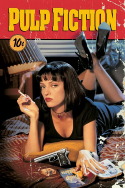
Review of Pulp Fiction (1994) by Thomas B — 30 Jan 2015
Whenever I tell my friends to watch this film (they totally exist!!) I always make sure to add: "You probably won't like it the first time around." This comes from experience after turning off the television in disgust after seeing it for the first time. It's a tribute to the film's enduring power and better-with-age quality that it now sits at the top of my favourite films of all time. .
Four stories intertwine as a pair of hitmen pick up a briefcase, a boxer pisses off a crime mogul, two armed robbers try their luck at a restaurant and an employee takes his boss' wife out for the night. .
It's difficult to pinpoint the exact source of Pulp Fiction's uber coolness; possibly the fact that it never tries to be. Quite the opposite in fact. Hitmen discuss Green Acres over breakfast, Mia and Vince do nothing but dance the night away and the soundtrack consists almost entirely of surf music and little known 70s tracks. As you can see, it doesn't exactly consist of pop-culture staples and things which are classified as cool. We sit through uncomfortable silences and conversations about foot massages and yet the film is touted as one of the benchmarks of cool. It's this insistent avoidance of what's recognised as cool which makes Pulp Fiction the coolest thing ever created. Instead of trying to exploit current pop-culture and get "in with the kids these days," it creates its own pop-culture and expects you to fall in line with it. By reinventing and patenting its own pop-culture, the film is entirely age-resistant, the proof of which lies in the fact that people who weren't even born at the time of its creation are trying to sneak it out of video stores to find out what the fuss is all about even today. And people who were older than Tarantino at the time of its creation still herald it as one of the greatest films they've seen. .
One of the main attractions of the film is Tarantino's script. Every single word of the entire film is quotable, whether it's something to do with hamburgers or pot bellies, it's as inventive and memorable as scripts get. One of the greatest aspects of the script is the pacing. Tarantino knows exactly how to take it slow and how and when to put the hammer down. A prime example of this is the infamous hamburgers scene. After being introduced by Vince and Jules talking about what they call various burgers in other countries, the two operatives head upstairs to retrieve a briefcase. The scene is filled with intricate slow-building intensity where the conversation revolves around what the boys are having for breakfast until finally it explodes into full-blown chaos. This restrained pacing is typical of the rest of the film, taking its time to arrive at every point it makes until going completely apeshit. Tarantino also shows a flair for subtlety, though that's kind of an oxymoron. The dinner scene between Mia and Vince is filled with subtext and nuance and while not even a word of a typical soppy love story makes its way in, it's never in doubt as to what's not being said. But it's the pop-culture defining quotes which make the film so incredibly watchable. Never again will someone be able to order a milkshake without the price coming into question, never will someone be able to quote scripture without someone piping up with Ezekiel 25:17 and the lamest joke in the entire world will always be one of the coolest things to say to a group of movie-lovers. .
Backing up this fantastic script is an amazing cast. It's an eclectic mix at first sight, but each and every part seems to have been tailored to fit the actor inhabiting it. John Travolta's career rebirth as Vincent Vega is fantastic, perfectly portraying the aloofness of a stoner and the assuredness of a gangster as well as a great gift for the inherit humour of the role. Uma Thurman's turn as Mia Wallace is similarly great, managing to be ridiculously hot while wearing more clothes than any number of so-called actresses with nothing between their ears. Bruce Willis' volatile Butch is perfectly restrained and brilliantly nuanced, Ving Rhames' Marsellus is gravitas in human form, Harvey Keitel's Wolf is the epitome of understated cool and Tim Roth and Amanda Plummer's Pumpkin and Honey Bunny are a perfect duo. But it's Samuel L. Jackson's Jules Winnifield which stands out in the incredible ensemble. His performance is a force of nature, exploding into rage while quoting scripture, levelling a room with a look and talking like a gattling gun. His performance is as funny as it is terrifying and constantly based in reality. .
Tarantino's direction, already shown in Reservoir Dogs and Jackie Brown to be restrained and subtle, a masterclass in choreographed realism, is just as effective here, if not more so. Many of the scenes lend themselves even more so to his directorial style, making way for beautifully intricate tracking shots and trademark corpse and trunk shots. But while his direction is undoubtedly fantastic, his restraint in many aspects is the thing to be admired here. It's not until a third of fourth viewing that you realise the intricacy in his work as he doesn't draw attention to any of it. This gives the film a base in reality which makes way for the script and performances to shine through. It also means that the darker moments are made that much more dark by comparison. .
Whether you like it for its technical aspects or simply to sit down with some of your favourite characters, Pulp Fiction is a perfectly paced, infinitely quotable and brilliantly executed crime film with a slew of indelible scenes which even today manages to change pop-culture to its will. .
Defining Scene: .
Mia's OD-ing fiasco. Perfect combination of Tarantino's brilliant direction, script and some fantastic performances.
This review of Pulp Fiction (1994) was written by Thomas B on 30 Jan 2015.
Pulp Fiction has generally received very positive reviews.
Was this review helpful?