Review of Project Nim (2011) by Jerry R — 09 Aug 2012
Where does a chimpanzee fit in the scheme of nature in relation to human beings? If you'll pardon me a crude analogy: If the evolutionary chain were a movie theater and humans occupy the front row, primates might place two rows behind us. We are a tiny fraction away from having the same DNA and when we look at them we can see that they are, basically, a savage version of what we use to be. Yet, in their eyes you can see that their thinking patterns must match ours in some fashion. What that fashion is exactly remains one of the great unsolved mysteries. What can they learn? Can they learn the way humans can? Are they communicating on our scale? Can they be taught from a young age and adapt just like a human child?
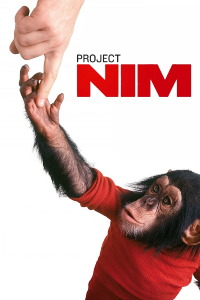
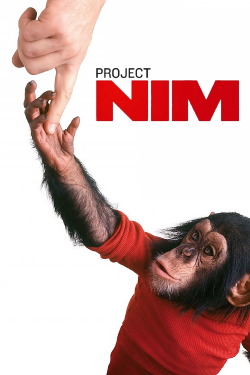
These questions were the focal point of a now-legendary experiment begun in 1973 and headed by a Columbia psychology professor named Herbert Terrace to see if an infant Chimpanzee could be raised in a normal human household and could be taught to communicate. The chimp was forcibly taken from his mother mere days after birth and given the name Nim Chimpsky (we learn the heartbreaking fact that this was the sixth child that this particular mother has had taken away and we see her in silloutte mourning the loss). Nim first lived in a brownstone in Manhatten with a married couple and their children. He wore clothes, he played with the pets; his human mother let him drink beer and smoke pot (this was the early 70s). She even breast-fed him. Most importantly, he was taught functional amounts of sign language. Nim's education in sign language was at the core of the project, even though one of the family members curiously points out that no one in the family was actually fluent in sign language to begin with.
The documentary Project Nim follows the progress of that experiment in reenactments and still photographs, but mostly through eyewitness testimony from the researchers who spent time working with Nim during the project. Some of the footage that we see might fit right in on a television sitcom or one of those shows from the 60s like "Daktari" or "Gentle Ben". We see little Nim rolling around on the floor playing with the kids, the dog and then the cat. It is all very cute, but one can't watch the footage and not be concerned. Nim, after all, an animal with violent tendencies.
Nim, through his training, seems perfectly happy, which is ironic when you compare him with some of the humans that are caring for him. Many of whom seem to have deep personality flaws. Dr. Terrace seems to evoke the quality of an father who raises a child from a distance, and the research assistants, Stephanie and Laura-Ann Petitto seem willing to forgive some of Nim's more aggressive tendencies and outbursts as he approaches maturity.
What becomes abundantly clear as Nim grows is something that Terrace doesn't seem to have considered: Chimps are cute and cuddly as babies, but as adults they are unmanageable. They don't know their own strength which is five times that of a human. We see talking-head interviews with many of the key participants in the experiment who show us scars from having been attacked and bitten by Nim during their time with him. One, in particular, was the most loving of all of Nim's parents and recieved a nasty bite through her cheek, not during a moment of violence but seemingly out of the clear blue sky.
I don't know if it was the intention of James Marsh, the director, but humankind isn't presented well at all in this movie. Nim is only a product of his circumstances - pulled away from his mother to spend the first half of his life in the spotlight, but when that spotlight is gone, what then? He's like a flavor-of-the-month celebrity who's light faded and everyone moved on to something else. So, knowing what we know about primate behavior, we kind of sense where the movie is going. Nim, through his work with the researchers eventually learned some 150 words of sign language and proved that a chimp could be taught. However, as Nim grows he becomes more aggressive and his wilder nature takes over and the story takes a turn that is achingly sad. He can't live with humans because he's too aggressive. He can't live with other chimps because he's been raised in the manner of a human being. Nim's contribution to scientific research has been incredible, but rather than being celebrated, he was shut away for the rest of his life and more or less forgotten. Thanks for nothing.
This review of Project Nim (2011) was written by Jerry R on 09 Aug 2012.
Project Nim has generally received very positive reviews.
Was this review helpful?