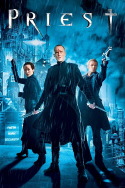
Review of Priest (2011) by Shiira — 03 Jun 2011
All is not quiet at the Catholic Holy Cross Cemetery. Somebody get a priest. On second thought, don't. That's what has John Ford rolling in his grave to begin with. It's the breach in the fine line between homage and ripoff.
The sacreligiousity at work here is two-fold. The filmmaker manages to upset both Christians and cineastes in equal proportions. The "Legion" director, whose funny idea of the holy spirit in his 2009 debut was that God would send down a battalion of homicidal angels to zombify the masses with an ecclesiastical opiate, has moved on from ripping off a B-movie classic like George Romero's "Night of the Living Dead".
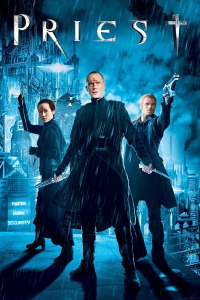
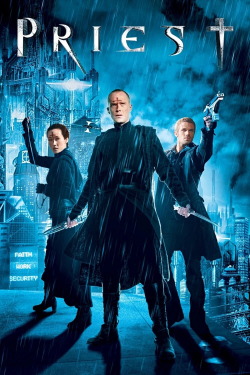
Now, in his not-so-infinite wisdom, he's raiding the film canon for ideas. In "Priest", the filmmakers takes "The Searchers" template and replaces the cowboys and Indians with clergymen and vampires, then sets their ongoing hostilities toward each other in a dystopian world where the Catholic church functions as a totalitarian regime.
The all-powerful monsignors, a group of theological autocrats, who preside over the God-fearing masses in these walled-up cities, use Orwellian-like methods of mind control to neutralize the priests, whom the church disbanded after the vampire menace was deemed to be over.
Taking a cue from Sam Peckinpah's "Ride the High Country", the priest(Paul Bettany), no longer a useful member of society(the marginalized vampires are tucked away on reservations), is reduced to shoveling coal for a living, a humiliating job, similar to the cowboy Westrum in the 1962 film, who runs a rigged carnival game out of desperation.
(Alas, Peckinpah was cremated and had his ashes scattered at sea.) Unlike Ethan Edwards(John Wayne), the priest never returns home to be among the kinfolk. That's probably because he still covets his brother's wife, Shannon.
The child they bore together prior to his leaving for the clergy is a dead giveaway; the child whom Hicks and the priest with no name are now searching for. Fate. You can't run away from it. By roaming the city all those years like a vagabond, the priest avoids the sexual tension that Ethan faces when he finally succumbs to love and returns home to see Martha Edwards, still married to his brother Aaron.
In the film's iconic first shot, when Martha opens the door, framing the outback in its opening, you notice her hands, first the left, then the right, gripping the house itself to steady herself as she makes her way outside.
In that instant, she's not a mother and wife; she's a woman in love, struggling to remember her vows. While Ethan approaches the homestead, Martha does something very subtle with her hand that hints at the desire which belies her blue dress and white apron get-up.
Before she straightens her fingers to block out the glare of the sun, they're arranged at the forehead in such a way that suggests she's about to faint. It's not the heat; this conservative frontier woman is swooning.
When Ethan chastely kisses her forehead, she closes her eyes. Meanwhile, the Confederate Army hero isn't thinking straight either. The cowboy mistakes Debbie for Lucy, despite the girls being at least ten years apart in age.
That's anguish. He wants to turn back the years. Because of "Priest", with its similar but different relationship dynamic between Ethan/Priest and Martha/Shannon, perhaps, a shared sexual past, and not unrequited love, is the correct interpretation for Ethan's stolen glances and the way Martha gently smooths her brother-in-law's military coat.
Maybe, just maybe, the identically named Lucy is Ethan's daughter. Now the scene where Ethan and Martha's hands briefly touch as they both reach for a lantern becomes more ambiguous. Aaron, who is storing money away while this display of subtle intimacy takes place, rather than being oblivious to his wife's slight marital indiscretion, may possibly know, and accepts their muted flirtation, but chooses to look the other way.
In "Priest", Owen knows that the child isn't his. Evidence of a sexual past can be gleaned from the scene in which Ethan stabs the soil(vagina) with his knife(penis), a metaphorical remembrance, perhaps, of the night he and Martha conceived Lucy, whose denuded lifeless body the war hero discovers in the cave.
"Don't ever ask me MORE," Ethan tells Brad, later on, when Lucy's boyfriend mistakes a squaw for his betrothed. "More", filtered through "Priest", suddenly becomes a loaded word.
Whereas Ethan's love for Martha outweighs his hatred for the Indians as the determining deterrent against killing Debbie, a converted Comanche, in "Priest", Hicks(the stand-in for Martin), Lucy's protector, probably knows that vampire infection isn't the sole reason for the potentiality of the father committing fratricide.
He broke his vow of celibacy. The timeline is a mere technicality. Now he must atone, murderously. Does the priest love God more than his daughter? Thankfully, no.
This review of Priest (2011) was written by Shiira on 03 Jun 2011.
Priest has generally received mixed reviews.
Was this review helpful?