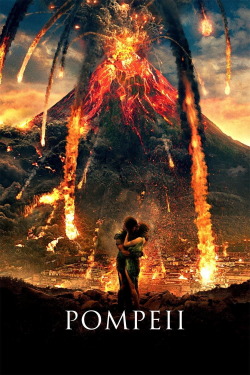
Review of Pompeii (2014) by Nightreviews — 24 Feb 2014
Pompeii is the type of epic disaster movie with a story-line centered on the brief and wholly unrealistic love story of a couple who just barely meets, a type of movie that is typically expected of directer Roland Emmerich (Independence Day, 2012, The Day After Tomorrow, Godzilla). Instead, surprisingly, Pompeii is directed by Resident Evil chief Paul W.S Anderson who visits the ancient Roman town-city with all the expected cliches of the disaster movie format that have become all too predictable. Thankfully, Emmerich hasn’t been able to deliver in a genre that he practically moulded as of recently, and Anderson gives audiences a fine, entertaining specimen of blockbuster proportions, with no shortage of historical inaccuracy.
The beauty about the legacy of the ancient Roman city, for Anderson at least, is that there has yet to be any sort of blockbuster feature film centered on it. Pompeii, a small port city which is located not too far from the base of Mount Vesuvius, experienced an eruption in or around 79 AD. The catastrophic eruption destroyed the city of Pompeii, as well as the surrounding cities including Herculaneum. However, unlike it’s cinematic interpretation, most of the people who died from the eruption did not suffer from flying lava bullets, tidal waves due to shifts in the Earth’s crust, or large holes in the street; rather, they died from extreme heat and suffocation as a result of the ash clouds. But we all know no one wants to see a movie where people just drop to the street and die. That’s what happened in The Happening, and no one wants to see that again, even if it is set against the amazing city of Pompeii.
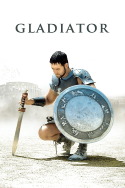
The truth remains, Pompeii is a large scale, slave-centered, disaster epic with hints of Gladiator and 300 all rolled into an ‘end of the world’ narrative. For the most part, the film is a satisfying display of Hollywood’s fascination with artificially sweetening historical events, making them grandiose and affecting. Like any good looming disaster, there is always hope for love, redemption and justice, which is exactly what Pompeii sets out to achieve.
Thanks to the success of 300 and audiences’ obsession with **** male bodies, no film set anytime in the ancient period, can have an actor show up on screen without a picture perfect set of washboard abs–an ingenious way to bring young and old female fare to the theatres. You gotta love multi-million dollar Hollywood marketing strategies. This time, the lucky stud to completely transform his body (if only temporarily) is Game of Thrones actor Kit Harington.
The film follows the constantly oiled up and über muscular gladiator Milo (Harington). Milo is happily born and raised in a small village belonging to the Celtic Horsemen Creed until one cold night when Corvus (Kiefer Sutherland), a senator under Titus and his Roman regime, comes and rips away everything Milo had come to know including his family, simply for the lust of land and rule. Lost and left for dead, Milo is thrust into slavery and raised among gladiators. Along with a vow to take revenge on Corvus, he grows up to be a lean, mean, gladiator-ific fighting machine. Almost two decades later, Milo’s amazing skills are noticed by a Pompeii aristocrat and gladiator recruit Graecus (Joe Pingue) and Milo is sent to Pompeii, where he meets and falls in love with the princess of the land, Cassia (Emily Browning). Unbeknownst to the inhabitants of Pompeii, something disastrous is brewing high inside the mountain leering down on them, ready to deliver a fate that quickly becomes a highly spectacle yet doomed story of honour, family, and love.
I am sure that there were many reasons why Anderson took on this project, especially since he is infamous for forcefully introducing 3D into his productions. His constant need for including the over-used movie gimmick is more than enough reason to revive pretty much anything, like Spider-Man for example. But, for the first time in a film made just for 3D, Pompeii surprisingly uses the fancy tool to it’s advantage and at times becomes almost unnoticeable, which is something that I haven’t really experienced during a film, especially one I wasn’t anticipating much from.
Although the film’s exterior focuses on Mt. Vesuvius and the destruction it is patiently planning, the heart and soul of the film seems to be centered on Harington and co-star Adewale Akinnuoye-Agbaje. Never have I seen a film where the two leads bond so much over the discussion of how they plan to kill one another. Sworn to be enemies and destined to fight to the death, the two men also happen to share the same cell, which kind of takes away from the imminent threat of death. But just like anything mass produced and destined for redemption, the two begin a friendship that sees them saving each other’s lives countless time; defying Rome and Corvus as well as giving one another a chance at retribution. The scenes between Harington and Agbaje are easily the best.
This review of Pompeii (2014) was written by Nightreviews on 24 Feb 2014.
Pompeii has generally received mixed reviews.
Was this review helpful?