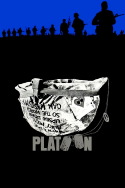
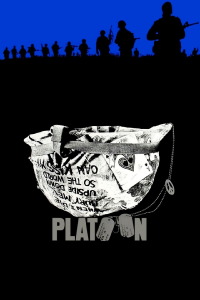
Review of Platoon (1986) by Philip J — 04 Mar 2013
Vietnam, 1967. Welcome to Bravo Company. Where boys learn to become men. And where boys must grow up fast or die young. The tropical heat will wear you down and diseases such as malaria spread quickly. And body bags are all too common a sight. We see a group of fresh faced recruits stepping off a military cargo plane. They are barely out of high school (hell many didn't even finish high school) and have an innocent, virginal look to them. Many are baby faced, thinking this will be an adventure. But the reality of war will hit them like a bullet to the brain. You know the old saying, "xin loi." Tough shit.
One of these recruits is Chris Taylor (Charlie Sheen), a young man who is thrust into combat duty despite his youth and inexperience. But Taylor is different from many of his fellow soldiers. You see, Taylor wasn't drafted by the Army; he volunteered to be here. Taylor dropped out of college in order to enlist in the military. He is driven by ideals and family pride - both his grandfather and father served in the first and second World Wars respectively. Taylor is a privileged kid, but doesn't believe it's fair that his kind get to escape the draft by enrolling in college while the poor have no choice but to make themselves sacrificial limbs in the name of preserving the United States. In a letter written to his grandmother, Taylor realizes that when he was growing up, his life was far different from those of his colleagues in Bravo Company. It's a revelation for him, how he had lived such a sheltered life from the real world. These young men serving in Bravo Company are grunts, people with little to no ambition and not much in terms of future goals. They came from small towns with broken homes, and a lack of family support. Their fellow soldiers in this platoon are their only true family. But to Taylor, these young soldiers represent the essence of true American valor.
"They're poor. They're the unwanted. Yet they're fighting for our society and our freedom. It's weird, isn't it? They're at the bottom of the barrel, and they know it. Maybe that's why they call themselves 'grunts', cause a grunt can take it, can take anything. They're the best I've ever seen, Grandma. The heart and soul.".
It only takes Taylor a week to realize how much Vietnam is an endurance test. Taylor finds himself exhausted. War takes a punishing cost on him and his fellow soldiers. When you see him accompanying his fellow soldiers on a mission, you witness his sweating and heavy breathing; fatigue is setting in quickly but he cannot be the weak link in this chain. Taylor sees red ants crawling on his neck, and other bugs crawling all over his face. He finds himself sleeping in dire conditions with one eye kept open so that his unit doesn't get ambushed in the middle of the night. .
"Somebody once wrote: 'Hell is the impossibility of reason.' That's what this place feels like. Hell. I hate it already and it's only been a week. Some god-damn week, Grandma. The hardest thing I think I've ever done is go on point three times this week - I don't even know what I'm doing. A gook could be standing three feet in front of me and I wouldn't know it, I'm so tired. We get up at 5 am, hump all day, camp around four or five, dig a foxhole, eat, then put out an all-night ambush or a three-man listening post in the jungle. It's scary, 'cause nobody tells me how to do anything 'cause I'm new and nobody cares about the new guys. They don't even want to know your name. The unwritten rule is a new guy's life isn't worth as much 'cause he hasn't put his time in yet - and they say, if you're gonna get killed in the Nam, it's better to get it in the first few weeks, the logic being: you don't suffer that much. If you're lucky, you get to stay in the perimeter at night and then you pull a three-hour guard shift, so maybe you sleep 3, 4 hours a night, but you don't really sleep. I don't think I can keep this up for a year, Grandma. I think I've made a big mistake comin' here...".
The Bravo Company platoon is led by field Lieutenant Wolfe (Mark Moses) as well as Staff Sergeant Barnes (Tom Berenger), and let me tell you, Barnes is as hardened as the permanent scars on his face. Although highly respected and feared, Barnes is callous, berating his own men and even threatening harm to them if they don't shape up. Meanwhile, Taylor becomes acquainted with Sergeant Elias (Willem Dafoe), who becomes a big brother of sorts for Taylor.
Many of the soldiers in this platoon are reaching their breaking point as the death toll rises and the unseen enemy has seemingly gained an upper hand. The platoon finds itself in a village where they believe that many of the villagers are working in collusion with the Viet Cong. Barnes gradually becomes unstable and this is evident when he kills an innocent villager in cold blood. Even Taylor finds himself at the verge of breaking down. At one point, during this village raid, Taylor points a gun at a one-legged Vietnamese villager. His decision whether to pull the trigger or not will have significant repercussions which he will carry for the rest of his life well beyond his service of duty in Vietnam...if he lives that long.
Taylor senses the tension in his platoon and the heightened animosity between Barnes and Elias. The members of the platoon have begun splitting into two camps, with some siding with Barnes and others siding with Elias. Taylor finds himself with Elias's group. If these soldiers want to stay alive, they will have to put aside their differences and learn to work together to defeat the Viet Cong. But the rift between the members of the platoon may be so great that there is no turning back...and they may be headed for destruction by their own hand...
In the war torn jungles of Vietnam, staying alive can be the hardest task. Keeping your sanity is a whole another challenge. Taylor has to learn to hold onto his humanity, even in the face of the darkest horrors of war.
Platoon is an honest glimpse into the lives of the soldiers who served in the front lines of the Vietnam War without the glamour and the glory. Forget all those Uncle Sam "I Want You" recruitment posters, you wanna know what war's really like? Oliver Stone tells it like it is in Platoon. The best filmmakers are ones that can tell stories while respecting their audiences and Stone does just that. Stone respects his audience and doesn't talk down to them. He respects them enough to present an uncensored perspective on what he sees is the truth as to what happened among US soldiers during the Vietnam War.
Director Oliver Stone is a Vietnam veteran and much of this movie is based on his own first hand experiences serving in combat over at Vietnam. It adds a layer of authenticity to this masterpiece and makes the viewer vicariously experience what Stone - and many soldiers - went through during the Vietnam War. Stone served in combat duty during the Vietnam War so he witnessed all the realities of war from the courage of his fellow men in the line of duty to the unspeakable atrocities of villagers being slaughtered. He has seen it all and Platoon perfectly encapsulates all of Stone's experiences in Vietnam.
In terms of cinematic storytelling, Oliver Stone is a visionary. Although the characters, events, and plot are fictional, Stone is using fiction to share his experiences serving as a soldier in the Vietnam War. Making this movie must have been a cathartic experience for Oliver Stone. I see this movie as Stone's personal memoirs of the Vietnam War in the style of a docufiction. It almost feels autobiographical as Taylor seems to me like a fictionalized version of Stone himself. Instead of making a straightforward documentary, Stone tells his own story through Chris Taylor. After all, like the main character, Stone dropped out of Yale University and served in Vietnam. He could have easily lived a prosperous life with an Ivy League education and a six figure job waiting for him, but he chose to enlist in the military because he felt it was the right thing to do. When we hear Taylor's voiceover narration while writing letters to his grandmother, it feels as though Oliver Stone is sharing his own stories with the audience. This voiceover device is a powerful tool that makes the story feel all the more real.
Oliver Stone also speaks for a generation, many of whom have kept these painful secrets about what they saw in Vietnam burned in their conscience for far too long. We are used to the old fashioned Hollywood movies depicting World War II heroics which get audiences pumped, making war seem almost exciting. They would be effective recruitment tools used by the military. But Platoon is different. We really see the inhumane side of war. The village massacre serves as an important turning point in this movie. Because it shows that these American soldiers were no better than the enemy they were facing. This movie flies in the face of all the celebrated jingoism of the 1980s Ronald Reagan era.
Platoon shows how war takes a toll on the physical body, the psychological mind, and the spiritual soul. War is not fun and games. War is hell and can break the most resilient of souls. For better or worse, war changes who we are and what we believe in. When we see our own colleagues dying right in front of our eyes, it impacts us, no matter how strong we think we are inside. War not only takes a physical toll on its participants, the emotional scars are even deeper. But those scars are buried deep inside festering until they can no longer take it and wish that it would all just end. The Adagio for Strings theme plays prominently throughout the movie, representing the true nature of war and its aftermath.
Stone goes for gut-wrenching realism here focusing on much of the mental breakdown of these soldiers. Even though these men are fighting on the same side in this war, we witness many of them turn against each other. We see the internal strife, exacerbated by the damaged morale. These soldiers are biting their lip in order not to crack under tremendous pressure.
Despite what these soldiers have been through, they serve our country, and they continue to do so, enduring the worst of conditions, sometimes inadequate equipment and supplies, and low morale among the soldiers.
Platoon is also a coming-of-age tale. We see Taylor changing and growing from his experiences here. If Taylor can somehow make it out alive and finish his tour of duty, Taylor will have grown up and become a different man. Not necessarily a better man, but wiser perhaps. Vital to the plot is the power struggle between Barnes and Elias. Elias is trying to hold onto those last shreds of morality. He becomes a mentor to Taylor, trying to protect him from the worst of war. This tug-of-war battle for Taylor's soul has Barnes and Elias pulling Taylor back and forth in opposite directions. It's interesting watching the two fight it out for Taylor's soul with Elias the angel on Taylor's shoulder and Barnes as the devil. Taylor will learn that losing your humanity is the greatest tragedy of all.
The narrative focuses on Taylor, but we get to know a variety of characters. We meet soldiers like Bunny (Kevin Dillon), who is a sociopath with a complete disregard for human life. Sgt. O'Neill (John C. McGinley) is a bit antagonistic and very manic, but in his own way, he's only following orders and is just trying to make the best of a harsh situation. There's fellow recruit Gardner (Bob Orwig), a nice kid but is exactly what he is - fresh meat. And King (Keith David), who is somehow able to keep his head straight amidst all the turmoil.
The cast is exceptional. I'm really impressed with Charlie Sheen's performance and this film showcases his immense acting talent. To think that Sheen was just 21 years old when he starred in this movie shows that he was indeed an acting prodigy. Unfortunately, I think Charlie Sheen peaked too early in his career and he never quite had a performance like the one he delivered here. In his later years, Sheen has been more well known for his off-screen antics, but in Platoon, Sheen delivers a truly winning performance. Tom Berenger is splendid as Staff Sergeant Barnes. You will absolutely despise his character even though he's one hell of a soldier. Barnes does some very despicable things and he tries to justify his conduct by saying that it's war and anything goes. I'm glad he received an Academy Award nomination for his role here. I'm usually used to Willem Dafoe playing over-the-top characters, but here he surprises me. You can tell that his character really gives a damn about Taylor's well-being and tries to be the moral center of the platoon.
Many of the other cast members were young actors who started out with smaller roles in this movie and have since gone on to great success. It's fun to watch future stars Johnny Depp, Forrest Whitaker, John C. McGinley, and Tony Todd appear in early roles here. The always reliable Keith David (one of the finest character actors and an underrated performer) is great as one of the more practical and poised members of the platoon. And Francesco Quinn - absolutely spellbinding as Rhah, a heroin addicted soldier who also takes Taylor under his wing. I thought that Quinn stood out among the members of the platoon and though he had a solid career in movies and television, he never quite achieved star status. It's a meaningful role. Rhah personifies the many young soldiers who use drugs as a way to ease the pain - and also to avoid confronting the very real prospect of dying on the battlefield. What's amazing is that there are no deadweight performances at all, everybody does their part and they do it well.
The storyline is relatively easy to follow though there's a great plot twist that really hits you like a punch in the gut. Military technical advisor Dale Dye (a decorated Vietnam Veteran himself who served as a US Marine Captain) provides further credibility to the storyline. I can't say for certain whether Platoon portrays a completely accurate depiction of how the United State military operated its protocol during the Vietnam War, but Dye works to make it as realistic as possible. Dye also has a supporting role as Captain Harris, the commander of Bravo Company.
Platoon is also enhanced by great cinematography which captures everything from the terror of the soldiers' faces to the intensity of the firefights during the night ambushes. Platoon was shot location in the Luzon island of the Philippines. Although not a perfect substitution, this island provides a suitable backdrop for a land that has been drenched by much human blood.
Oliver Stone stages the battle sequences with a degree of flair. The way battles were thought in Vietnam was different from other wars. Vietnam War relied on the strategy of subterfuge. The enemy was much more difficult to detect. They would use the environment to their advantage in setting traps and ambushing the soldiers. The soldiers would hear gunfire and know they were being shot at, but they couldn't see who was doing the shooting. So the soldiers had to learn how to camouflage themselves and blend in with the jungle settings. The soldiers also have to watch out for booby traps rigged by the Viet Cong.
Platoon doesn't flinch at the violence and brutality. We see and hear soldiers screaming in agony if they are lucky to survive. Body parts get blown away by grenades and other explosive devices. And there are graphic details of the soldiers' wounds being treated. Though not the most gruesome of war movies, it can be tough to watch at times.
Platoon is full of unforgettable images. One of the most popular scenes is when we see a soldier thought to have died emerging from the jungle and running in the field, trying to escape the North Vietnamese soldiers. He raises his arms in a desperate attempt to cling onto life. It has become an iconic moment not just for this movie, bu.
This review of Platoon (1986) was written by Philip J on 04 Mar 2013.
Platoon has generally received very positive reviews.
Was this review helpful?