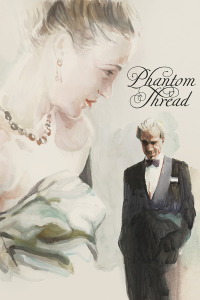
Review of Phantom Thread (2017) by Axgrinder — 21 Jan 2018
Daniel Day Lewis is so good an actor that I find him to be totally believable in almost any role he immerses himself in. His portrayal of London dressmaker Reynolds Woodcock proves no exception. On the other hand, I found the whack ending to this movie to be far from believable, and consequently insufficient to salvage a film that is most easily labeled as a long-winded character study.
The film is set is 1950’s London. It’s time in which social rank and class snobberies are still quite in vogue. Kudos to director Paul Thomas Anderson for his subtlety in this regard, and avoidance of a lot of overt explanations about the time, place and social class structure of the time, and leaving it to the viewer to figure out. Woodcock is portrayed as a man who is totally self-absorbed. His work is his life. He demands perfection out of everyone around him. He has zero capacity for indulging the needs or desires of others. His clients are European high-society and royalty, but he does not socialize with them. He has no friends; only the memory of his deceased mother to sustain him. It’s a life that appears to be full on the surface but, in fact, is mostly empty. It’s been reduced to a repeating cycle in which Woodcock works all hours of the day and night until he reaches the point of exhaustion. Once he recovers, he starts the cycle over again. The only time anyone can tell if he’s happy is when he is ordering a big breakfast.
Woodcock is not homosexual, but neither is he deeply physically or emotionally attracted to women. Instead, he is attracted to women who have a certain body type that meet his ideal standard for fitting into the dresses that he creates. When they later fail to meet up with his social and cultural standards (such as when they make too much noise while eating), he judges them inferior and becomes bored with them.
Alma is a waitress in a restaurant. Her accent gives her away as an immigrant. Here again, director Paul Thomas Anderson wisely avoids overtly calling attention to their different social statuses. Woodcock is attracted to her because shape. She’s flattered by his attention but thinks she can engage him on her terms, which succeeds only in annoying him. Woodcock begins to lose interest and mocks her but, for reasons that are unclear, doesn’t dismiss her. It is at this point that the movie begins to lose credibility. What she does to him next in retaliation is beyond forgivable but, bizarrely, Woodcock interprets her actions as true love. Beyond that, I cannot tell you more without spoiling the movie. Suffice it to say that the ending feels entirely out of character with the rest of the movie. To my mind, it’s vaguely reminiscent of Kathy Bates in Misery, and Isabella Rossellini in Blue Velvet.
This review of Phantom Thread (2017) was written by Axgrinder on 21 Jan 2018.
Phantom Thread has generally received very positive reviews.
Was this review helpful?