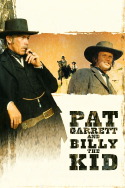
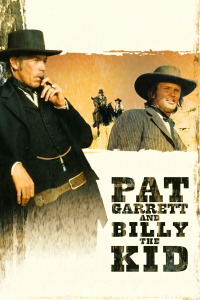
Review of Pat Garrett & Billy the Kid (1973) by Adam T — 02 Jul 2007
[b][b][u] Demons in the Dust[/u][/b][/b].
[b][u][/u][/b].
[u][/u]Sam Peckinpah's diametric Westerns.
By Jonathan Hiott.
Having the privilege to learn somewhat about Sam Peckinpah's professional life on the DVD extras for [i]The Wild Bunch[/i], I came away with a sense of sadness for this man's life, of a restless, tormented soul. Clearly he believed, like many artists before him, that a tortured life led to better artistic output. After watching his Straw Dogs several years earlier and being rather shocked by its violent display, Peckinpah was just a name, an unusual name. I had no intention at the time to further explore this man's work. After seeing The Wild Bunch, interest was piqued. After viewing Peckinpah's final western, Pat Garrett and Billy the Kid, exploration seems almost vital.
Comparison and contrasts can be seen between the two films, not the least of which is the presence and portrayal of the outlaw figure. In The Wild Bunch (TWB), there are several outlaws who are bound together by a code. The code can be described as professionals maintaining their professionalism in a world that no longer cares about their profession. The head of the gang is played by William Holden, who bears the weight of his character with dogged aplomb. These men kill for money but somehow we care for them. This is the beauty of great westerns, such as The Searchers, who can evoke sympathy toward malicious men. In [i]Pat Garrett and Billy the Kid[/i] (PGBK), the protagonist isn't so clear. Pat Garrett, played beautifully by James Coburn, is the sheriff hunting down Billy and turns out to be more of an outlaw than Billy, played by Kris Kristofferson. Garrett boozes and womanizes like a pro that's been doing so for years. He is as criminal as the ruffians he chases, yet they respect Garrett. It is explained that Garrett used to be in the same gang as Billy. The two men have a complex relationship in that they are friends and enemies. A mutual respect is present and Peckinpah loves this sort of male-bonding.
Both films contain world-weary men staring off into the distance pondering deep and meaningful ideas and perhaps, regrets. That said, [i]PGBK [/i]is a more thoughtful film with a deeper soul. Maybe the most introspective of all westerns. Perhaps the soul of [i]PGBK[/i] is the impish, quiet Bob Dylan. Dylan also provides a moving soundtrack.
[i]The Wild Bunch[/i] is a straightforward blood-and-guts western. It was pioneering for its use of blood packs to simulate gunshot wounds. Blood had never flowed like it did in these two movies and no western before had done it so graphically. Although, to a modern viewer, the blood looks fake. To be sure, significant improvements in blood effects technology have been made! Also, we see dramatic use of slow-motion film during gun fights. The slow-motion is almost overdone. Peckinpah broke the mold for film violence and set the brutal stage for his successors such as Scorsese, Tarantino and John Woo. Peckinpah's violence has been described as operatic, where bloody deaths appear like macabre wastes of humanity. This description is no more evident than in [i]TWB.
[/i]Both films offer insight into a tumultuous mind in Sam Peckinpah and pay tribute to a dying West, a West that John Ford had practically built with his canon of films in the preceding decades. Peckinpah's Westerns were the logical successors to Ford's in the violent Vietnam era. Peckinpah is perhaps the last maverick of modern American film and certainly the last great western filmmaker of the twentieth century.
This review of Pat Garrett & Billy the Kid (1973) was written by Adam T on 02 Jul 2007.
Pat Garrett & Billy the Kid has generally received positive reviews.
Was this review helpful?