Review of Papillon (1973) by Harry W — 17 Jul 2014
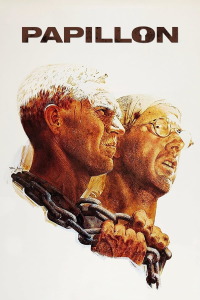
Teaming up Steve McQueen with Dustin Hoffman, Papillon sounded like it would be a very innovative film.
Papillon is a memorable film because of the way that it depicts the harsh reality of the prison system. The atmosphere of the film has not a hint of optimism in it, and the way that the film supports itself instead of falling into melodramatic territory is the way that it establishes the friendship between Henri "Papillon" Charriere and Louis Dega. Like a true prison sentence, survival in a harsh reality is difficult but the friendship between people can save it all. The underlying themes in the film are focused on the will for humans to survive instead of being about them going against the authority figures in a prison system, so it has an interesting story which takes an alternative approach to the theme of a prison movie setting than many others do. The atmosphere of the film is not specifically threatening, but it rather has a certain empty tension. At times, this can be a little too empty howerver, and by today's standards there is the distinct possibillity that viewers will find issues with the slow pace of the film as well as its extensive length, and so its impact is not likely to be as relevant today as it was upon its original release date. People familiar with the classical film style that director Franklin J. Schaffner applies to the film are more likely to appreciate it than contemporary viewers, and even I felt the effect of the slow movement in the fiolm. But its depiction of the damage that prison has on one's spirit predates so many other great prison movies which means that it comes off as being a somewhat nostalgic piece.
Papillon is interesting because it is a surreal film. It has some memorable sequences which make the atmosphere of the film rather strange, and as a whole it is ambiguous because of the nature of the setting. The setting of Papillon capitalises on some beautiful scenery that is captured all with nice cinematography which easily makes the story feel legitimate, but it is impossible to tell what is going to happen. The story goes in all different directions and to all different places, and the scenery of the film constantly has viewers asking questions about where they are. It gives them a sense of isolation from understanding everything, similar the isolation that the characters in the film feel which means that it is a tale that is easy to get drawn in to. The line that Papillon walks between realsim and mystery is interesting, and it makes the project a memorable film. The problem however is that the film is a lot more focused on establishing the nature of the setting than it is at getting into the minds of the characters, and therefore it fails to involve viewers deeply with the story. Papillon is admirable for the subject matter and the scale of the spectacle, but the characters are not all that easy to establish a connection to and so the project ends up somewhat shallow to a certain extent. Papillon is a good film, but it can't compare to the many more gritty and hard hitting prison films that predated it like Cool Hand Luke or others that would follow like The Shawshank Redemption. It has a nature stands out, but as a whole the experience of the film is not as satisfying as one might have hoped.
But the musical score in the film is beautiful. It is not used to excess as the atmosphere of the film is allowed to naturally develop on its own, but at times the music is used to subtly enhance that which proves to be a nice touch. It is one of the nicest aspects of the film and it reflects the gentle movment of the story while reinforcing the general nature of the scenes.
And the script in Papillon is nice, as well as the fact that the cast contribute all of their best efforts to ensure that it comes off as a well acted piece.
Steve McQueen's leading performance is one of his most sympathetic to date. He doesn't say too much, but his physical presence is good and it is always easy to symptathise for him. He projects a lot of inner torment in the leading role because it never looks like he has any spirit or the determination to really do anything which means that he is the ideal product of the prison system. He conceals his emotions and projects a stoic nature in the role which means that he gets the profile for the role of Henri "Papillon" Charriere easily, and it doesn't require him to say all that many words for him to establish that. But when he delivers his lines, he does it well because it seems like they are the few words he will ever say before his character passes away. He never pointlessly blurts terms out, he speaks things which are truly felt from within his soul. Whatever kind of a person Henri "Papillon" Charriere was, Steve McQueen is able to give a performance which really deals the character some interesting justice, and so it is one of the finer performances of his career.
Dustin Hoffman follows with a powerful supporting performance. Although he doesn't stand up as much as Steve McQueen, the chemistry between the two actors is essential to the film because it gives a kind of support to the project that establishes the nature of the film as not falling on to melodramatic terms. On his own, Dustin Hoffman holds his own with a powerful line delivery and a smile which lights up the screen in Papillon, and so he makes a very friendly presence in the film which does not fail to entertain. Him and Steve McQueen truly make an impressive duo.
So Papillon is a slow, long and somewhat shallow film when it comes to handling its characters, but it is a beautifully shot and well acted piece which has a strong atmosphere to it.
This review of Papillon (1973) was written by Harry W on 17 Jul 2014.
Papillon has generally received very positive reviews.
Was this review helpful?