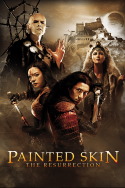
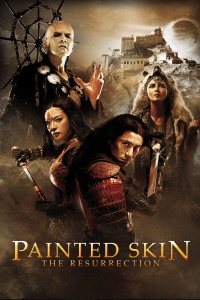
Review of Painted Skin: The Resurrection (2012) by Jack P — 04 Mar 2013
A Demon's Redemption.
There is a category of aesthetic that takes from dark places and creates sensual beauty. It is a dark beauty, where blood red is crimson red, and ink black is ebony black, and the macabre is tender as a newly opened flower. I have always enjoyed this aesthetic view point, which caters to the stories of ugly, golden hearted misfits. Or villains who are sorry for what they have done, and only committed foul deeds in the first place to have what others had. Good monsters. This is the type of story that Painted Skin tells. A demons punishment and redemption for wanting what she can not have.
Painted Skin: The Resurrection is a sequel to the first Painted Skin movie, which I have to admit, I have not seen. I know it stars Donnie Yen and is directed by Gordon Chan, which leads me to believe it is more focused on action. Wu Ershan has taken over the story for it's second installment, and has focused on the story more than action. Action gets it's place, but it is kept controlled next to the lush dark magic of the tale itself.
This tale is pure fiction, a Chinese based fantasy. I urge people to think of stories like Lord of Rings more than period pieces, for this is not a period piece. It is built on aspects of Chinese history and culture, just like western fantasy is based on Medieval Europe. This tale takes from the period of the Han Dynasty, when it was struggling to control the Hexi Corridor, which was the only path the Han had to the Silk Road trade routes. The Han competed with a group they labeled the Xiong Nu, a nomadic people that were tribal and clannish in nature. They were predecessors to the Mongols.
The story centers around the fox demon Xiaowei, played by Zhou Xun, who is imprisoned in ice as punishment for her involvement with humans. Another demon, this one a bird named Que'er, played by Yang Mi, sets Xiaowei free and helps her to find a human who will give their heart willingly to the fox demon that she might become human. The two encounter the last unmarried Han princess, Jing, played by Zhao Wei, who is traveling to see a general named Hou Xin, played by Chen Kun. He commands the White City, which guards the Han Empire against the Tian Liang barbarians, the story's Xiong Nu.
Jing is a beautiful but disfigured woman who is in love with a man below her station, General Hou Xin. Hou Xin is ashamed of his failure to protect Jing against an attack which happened years ago, which is why he is out on the borders of the Empire, an apparent self exile. Xiaowei tries to use these unrequited lovers to get the heart she needs to become human. This will involve Jing making a devil's deal with Xiaowei, so that she can be with Hou Xin. Que'er has her own endearing interactions with a descendent of demon hunters, who is more of a poor con man than a informed mystic. All the while the Tian Liang attack the city over a broken promise made by the Han. Surprisingly, this is love story.
Everything about this movie is a wonderful Chinese gothic tapestry. The color schemes of the sets and costumes are all darkened, richer colors, and muted earth tones. There is always a color contrast to found be found between some dark color and a deeper more dynamic color. The characters have their own color schemes which fleshes them out as living art. A lot of the movie is CGI, but beautifully done. The CGI is there to create the magic of the demons, and it always blends effortlessly with the reality the actors occupy. There is one scene with a bear that does not live up to the rest of the movie, but that scene is a flashback, so it is hard to tell if it was done that way on purpose. There is another scene involving the very visceral activity of switching bodies, which by all means should be grotesque, but is portrayed here as sensual, like a massage, or slow dancing. It is almost tender and gentle when completed.
The actors all do a wonderful job and the cast is lead by a strong set of females. Zhou Xun and Zhao Wei are two of the Four Dan Actresses, a group of actresses beloved in China. The other two being Xu Jinglei and Zhang Ziyi, of Crouching Tiger, Hidden Dragon fame. On a side note, Dan is the word for female leading roles in Peking Opera, so their collective title is saying that they are the four leading ladies. What this means is that not only are these actresses some of the most skilled at their craft, but some of the most beautiful talents China has to offer. The other actresses do not pale next to these leading ladies, however, making sure the film is dominated by women. The male roles are really side characters playing in a world that is truly run by feminine influences.
Painted Skin: The Resurrection is gothic fairytale unique to China's sense of history and aesthetics. It is a pleasure to watch and get lost in. The enjoyment not only comes from the special effects, sets and costumes, but the talented and endearing talents of China's current top actresses, as well as, the eternal theme of love across boundaries and stations. While intensely gothic in appearance and matter, it really turns out to be an enjoyably tender film.
This review of Painted Skin: The Resurrection (2012) was written by Jack P on 04 Mar 2013.
Painted Skin: The Resurrection has generally received mixed reviews.
Was this review helpful?