Review of Outland (1981) by Mel V — 15 Mar 2009
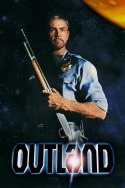
Two years before Sean Connery appeared in Brian DePalma's [i]The Untouchables[/i] and won the Best Supporting Actor the following spring, Sean Connery took the lead role in [i]Outland[/i], writer-director Peter Hyams' ([i]A Sound of Thunder[/i], [i]2010: The Year We Make Contact[/i], [i]Capricorn One[/i]) science fiction/western. [i]Outland[/i] opened to mixed reviews and middling box office returns, but it?s still worth revisiting, if not for the ?High Noon in Space? storyline, then for Sean Connery?s central performance, Philip Harrison?s ([i]The Core[/i], [i]Mississippi Burning[/i], [i]Never Say Never Again[/i], [i]Pennies from Heaven[/i]) production design, Stephen Goldblatt?s ([i]Charlie Wilson?s War[/i], [i]Closer[/i], [i]Lethal Weapon I and II[/i], [i]Young Sherlock Holmes[/i]) noir-influenced cinematography, and Jerry Goldsmith?s ([i]The Mummy[/i], [i]Star Trek: First Contact[/i], [i]Total Recall[/i], [i]Alien[/i], [i]The Omen[/i]) orchestral score.
Set in the distant future, [i]Outland[/i] centers on William O'Niel (Sean Connery), a federal marshal assigned to Con-Am 27, a privately owned titanium ore-mining colony on Io, one of Jupiter?s moons. O?Neil?s wife, Carol (Kika Markham), and son, Paul (Nicholas Barnes), have joined him on Io, but Carol chafes at putting O?Neil and his career over her own well-being and that of their son, who?s only seen Earth on film or in photos. The Con-Am 27?s administrator, Sheppard (Peter Boyle), has little use for O?Neil or O?Neil?s desire to enforce the laws without exception. Carol leaves Io unexpectedly with Paul for the nearby space station and refuses to return. With the possible exception of his second-in-command, Montone (James B. Sikking), and the colony?s medical officer, Dr. Lazarus (Frances Sternhagen), O?Neil finds himself without allies.
When two miners kill themselves, one cutting his oxygen line after suffering from a hallucination and another walks into an elevator headed for a depressurized area without his space suit, O?Neil begins to suspect there?s more going on than ?cabin fever,? especially when the colony?s chief doctor, Dr. Lazarus (Frances Sternhagen), informs him that the company has shipped the bodies off-colony for disposal before she could complete an autopsy on either miner. The trail eventually leads to a dangerous speed-like drug that enhances miner productivity, but causes long-term mental and emotional instability. As O?Neil digs deeper, he discovers a drug-smuggling conspiracy that reaches into Con-Am?s upper management. When O?Neil becomes a threat to Con-Am?s profitability, the company sends an assassination team to eliminate him.
The influence of Ridley Scott?s [i]Alien[/i] on [i]Outland[/i] is evident from the first scene. If [i]Alien[/i] was, someone long ago phrased it, ?Truckers in Space,? then [i]Outland[/i] could be described as ?Miners in Space.? Of course, [i]Alien[/i] was more than just ?Truckers in Space.? Space mining and hauling was just a backdrop to the ?survival horror? storyline. In [i]Outland[/i], there are no aliens, just criminal, destructive human behavior (performance-enhancing drugs sold to miners, a top-down cover-up). Both films depict corporations as rapacious and exploitative: corporate executives are more than willing to sacrifice people for profits. In [i]Alien[/i], the Weyland-Yutani Corporation hopes to convert the alien species into a profitable bio-weapon. In [i]Outland[/i], mining quotas and bonuses lead the mining colony?s administrator (and presumably his superiors) to compromise the miner?s health and safety by encouraging miners to take performance-enhancing drugs (with predictably dire consequences).
The combination of science fiction, western, and urban crime drama elements in [i]Outland[/i] isn?t particularly original. Hyams structured [i]Outland[/i] as a futuristic version of Fred Zinnemann?s [i]High Noon[/i], with minor changes. While [i]Outland[/i] slowly builds to O?Neil?s face-off with the company?s assassins, leading to a running battle inside the colony?s abandoned buildings and walkways, Zinnemann and his screenwriter structured [i]High Noon[/i] around the impending arrival of the central character?s enemy and his gang, with the sheriff forced to confront his inner doubts, his wife?s concerns for his safety, and the townspeople?s unwillingness to help him. Still, the similarities are close enough that anyone who?s seen both films will immediately make the connection.
Hyams take on the future reflects what he sees as the unchanging, perhaps unchangeable impulse to exploit natural resources and other human beings for profit, minus laser weapons or advanced computers, of course (videophones, however, are a go in Hyams? view, as they were in [i]2010: The Year We Make Contact[/i], the sequel to Stanley Kubrick?s [i]2001: A Space Odyssey[/i] Hyams made three years later). The expansionist impulse is still with us, as is the ?manifest destiny? that justified the American Republic?s expansion from the Atlantic Ocean to the Pacific Ocean and, eventually, into outer space.
This review of Outland (1981) was written by Mel V on 15 Mar 2009.
Outland has generally received mixed reviews.
Was this review helpful?