Review of Onibaba (1964) by Alexandre B — 10 Mar 2009
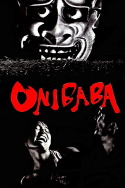
A mother and her daughter-in-law in feudal Japan, surivive by killing passing samurai who wander in the tall grass plains in which they live, the grass is tall enough to hide in, and they spear passerbys, strip them of their armor, and sell it. They dispose of the bodies in a an enormous mysterious hole, in the center of the field. There fighting is becomming more scarce, and the scavenging is getting harder. They get rice for armor, and stuff their faces full, and lay down breathing heavy (they do this everytime after they eat). Life goes on like this, until thier son's freind and neighbor returns to disturb their peace.
The daughter is attracted to the man, the mother resents their relationship, maybe because she resents the daughter whose still young enough to entice the man, and or the man for stealing the girl away who she "can't kill without.". In any event, she finds a demonic samurai's mask, and tells the daughter that adultresses burn in hell and are forever tormented by demons, on her late night visits to the man's hut, the mother begins pretending to be a demon, and tormenting her.
It's beautifully photographed,, filmed completely within the tall grass, the landscape becomes an alien environment. This film does for grass what "A Woman In The Dunes" did for sand, that is makes it an erotic, existential, ever shifting underworld. The score is an awesome combination of Jazz, tribal drums, and traditional eerie horror strings.
The story is a primal one of sex, death, curses, and religious manipulation; it was based on a Buddhist parable. Its part horror, existential erotic drama, and period peace, without succumbing to the conventions of any. And a bit poetic too, the title translates as Demon Woman, but I get the impression "Blades of Grass" might have been apossible US title. And my God its well shot, a photographic marvel really.
First time I watched it I didnt get past the first half hour, next time it came on tv, I was mesmerised. It's skyrocketed into my top 20, and become maybe my favorite Japanese film, ever. First time around I had the crtierion dvd, from the library which had a short essay in the back by director Kaneto Shindo, where he basically says the film is his metaphor for sex, but is open to many meanings. So the big hole in the field, is every bit as knee jerk Freudian as you might imagine, but it could function as a metaphor for the unconcious too, bottomless, until the mother descends into it and retrieves the primordial mask.
Short version: it's awesome, see it.
This review of Onibaba (1964) was written by Alexandre B on 10 Mar 2009.
Onibaba has generally received very positive reviews.
Was this review helpful?