Review of One-Eyed Jacks (1961) by James H — 19 Jul 2010
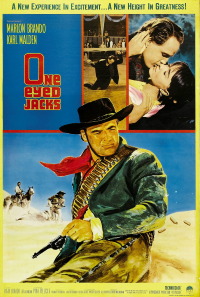
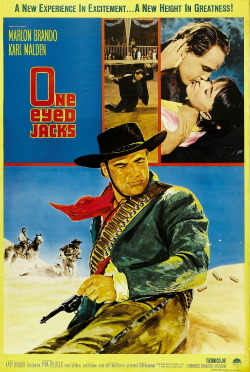
Academy Award Winning actor Marlon Brando directed one movie during his prestigious 50-year career in Hollywood. Brando's Pennebaker Productions figured a western might be a worthwhile investment since westerns had been profitable during the 1950s. The company shelled out $40,000 for the rights to author Charles Neiderâ??s seminal western novel â??The Authentic Death of Hendry Jones,â?? fictional adaptation of the a friendship between Patrick Garrett and Billy the Kid. Several scenarists came and went before â??One-Eyed Jacksâ?? was completed. Among the scenarists were a young Sam Peckinpah, but novelist Calder Willingham replaced Peckinpah. This amoral western melodrama dealt with the themes of friendship, greed, deception, betrayal, and revenge. The troubled production history of this splendid horse opera casts a shadow over its artistry. First, Brando created several legends about his use of six or more takes for a scene. Second, the story goes that the star waited for the most dramatic waves to break on the shore. Brando toiled for six months on â??One-Eyed Jacks.â?? Initially, â??Paths of Gloryâ?? helmer Stanley Kubrick started out as the director, but artistic differences between Brando and he led to Kubrickâ??s dismissal. Reportedly, Kubrick preferred Spencer Tracy over Karl Malden for the villainous role of Dad Longworth. Brando objected on the basis, however, that Pennebaker Productions had already paid Malden the sum of $300-thousand. Afterward, when nobody stepped forward to helm the film, Brando decided he would try. Paramount executives should have had their heads examined for letting a temperamental actor like Brando call the shots on a film.
Three American outlaws, Rio (Marlon Brando of â??Julius Caesarâ??), Dad Longworth (Karl Malden of â??Baby Dollâ??), and Doc (perennial character actor Hank Worden of â??Red Riverâ??) hold up a Mexican bank. Dad and Doc ride off to shack up with prostitutes in a bordello, while Rio heads off to romance a refined lady at her hacienda. Mexican Rurale captain (Rodolfo Acosta of â??Hondoâ??) leads a posse to the bordello and they kill Doc when they raid the place. Dad slips out by the window with his gun, but he forgets his boots. Dad rides off to alert Rio. Together they light out into desert with the Rurales on their trail. Rio loses his horse and has to double up on Dadâ??s mount. They take refuge on a hill and exchange gunfire with the Rurales. Our heroes decide that one of them must round up fresh horses so they can escape from the Rurales. Rio draws two bullets and grips them in his fist. Interestingly, our protagonist lets Dad win and Dad sets out for fresh horses while Rio holds up the Rurales. Dad rides into a tiny ranch and buys a horse. He is shifting the gold coins around in his fist when he decides to leave Rio to the Rurales. Eventually, the Rurales surround Rio and he surrenders. He spends the next five years in a stinking Sonora Prison, while Dad lives high off the hog in Monterey, California, where he has gotten himself elected sheriff. Moreover, Dad has married Maria (Katy Jurado of â??High Noonâ??) and adopted Mariaâ??s daughter, Louisa (Pina Pellicer of â??Macarioâ??), as his own. He owns a house about 10 miles out of town.
Rio and Chico Modesto (Larry Duran of â??Viva Zapata!â??) break out of the Sonora Prison. They are laying low in a cantina when Bob Amory (Ben Johnson of â??Rio Grandeâ??) approaches Rio about robbing a bank in Monterey. Rio learns Dad Longworth is the town lawman. Rio visits Dad before Amory and his sidekick, Harvey Johnson (Sam Gilman of â??The Young Lionsâ??), show up in Monterey. Initially, Dad believes Rio has come to kill him for double-crossing him back in Sonora. Rio doesnâ??t want to shoot Dad. Rio explains he gave the Rurales the slip and eluded them. Dad introduces Rio to his family and Louisa takes an immediate interest in him. Later, Rio guns down a drunken man in a Monterey bar, Howard Tetley (Timothy Carey of â??The Killingâ??), who was abusing a helpless woman. Dad has had enough of Rio. Primarily, Dad is angry because Louisa spent the night on the beach with Rio. Dadâ??s sleazy Deputy Lon Dedrick (Slim Pickens of â??Rocky Mountainâ??) has had his eye on Louisa and hates Rio. Dad arrests Rio for killing Tetley. Disarming Rio, Dad lashes his wrists to a horseâ??s hitching rack. Wielding a bullwhip on Rio, Dad sends him to his knees. Dad reverses a shotgun and smashes the butt of the weapon against Rioâ??s right hand to destroy his hand.
Rio and company flee Monterey, but our protagonist is even more determined to kill Dad. Rio recuperates on the beach and gets back the use of his gun hand. Bob and company ride into town to rob the bank. The robbery is a bust, but a little girl dies during the shoot-out. Rio is riding back to town when Dadâ??s deputies arrest him and prepare the gallows for his inevitable hanging. Rio escapes from jail and shoots it out with Dad in the town plaza. The striking locales set â??One-Eyed Jacksâ?? apart from most westerns. When Brando left the production, he had filmed about five hours of footage and assembled his own cut. Paramount whittled the unwieldy opus down to two hours and forty-one minutes.
Financial woes aside, â??One-Eyed Jacksâ?? qualifies a good, often compelling western about two bad men who clash at the outset over stolen gold. One lands in a filthy Sonora prison, while the other one ends up in California with a badge on his chest. The cast is stupendous, particularly Malden who plays a thoroughly treacherous dastard. Ben Johnson, Slim Pickens, Katy Jurado, Timothy Carey, and Pina Pellicer all contribute memorable performances. â??The Magnificent Sevenâ?? lenser Charles Lang, who makes the scenic Monterey coast with its crashing surf and the rugged Mexican locations look absolutely dazzling. Not surprisingly, Lang received an Oscar nomination for Best Cinematography. Moreover, Brando was nominated for Best Director. Unfortunately, the studio shots involving back projection detract from Langâ??s visual real-world composition. Sadly, â??One-Eyed Jacksâ?? never recouped its negative cost, the amount that it took to produce this exotic western.
This review of One-Eyed Jacks (1961) was written by James H on 19 Jul 2010.
One-Eyed Jacks has generally received positive reviews.
Was this review helpful?