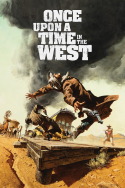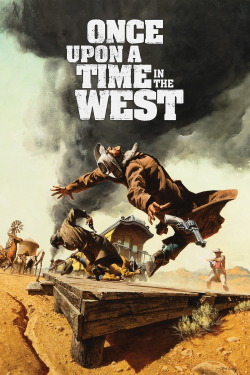
Review of Once Upon a Time in the West (1968) by Edith N — 23 Nov 2012
Not as Shining as We Like to Imagine.
People seem perfectly willing to tell me that this was Henry Fonda's second turn as a villain, but they won't give me any details about the first one. Obviously, he was a villain nothing like the one he plays here, to the extent that Fonda initially turned down the role, but I haven't seen all of the movies he made before this one. I haven't seen a movie where he played a character I would consider a villain. I have seen movies that a lot of people in this made, either before or after--female lead Claudia Cardinale was in both [i]8 1/2[/i] and [i]Fitzcarraldo[/i]--but I don't know what they're talking about with Fonda. I do know that Eli Wallach talked him into taking the part, having enjoyed his own work with director Sergio Leone, but I don't know who had previously talked him into playing the heavy. Or maybe no one ever did, and the whole thing is a lie.
Brett McBain (Frank Wolff) owns a ranch in the middle of the Arizona desert called Sweetwater. On the day that his new bride, Jill (Cardinale), is to arrive, Frank (Henry Fonda) and his gang butcher the entire McBain family. Jill surprises the town by announcing that she and Brett were married in New Orleans a month earlier. This means that she is the heir to Sweetwater. This doesn't go over too well with Morton (Gabriele Ferzetti), the railroad baron who hired Frank in the hopes that Morton would get Sweetwater cheap; it's the only water for miles. Jill finds herself under the protection of gunslinger Harmonica (Charles Bronson) and bandit Cheyenne (Jason Robards). She will lose all claim to the land if she isn't able to build a station by the time the railroad actually comes through. Frank starts thinking that maybe he can be a businessman like Morton, and possibly Harmonica thinks that saving Jill will make up for all the wrong he's done in his past--though he also blames Frank for that, and he's not far off.
In the end, there's no way to be sure that anyone's actions are all their own doing or the responsibility of anyone else. There's some balance, I'm sure, but we can't know where it is. There is no doubt that Harmonica was shaped by what Frank did to his brother all those years ago. I mean, that was seriously messed up. However, there are several possible different responses, and becoming a gunfighter? Not necessarily the most logical. The West is so lawless that the sheriff (Keenan Wynn) can't control the auction of Sweetwater, and it looks as though the thugs hired by Morton are going to throw the whole thing. However, Harmonica isn't part of the solution, much though he clearly wants to be. As just another gunman, he's part of the problem. He's better than Frank; he does what he thinks he's right, not what is best to him at the time, but he isn't working within the law. There is no law to help Jill, and Harmonica is what she's got. But is it Frank's fault?
We seem to idolize the Old West in a way that it doesn't necessarily merit, and though Leone enjoyed directing Westerns, they aren't as romanticized as most of the other Westerns that Henry Fonda made. These are people leading harsh, brutal lives. Sweetwater is a large, impressive building on the outside, but it's no great shakes on the inside. Even if it were, Jill has gone from New Orleans to the middle of nowhere, largely in the hopes of being a beloved and protected wife. She gets to Arizona, and she is no one. She is not a wife or a mother. She isn't even a much sought-after prostitute, which she had been, back in New Orleans. She is, to be honest, the kind of woman a lot of pioneers families have in their histories. It's also worth noting that practically every male character in the movie dies, good guy or bad--and no one is purely good or bad anyway. It isn't the coming of the churches and schools that are bringing morality to this part of the world; it's the coming of the railroad.
I was impressed by the music, I must say. I would listen to some of this just for simple pleasure. And while I'm not terribly interested in watching this movie a second time, I don't think I'd say no to the opportunity to see it on the big screen. My TV, which seemed so big when I bought it, is only average-sized by current standards. This movie really deserves something much larger. I liked it more than I liked the only other Leone film I've seen thus far, but it still isn't something I'd watch for pleasure. I've watched this largely because it makes all the lists, and I do like Henry Fonda quite a lot. I won't say I watch every movie that makes it to the lists I consult; there are some that, no matter how much I respect the source creating the list, I have no interest in watching. I won't watch Woody Allen movies or Martin and Lewis movies, for starters. But I figured, yeah, I'd give this a try. I'm glad I did; it isn't a revisionist Western the way a lot of these movies are, even if it isn't a traditional Western, either.
This review of Once Upon a Time in the West (1968) was written by Edith N on 23 Nov 2012.
Once Upon a Time in the West has generally received very positive reviews.
Was this review helpful?