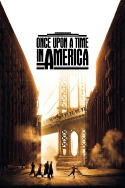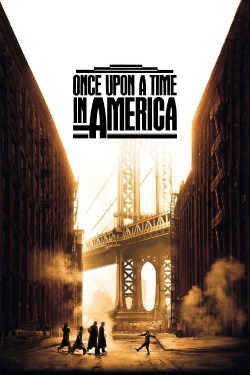
Review of Once Upon a Time in America (1984) by Cameron J — 19 May 2012
I can't tell if this was Sergio Leone making up for not doing "The Godfather" (Wow, and if you though Coppola's version was long enough) or deciding to take such a departure from formula that he not only left the western genre, but didn't focus quite as much on Italians. If he was gunning for the latter, then maybe he could have done a better job when it came to deciding on which other ethnicity to focus more on, because in New York and a couple of other areas, the differences between Jews and Italians are so scarce that I'm kind of against religious compromise, because if the Italian Catholics and Jews were to form a single religion and shake hands, then the universe would probably collapse in on itself from a paradox spawned from two totally tantamount forces colliding. Anyways, mine and I'd imagine Hutton Gibson's crazy theories aside, Leone's supposed departure from Italian over-focus isn't helped by the fact that he decided to make the lead Robert De Niro, and I'm not just saying that because De Niro actually is, well, come on, just look at the name, but because, from the '70s to '80s, if you had a sprawling crime epic that was specifically about "Italians", then you better believe that De Niro was probably somewhere in there. Other than that, and the fact that it was actually produced in Italy and features an Italian-sounding score and a crew of mostly Italians, this film is about as American as pasta and pizza in New York, a location where food like that really is as American as Taco Bell, and it doesn't get any more American than that. It figures that the first time Leone submits and goes full-fleged 'Merican, we go behind his back and give his ultimate passion project a dumbed-down, radically shorter theatrical recut that was apparently so bad that it almost destroyed his faith in film. Granted, he did die five years later, so it's not like we would have missed all that much if he did quit, especially when you consider that this film takes about five years to watch, but hey, if Leone was gonna bail, then he may as well have gone out on a high note (Yeah, because all of the films he did before were so not all that good and wouldn't have given him notoriety), and make no mistake, this was the highest note he had ever hit. Still, not only did this film peak for Leone, in terms of quality, but it also peaked for him, in terms of runtime, because this was by far his longest film, and boy, does he not let you forget.
The film's slow spots are inexplicably quite less tedious than the slow spots in Leone's own similarly titled "Once Upon a Time in the West", and the reason why that's so inexplicable is because, although this film isn't as dull as "In the West", there are many points where the film is just as do-nothing and quiet as "In the West", and it doesn't get much more do-nothing and quiet than that. The reason why this film is considerably less dull might very well be because it, while over an hour longer, or over 100 minutes longer, in the case of the newly rediscovered "Redux" (Those poor movie buffs trapped watching the screening of a movie this slow for four-and-a-half hours at Cannes), is more justified in its mammoth runtime. Still, just because this film's runtime feels more fitting than the runtime on "In the West", that doesn't mean that the sprawling runtime is completely justified, as the film, much like "In the West", finds itself padded by many a gratuitously overlong period of total nothingness, as well as much repetition during actual moments of substance. To make matters worse, the film's focus, as well as its storytelling themes, seem inconsistent, for there are many layers to this tale, yet the transitions between those layers feel hurried and a smidge inorganic, partially because of the film's bumpy jumps between being a surrealistically stylized meditative film to a simple steady drama drive inconsistency into the film's storytelling themes, rendering the final product often offputting in its progression and leaving steam to go dead here and there. I joke about this pretty much being Leone's compensating for his fans for not doing "The Godfather", but this pretty much is the Jewish (Or still Italian, I can't tell) "Godfather", "The Godfadda" (*drum snare*), only it's held back from reaching its high aspirations, due to its unfortunate thematic inconsistencies and dullness consistency. However, at the end of the day, whether it be his passion behind it or what, Leone had crafted what is, to me, quite decidedly his finest film. True, the product's full potential of greatness ultimately goes squandered by its being overambitious and much too flawed, yet you'd still be hard pressed to not be engaged by the film, even with its mammoth length, being secured in by, if nothing else, fine style.
I joke about the score sounding too Italian, but if your an Italian score composer, it's gonna be hard to drop that sound, yet that doesn't make Ennio Morricone's score anymore impressive, which isn't to say that it's quite as stellar as the work he did with Leone where he really did just give up and go Italian with his music, yet it's still very sobering and graceful, with a gorgeous tune to both engage the audience and supplement the spirit of the film. The spirit of the film goes further brought to life by the lively production designs, which bring both the hustle and bustle and broadness of '20s, '30s and '60s New York with classy scope, made all the more attractive by the sweeping observations of cinematographer Tonino Delli Colli. Based on style alone, this film is engaging, yet what truly enthralls is simply the story, which may not be the most original you can find among the gangster genre, but remains layered and pumped with depth, carried by across-the-board strong performances. From the young talents who capture the thrills of adolescence and pain of early maturity, to the effectively brutal criminal performers and always worthwhile Robert De Niro and James Wood - both of whom adopt a stern, yet humanly emotional presence of layered experience, married with pain that you can neither ever get used to or forget -, the performances ring true and help in capturing the soul and depth of this epic drama, especially when they form electric chemistry between the performers, yet also remain mere supplements to the effectiveness forged from the efforts and passion of the film's true star performer: the one offscreen, Sergio Leone. Leone was never the strongest storyteller, and even here, his faults as storyteller prove detrimental to the final product's quality, yet his inspiration for this project remains palpable, for the less urgent moments of the film go riddled with a sense of human liveliness and charm, while the more intense moments go pumped with unrelenting intrigue and sometime razor-sharp tension, made all the sharper by Leone's fine taste in action being used less for spectacle and more for substance, with impactingly not-so gratuitous-feeling violence making the hit harder. Still, what remains constant about Leone atmosphere is subtle depth, which is often too subtle to the point of slowing down the film or even giving it the occasional touch of pretension, yet is more often than not winning, giving the film a somber elegance and consistent intrigue that intensifies the effectiveness aforementioned tones captured so well by Leone and gives the film emotional weight. The film is brutal and unflinching when it's not soulful and deep, and Leone, with inspiration and sobering depth, graces the film with subtlety and ever-engaging intrigue that could have made this film truly brilliant, were it's major missteps cut back, if not cut off, yet makes it an ultimately emotionally and aesthetically rewarding stands, as it stands, making it both Leone's finest accomplishment and his satisfying fond farewell.
At the end of the day and, by extension, the end of the film, slowness and many a long period of nothingness, if not repetition, plagues the film about as thoroughly as its thematic and narrative focus unevenness, rendering its potential squandered, yet still delivered upon enough for the film to really hit, being charged by gripping style and a slew of strong, layered performances, teathered together by across-the-board effective chemistry, while Sergio Leone's inspired and subtley graceful execution of the grit of the subject matter, as well as the charm and rather haunting emotional depth of the human aspects does the most to carry his passion project, ultimately leaving "The Godfadda"-I mean, "Once Upon a Time in America" to stand as a deeply enjoyable and impacting epic that Leone's legendary career had justifiably been building to.
3/5 - Good.
This review of Once Upon a Time in America (1984) was written by Cameron J on 19 May 2012.
Once Upon a Time in America has generally received very positive reviews.
Was this review helpful?