Review of On the Waterfront (1954) by Nathan H — 09 Jun 2014
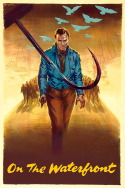
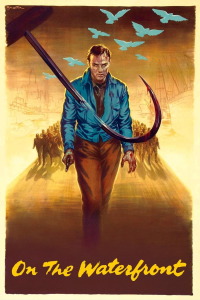
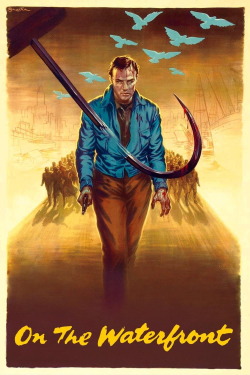
On the Waterfront. Just the mention of Ella Kazan's magnum opus brings to mind black and white images of grizzled longshoremen, run down tenements, and a young, handsome Brando telling us he "coulda been a contender." It won eight academy awards, was selected for preservation by the Library of Congress, and has appeared on practically every critic's short list of the greatest movies ever made. And you'd better believe it belongs there. Gripping and tense, with incredible acting and a powerful message, it was and is a watershed work of cinema whose impact hasn't lessened a bit in the sixty years since it was released.
Much of the film's greatness owes to its leading man. Brando is beyond magnificent. His acting has more facets to it than a diamond. Like an onion, you keep finding new layers as you go along. His gestures, his facial expressions, the way he says his lines in his heavy Brooklyn accent combine in an acting style that's exaggerated yet believable, lending him an incredible and unforgettable presence.
As prizefighter turned harbor bum Terry Malloy he's charismatic, romantic, jaded, cynical, vulnerable, pitiful, sympathetic, and deeply convicted all at once. He's a nobody who knows that he could have been a somebody, a lay about who coasts his way through life on connections and doing the occasional favor for the union bosses. He's a man who claims to believe in nothing but looking out for himself, but whose conscience just won't let him rest until he does the right thing, even if it makes him an outcast- or worse.
His internal struggle between doing the right thing and the easy, safe thing shapes the film every bit as much as the external struggle between him and Johnny Friendly's goons. Both conflicts present a stark contrast between the noble and the base. Just as the dichotomy between the longshoreman and the local bosses is one of hard work and brotherhood against greed, corruption, and oppression, so his choice is between courage and altruism, or giving in to temptation and fear. Yet there's another element to his dilemma that's not so black and white.
If he testifies, he'll be breaking the code of silence that rules the waterfront. The very people he's helping will look down on him as a snitch, a "cheese eater" in waterfront vernacular. What's more, he'll be turning on his own brother, who sits at Johnny Friendly's at right hand and gave Terry every break he ever had. Even when his brother is halfhearted trying to threaten him into staying mum, you can see the love they have for each other and their anguish that they could be on opposite sides of this unfortunate business.
Terry isn't going to take the big step on his own, but he's got two people to give him the push he needs: local priest Father Barry, and Edie Doyle, sister of the man Terry saw murdered. Barry, played by Karl Malden, is the one man who's not afraid of the mobsters running the waterfront; he's angry. Angry that they can continue to prey on and profit from the common folk, that they can get away with murder, that everyone else is scared enough to let them get away with murder. His speech over the body of a worker killed in an "accident" is a profound spectacle of righteous indignation. Only in the same film as Brando does his performance come off as second best.
For her part, Edie, played by Eva Marie Saint, makes the perfect romantic interest for Brando's Terry. Though innocent and somewhat shy, her determination to find out who killed her brother makes relentless and feisty, unafraid to call out those who know more than they're saying. Alone among the waterfront's residents she sees the inherent goodness behind Terry's tough façade, and believes that he can do what's right, and will- whether he wants to or not. And as mismatched as they seem to be, there's an undeniable attraction between them. Together they remind me more than a little of Rocky and Adrian.
Terry's ultimate decision to testify against the bosses is of course a stand in for Kazan's decision to testify before the house, for which he was reviled by many in Hollywood. Whether Kazan made the right decision is beside the point in judging the merits of this film. What matters is that Terry's story is Kazan's retelling of his own story, and that, as much as Brando's acting, is what gives it its impact. Kazan absolutely threw himself into making this movie. As a way of justifying himself, getting back at his critics, and proving that he was one of if not the best damned director in Hollywood, he poured everything he had into the project; and the results are spectacular.
In every scene Kazan ratchets up the tension and suspense, making Terry's dilemma more pressing and bringing the specter of violence closer. The stark black and white cinematography lend the film even more atmosphere, the shadows and unlit nighttime streets heightening the sense of danger as the bleak rooftop vistas bring out the poverty and lack of prospects facing the waterfront dwellers. The tight pacing alternates between scenes of Terry's inner struggle and the more physical battle being waged throughout the neighborhood, never rushing nor letting the movie drag. And when the tension boils over and things come to a head, Kazan makes sure his message is delivered with all the power he can muster.
The moral of this movie is not, as some have interpreted it, that unions are corrupt and predatory or that snitching on your friends makes you a hero. It's that when you see corruption all around you, when people are being hurt or taken advantage of and that's just the way it is, it doesn't matter if there's a code of silence. It's not talking that's a betrayal; of yourself and those around you. There's no honor in protecting men who have no honor themselves. Friends who are willing to see you dead aren't really your friends.
Terry's decision is made more noble because he didn't just anonymously leave a tip or make a statement in the safety of a police station. He stood up on the witness stand in front of bosses and told the whole truth for all the world to hear. And then against all good judgment, he went right down to the docks and told Johnny Friendly right to his face what a loser he was. His decision to let Johnny goad him into a fistfight probably owed more to hot headedness than courage, and even an ex-heavyweight can't take on a whole gang with bare knuckles. But even if he couldn't win a fight against Johnny's gang, he still won the battle. Because what he couldn't do with his fists he did by inspiring others with word and courageous example.
In real life things wouldn't work out so easily, and they didn't. In the true story that On the Waterfront was based on, one dockworker's defiance was not enough to bring down the mob and clean up the docks. But watching Brando take those slow, faltering steps to the loading dock, blood on his face and eyes half closed as every man silently watches, you can absolutely believe that the little guy can triumph and honest men can overcome the most deeply entrenched corruption.
This review of On the Waterfront (1954) was written by Nathan H on 09 Jun 2014.
On the Waterfront has generally received very positive reviews.
Was this review helpful?