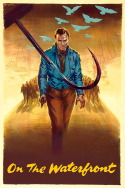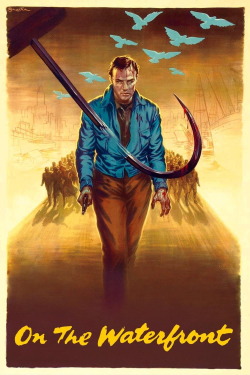
Review of On the Waterfront (1954) by Stephen R — 08 Mar 2010
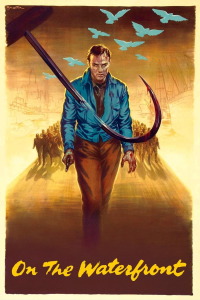
In the opening shot of Elia Kazan's On The Waterfront we see the massive shadows of New York Harbor. Within those shadows we see a group of men moving across the pier. They are the gang of a man named Johnny Friendly, portrayed by legendary character actor Lee J. Cobb (12 Angry Men, The Exorcist). Within that group of men we see a punch drunk boxer, his expression is solemn, but his eyes are alive. That man is Terry Malloy. A bum, as he is so often referred to, not in the common sense of the word, but in reference to his short lived prize fighting career. A career that was surely over before it ever started.
Marlon Brando is Terry Malloy. I don't want to say he plays Terry because that would be denigrating to the stature of this performance. He is Terry Malloy. Watching Marlon Brando's performance is both exhilarating and heart wrenching. Like a Beatles song Brando breaks your heart as you hum along. He's been told he's dirt for so long now it's become second nature, not only does he not refute these claims, but he makes them himself. Yet in those eyes, and in that furrowed brow, scarred from being opened up one too many times, we see a man dying to show the world what he can do.
The New York City waterfront is legendary for it's corruption and brutal tactics, and this is the world that On The Waterfront inhabits. The local union leader Johnny Friendly, with the help of his right hand man Charlie the Gent (Rod Steiger) who also happens to be Terry's brother, has a tendency of getting rid of anybody who would dare to question his supremacy on the docks. "You stand up, the lights go out, than you go out" explains one longshoremen. After Terry is tricked into helping Friendly dispose of one of his enemies, his conscience begins to get the better of him.
Director Elia Kazan (A Streetcar Named Desire) is well known for getting great performances from his actors. Martin Scorsese once stated that anything he knows about acting he learned from the films of Elia Kazan, and while Brando's performance is astonishing it is supported by great performances on both sides of the coin. His past is represented by Cobb's Johnny Friendly, who is both frightening and obnoxious, which must be a difficult combination to pull off. As well as by Rod Steiger's performance as Charlie the Gent, a sort of reluctant henchman. He and Brando share one of the most iconic scenes in movie history in the back of a taxi cab as the movie nears it's climax.
Terry's possibility of a brighter future is personified by Father Berry (Karl Malden), a crusading priest, and Edie Doyle (Eva Marie-Saint), the sister of the man who's been murdered. As the tension mounts and the body count grows these actors have to match the intensity of the villainous characters if we are to believe that Terry would ever go straight. Malden, with his smoldering delivery, and Saint (in her first ever performance), with her baby faced sincerity are both up to the task.
As I re-watched Waterfront today a question popped into my mind. What is it about boxers that make them such interesting subjects for movies? There are great movies about athletes of all kinds of course but certainly no sport has reached the cinematic heights of boxing. Requiem for a Heavyweight, On the Waterfront, Rocky, Raging Bull, The Boxer, Million Dollar Baby, even the recent documentary Tyson, all great films centered on the sweet science. I've thought about it and my conclusion is this. Boxers make a living being punched in the face, it's a totally unnatural profession and should inspire natural sympathy from anyone with half a heart. In Rocky there is a line spoken by Sylvester Stallone "Boxing is the one profession where you're guaranteed to end up a bum." No wonder I, and so many others, like watching these pictures. They're a great example of the magic of cinema. Making a work of art out of lives destined to be forgotten.
This review of On the Waterfront (1954) was written by Stephen R on 08 Mar 2010.
On the Waterfront has generally received very positive reviews.
Was this review helpful?