Review of Okja (2017) by Jack S — 03 Jul 2017
OKJA's.
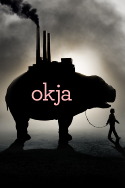
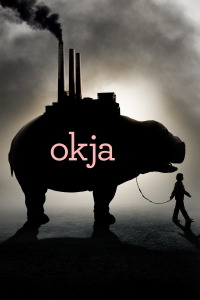
Okja continues Netflix's foray into Hollywood film-making, with director Boon Joon-ho bringing an accomplished, but in this reviewer's opinion, morally flawed movie to their summer roster.
Story.
The year is 2007, and the world is "[in need of] a miracle." Tilda Swinton, who fabulously plays the Mirando corporation's CEO, makes a dazzling entrance at a press gathering in her father's massive defunct factory in, presumably, Manhattan. The cinematography and visuals here absolutely shine. There, she unveils with gusto the company's newest revelation, the "SuperPig", one so large it needs an 18-wheeler to transport. The pigs are eco-friendly and ostensibly GMO-free and all that. They've produced 26 "miracle piglets" by "non-forced" means; they'll be split to 26 farms around the world to the best farms and farmers, their "progress" being measured, of course.
10 years later, we see Mija, in care with her grandfather, spending long, languorous afternoons bonding with this incredible creature (pet?) Okja, who's now grown and full-size. We see her slink away from her bedroom to cuddle with him at night; in another scene, she's brushing his teeth (inside his mouth, no less!) and looking like a half-eaten kiddo. This is as about as compelling a child / pet love story as you get.
Not just your average pig.
Okja shows his uniqueness in a number of scenes. Not only does he - ostensibly - understand Korean, he realizes something no animals beyond humans do - future-thinking and self-sacrifice.
Unfortunately, plots need to move along, and trouble starts brewing - both logistical and moral. The 10-years have come to an end, and that means Okja's due for a visit. Johnny Willcox (well-played by Jake Gyllenhaal), an animal-loving TV-personality and 'face' of the project, arrives with his crew and sizes up the beast, cameras in tow.
Mija is none the wiser, considering this a routine visit; in reality, she's about to lose her best life friend. Before, her grandfather assured her over dinner that he had paid Mirando to keep Okja around and off the chopping block. (And then cowardly turned his attention to a broken TV set.) As the crew arrives, he scurries her off to her mother's and father's gravesite. You can tell how the rest goes.
This is one of the first disappointing notes in the movie - the grandfather's reluctance to be truthful and honest with his daughter. Over 10 years, one would have to be blind to miss the relationship Mija and Okja have developed. He later reveals his true interest - that she go into the city, live normally, and meet a potential mate, not "roll around with pigs all day". Here, we see him care for her future and development, but his betrayal of his own granddaughter is something some filmgoers may overlook due to its practicality, but truly strikes at the heart - you cannot trust your own family. Worse, he handles the affair without dignity - dragging Mija to the grave so he may scold her when she (understandably!) screams in anger, "talking" to her now-passed parents. How shameful.
Capture.
Okja is taken away, and we're led on a bittersweet chase by Mija through Korea. She eventually finds Okja, clamboring onto her captors' truck and towards her destiny. And here we meet the Animal Liberation Front, a fun set of vigilantes led by Jay (Paul Dano). In a scene reminiscent of The Dark Knight (minus the violence), he and his team pull adjacent to Okja's trailer and, clad in black clothes and ski masks, scream to the drivers "we're here to help, we don't want to hurt you." Eventually, the capture truck is sideswiped and Okja rescued.
Okja is - for now - safe. When Jay (Paul Dano) and team (including K, Steven Yeun) sit down to explain their presence and the ALF's mission to Mija, Dano over-acts the expository speech with great bombast; K (Yeun), the only Korean-speaker in the group, translates judiciously, and on Paul's more outrageous lines, doesn't bother. Summing up 10 minutes into one:
The ALF is against violence and is trying to free animals. Mija: "OK, thanks for helping, give me my Okja back.".
But the ALF hasn't come without an extra motive - they need Okja on one more mission before presumably re-rescuing her again. The conversation ends - will Mija give her consent?
K, continuing his translator role, asks. She refuses. In the heat of the moment, K announces "she agrees", and the group cheers.
ALF - really the saintly ones?
The ALF accomplishes what they set out to, but through their antics, we learn their true character. They comprise five or six animal rights activists, punk-rock looking fighters, with two of the men ostensibly in a same-sex relationship, which I'd argue is unnecessary and just adds to the film's "hipness"; a same-sex couple or lack of couples entirely would have a net effect of zero. This is just flourish.
The ALF claims they're non-violent, but in multiple scenes the team can be seen shouting expletives (F-bombs, this film includes aplenty) and fighting back to semi-armed forces. K's mistranslation - later admitted to the team in their operations room - is followed by Jay (Dano's) brutally shoving and kicking K (while on the ground) for his betrayal, and then banishing him. In another pursuit scene, the ALF dumps hundreds of marbles on the ground toward running, incoming Mirando troops; I heard at least one or two back-breaking falls (or concussion-causing?). The ALF seem to - again - have no issues hurting humans in the name of protecting animals.
Language and culture.
The movie attempts for some laughs with cross-cultural language exchange; the hijacking ALF forces have difficulty communicating to the Korean driver from Mirando. No one but K, apparently, has bothered to pick up any Korean (hell, even Mija picked up a basic US English book on her way to the States). And in a cheesy moment filled with cliché, K's character eventually reveals to Jay how "sacred" the translations are to both him and the ALF. Really, K? Jay should learn some Korean, particularly if he's world-bound to spread the gospel.
Deception.
From the first board scene, we see Nancy Mirano (Tilda Swinton) being betrayed by her own second in command, who surreptitiously slides an iPhone - clearly dialed to her twin sister and business competitor - onto a glass table; the viewer, via the low shot, can see a call is active. Nancy's having a breakdown and her sister is being clued in, live. Frank Dawson (Giancarlo Esposito) plays the "right hand man" role well, and much later joins - without flinching - the twin sister after Nancy's fall from grace. Just who is on who's side anyway - this isn't an espionage thriller? Who can one trust? Nancy has a hostile relationship her sister, and her own second in command is a Judas.
In the end.
Okja is beautifully shot and enhanced; we believe Okja is real from the moment we see her. Tilda, Jake, and Okja do remarkable acting jobs. The third act brings resolution, but ultimately, what message was this film trying to convey?
The main messages I left the film with were: the food industry has... issues. And the world is a cruel place.
Grandfather betrays granddaughter, company betrays society via food, ALF betrays its own mission, and sister betrays sister, helped by (ostensibly) her most trusted business comrade.
In SnowPiercer, also by Joon-ho Bong, we see the protagonist and villain stare back at a train-car filled with people fighting for their life using axes and other implements. "Look at them... that is what we are," (paraphrasing), the villain says in disgust. Is Bong continuing this message with Okja? The world is cruel, people are bad; animals are our only salvation.
Final review: 6/10.
This review of Okja (2017) was written by Jack S on 03 Jul 2017.
Okja has generally received very positive reviews.
Was this review helpful?