Review of Odds Against Tomorrow (1959) by Patryk C — 16 Oct 2012
Not That You Want Them to Succeed Anyway.
By 1959, the US military had desegregated. Little Rock Central High School was being desegregated. Buses were being desegregated. Sit-ins were beginning to desegregate lunch counters. Heck, the National Hockey League was desegregated, as much as it ever really has been. However, to this day, there are people who resent this. A current, and depressing, theme in some circles is "put the white back in the White House." And so in 1959, it is hardly surprising that there is a white man who is not interested in working with a black man--even if the job he is not interested in doing with a black man is knocking over a bank. What is much more surprising is that a film noir was made in which the black man was something approaching the hero--a criminal, yes, but a criminal with an understandable motivation. This couldn't have done much at the box office, all things considered--even Nat King Cole couldn't find a national sponsor for his TV show.
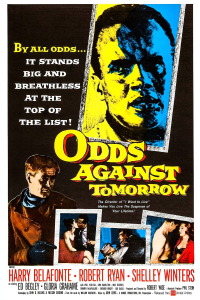
Johnny Ingram (Harry Belafonte) is a gambler. He would be making a decent living as a calypso entertainer, but he gambles and loses and is heavily in debt. He is also being followed by ominous men, who keep an eye on him enough to be able to threaten his ex-wife, Ruth (Kim Hamilton), and their daughter, Edie (Lois Thorne). In order to pay them off, Johnny finally agrees to rob a bank with Dave Burke (Ed Begley). However, the third person in the scheme is Earle Slater (Robert Ryan). Earle is from Oklahoma, which is more Southern than a lot of people realize. He has definite views about blacks, and that does not include the slightest interest in knocking over a bank with one. However, for some reason, Dave thinks that Johnny and Earle are the right people to help him. What's more, neither man has much else in his life. Earle feels that his life is worthless because his wife, Lorry (Shelley Winters), is the one earning the money.
There isn't an awful lot of plot to the movie. It's mostly seeing what kind of people Johnny and Earle are. Johnny resents like hell that his wife is friendly with the white people at Edie's school, and he's afraid that his wife will teach their daughter to kiss up to them. He also conflates "be respectful to" with "kiss up to." Earle, on the other hand, has the kind of slatternly wife that Shelley Winters always seemed to end up playing. She works, and the implication is that she isn't just waiting tables. I'm not sure Earle likes her very much, and I'm certain he doesn't love her. Their upstairs neighbour, Helen (Gloria Grahame in the kind of role she always seemed to end up playing), is fascinated by him, and he's perfectly willing to go along with whatever ends up happening because of that. It also almost seems as though Lorry knows what is going to happen but resigns herself to it if it will make Earle stay around a little longer, if it will make him a little happier.
It's also worth noting that, for all Earle thinks blacks need whites to think for them, Johnny is clearly smarter than he is. Oh, sure, Johnny isn't all that bright in a lot of ways. That's why he ended up as part of this group in the first place, after all. We see the life he could have had with Ruth and Edie, and we see why he doesn't have it anymore. However, we also see that he is at least clever enough to come up with a solution to the one thing that makes robbing that particular bank in the way they've come up with a challenge. Earle's solution is firepower. Johnny considers the problem and comes up with a solution that, in theory at least, won't end with anyone's getting hurt. Though I suppose Earle would spin that as cowardice or something. Doubtless some of the audience did as well. However, I don't see how Earle's plan, such as it was, could have worked in the first place. I don't think shooting would have gotten that door open, and it certainly was much more likely to draw attention.
I also have to say, I found the ending to be a little heavy-handed. I'm going to go ahead and give the spoilers, partially because I doubt most of the people reading this care and partially because I don't really have much else to say about it. The whole thing ends up going horribly wrong in ways none of them could have predicted. (Partially because Earle is asserting dominance in a particularly stupid way, but partially because things just happened.) Dave is dead, and Earle and Johnny are trying to make their escape. However, as you might imagine, those two making an escape together doesn't go well. They still don't like each other, and each blames the other for everything that has gone wrong. And Johnny, for reasons I somehow missed, ends up shooting. And there is this big explosion, because [movie physics], and they are both killed. Burned pretty much beyond recognition. So burned, in fact, that you can't tell the black man from the white man. The End. I mean, I ask you.
This review of Odds Against Tomorrow (1959) was written by Patryk C on 16 Oct 2012.
Odds Against Tomorrow has generally received very positive reviews.
Was this review helpful?