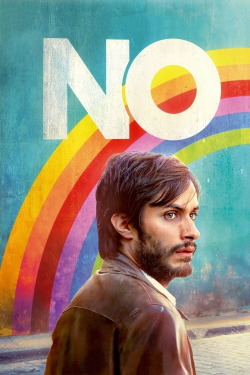
Review of No (2012) by Christopher Llewellyn R — 12 Apr 2013
I just watched this film last night, and loved it. It was nice to see Gael García Bernal in a good movie again. Though I have admired him as an actor since "Amores Perros," I hadn't found any of the films he was in since "The Motorcycle Diaries" to be that spectacular. With "No," however, his usual fine performance is showcased in an equally fine film.
"No" tells the story of René Saveedra, a Chilean advertising executive recently returned from exile in Argentina, who finds himself drafted by the anti-Pinochet opposition to spearhead their ad campaign in the 1988 YES/NO referendum. At that time, in Chile, the government of the military dictator Augusto Pinochet had found itself under increasing international pressure to democratize the country, and so had offered the Chilean people a chance to vote in a plebiscite for Pinochet to remain in power (YES) or against his remaining in power (NO). While his rule was brutal, conditions in the country had improved for some since the coup that brought him to office in 1973. Not everyone hated him. But even those who did hate Pinochet were scared. All indications were that the YES camp would win.
A funny thing happened on the way to the election, however, which is that the disparate forces of the opposition came together around a smart ad campaign. Allowed 15 minutes of TV time every night, each side tried hard to appeal to the Chilean populace. What the NO camp did was remarkable. With humor and optimism (and smart commercial instincts), they created a series of ad spots that inspired over 50% of Chileans to vote NO. Although the Pinochet government tried to fudge the results, there were too many international observers, and the military leaders of the country abandoned Pinochet, forcing him to recognize his loss.
This really happened. And that is what "No" is about. It's a compelling story, brilliantly told and acted.
One of the director's most interesting choices was to film the entire movie using video cameras from the 1980s, so that the look of the movie matches the period in which it takes place. Those folks who want their current cinema to be in high def, 2K, 4K, or beyond, will be disappointed. But if you give the movie a chance, within 5 minutes you'll forget all about any potential image distraction, and may even enjoy the look. I know I did. After all, nothing counts more than story.
One of the director's most controversial choices was to invent the main character of René Saveedra. Many of his fellows Chileans were not happy. Why create a fictional character when the actual story is powerful enough? Why distort history? Good question. I suppose Larraín found it more narratively coherent to do it this way. As a non-Chilean, all I can say is that Larraín effectively tells his tale. I sympathize with those who dislike what they deem unnecessary liberties with the truth, but I also sympathize with artists who struggle to remain true to the overall story with as simple a through-line as possible. Sometimes narrative simplicity is the best way to tell the history of an event of great complexity. What do you think?
Regardless, for this viewer, the movie worked. In spite of its negative title, "No" is a positive contribution to recent filmmaking.
This review of No (2012) was written by Christopher Llewellyn R on 12 Apr 2013.
No has generally received positive reviews.
Was this review helpful?