Review of Ninotchka (1939) by Brett H — 03 Mar 2009
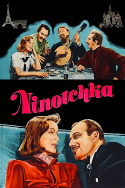
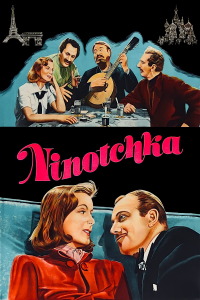
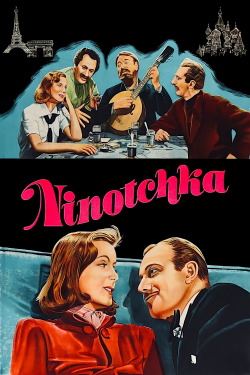
Ninotchka begins with three Russians, who need not do more than appear on screen to be funny, in Paris to sell jewelry seized from the aristocracy during the Russian Revolution. They meet Melvyn Douglas, who plays himself as always, and nonetheless is quite good at it, on a mission from the Russian Grand Duchess who wants to recover her jewels before they are sold. He charms them and winds up talking them into staying in Paris. The Soviet Union then sends Yakushova, the Greta Garbo character, a special envoy whose objective is to proceed with the sale and retrieve the three bumbling men. Garbo inhabits her character like no other could, and it is a complete mystery how. Her countenance is so cool, earthy, foreign, penetrating. The script creates fine moments of humor out of her being inflexible and thoroughly businesslike at first, but it is Garbo who makes it more than funny. She makes you exceedingly conscious of just how farcically pragmatic and robotic she is. And we are just as stunned as she is when she gradually becomes seduced by Melvyn Douglas and the freedom of the West, and falls in love with both. The three Russian stooges also become happily accustomed to capitalism.
And then that is where Ninotchka begins to lose a bit of steam. There are hilarious early scenes, such as the classic bit where Douglas tries relentlessly in the French restaurant to make Garbo laugh (as she famously does) or even crack a smile. The beginning, when Douglas is corrupting the three Russian guys, is directed with a novel approach, one that adds to its tongue-in-cheekness, by Lubitsch, depicting most of it through the reactions of the maids and cigarette girls who enter and exit the hotel suite and the reactive sounds of the Russian men within the room. But during the second act, the movie takes a less than graceful turn for the more dramatic for the sake of being very loudly pro-capitalist, anti- communist propaganda.
I don't say that it loses its impact in this manner because of any personal feelings about its agenda. Actually, its saving grace comes at the very end with an unexpected joke that satirizes capitalism. Rather it is the fact that it becomes almost entirely about its agenda instead of following through with the promising spirit of its first half. In spite of this, Ninotchka is a decent entertainment.
This review of Ninotchka (1939) was written by Brett H on 03 Mar 2009.
Ninotchka has generally received very positive reviews.
Was this review helpful?