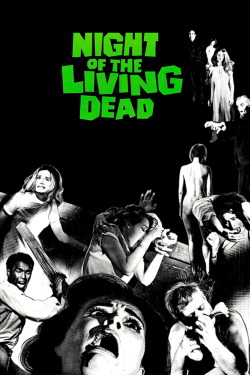
Review of Night of the Living Dead (1968) by Allan C — 16 Jul 2018
The granddaddy of modern zombie films and arguably also the progenitor of the modern day horror film. NOTLD's story should be familiar to modern horror audiences, even if you've never seen this film before, as this film's influence on survival horror films cannot be emphasized enough.
The recently dead mysteriously rise and come to life to mindlessly feed on the flesh of the living, who then in turn become the undead themselves to create more undead flesh eaters. The film follows a disparate group of survivors who have found shelter in an abandoned farmhouse where they barricade doors and windows, share information/stories about what they think is going on outside, bicker amounts themselves over what to do in the situation, and all of the usual tropes we typically see in horror siege films.
Writer/producer/director George A. Romero gets credit with this film for creating the "rules" for zombies (i.e. zombies are slow and dumb, anyone who dies will rise to feast on the living, you must destroy the brain to kill a zombie, etc.
), in much the same way Bram Stoker made established the rules for modern vampire depiction with Dracula in 1897 or how Curt Siodmak established the rules for werewolves with his script for "The Wolf Man" in 1941.
Romero's zombie rules are taken for granted at this point, but it's a major achievement that may not be quite appreciated, to have essentially invented a movie monster that has continued to endure for over than 50 years.
Romero's zombie rules have been followed by most zombie movies up until "28 Days Later" when filmmakers and authors started playing with the rules (much the same way that's been done with vampires and other creatures of the night), but Romero's rules have still been adhered to by everything from Max Brooks' "Zombie Survival Guide" to Robert Kirkman's "The Walking Dead.
" Without "Night of the Living Dead" we would never have had the many end-of-the-world classics like Lucio Fulci's "The Beyond," Sam Raimi's "Evil Dead," Stuart Gordon's "Re-Animator," Robert Kirkman's "The Walking Dead," Charlie Brooker's pre-Black Mirror TV mini-series "Dead Set" or the above mentioned "28 Days Later," not to mention a ton of great zombie fiction from authors like Stephen King, Joe R.
Lansdale, and Brian Keene, or some great tongue-in-check zombie films like Grindhouse's "Planet Terror" or Simon Pegg's "Shaun of the Dead," or some fun lesser but entertaining zombie films like "REC," "Dead Snow," "Dead Alive," "Zombieland," "Le Horde," "Shock Waves," "Juan of the Dead," "The Dead," "Night of the Comet," "Demons," "Pontypool," "Return of the Living Dead," or the super gory "Zombie 2" (Wondering about Zombi 1? Romero's sequel to NOTLD "Dawn of the Dead" was released in Italy as "Zombi" and this Italian production was marketed as a sequel).
Romero also gets credit with "Night of the Living Dead" for establishing the horror film siege scenario that's endlessly been used to this very day (everything from "Assault on Precinct 13" to "Aliens" to "From Dusk till Dawn" to "The Mist" to "30 Days of Night" to "The Purge").
Sure there were siege films going back as far as "The Lost Patrol" or "Rio Bravo," but Romero established the plot, story, and genre elements that remain strong to this dya. The cultural influence of this "Night of the Living Dead" cannot be emphasized enough.
Looking at the film on it's own, Romero doesn't just tell a zombie siege film story, but also injects a smart political subtext into the film about race relations. Ben, a black man, and Mr. Cooper, a privileged white man, clash throughout the film as to if it's better solidly barricade themselves in the basement or to stay upstairs with the partially barricaded doors and windows to have a potential path for escape if needed.
It's notable that Ben has the only gun in the film and Mr. Cooper desperately wants to literally wrench it from Ben's grasp to take control of the situation. For a film in the 1960s, it's quite provocative to cast a black man in in the heroic lead role, telling a group of white people what to do.
Romero admitted that he didn't write the character of Ben as a black man, but that after casting the excellent Duane Jones, the story began to take on these elements of race and politics. SPOILER ALTER! At the end of the film, it's undeniable when Ben, the only surviving member of the group, is casually killed by a redneck posse and his corpse thrown on a bonfire, quickly followed by black & white newspaper photographs of the incident, that the audience would think of the recent assassinations of Martin Luther King Jr.
and Malcom X. "Night of the Living Dead" also works as a Cold War parable for US involvement in Vietnam. The US has better technology and know how, but were overwhelmed by the sheer numbers and the relentlessness of those who they were fighting.
So overall, although the acting is admittedly not the best (except for Jones) and the production values are pretty low, "Night of the Living Dead" is a classic that has greatly influenced innumerable books, movies, comics, TV show, and popular culture ever since and in ways than cannot be over stated.
This review of Night of the Living Dead (1968) was written by Allan C on 16 Jul 2018.
Night of the Living Dead has generally received very positive reviews.
Was this review helpful?