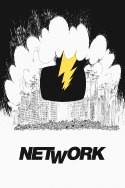
Review of Network (1976) by Matt P — 09 Oct 2011
"This was the story of Howard Beale--.
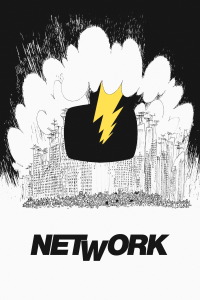
Sidney Lumet's audacious film "Network" has put behind 30 years, and to be quite honest, never held as great of importance as it does today. Not to say the film was groundbreaking for its time, I don't see why anyone would consider it an unnecessary film. Like the power of the the media and the corrupt execs behind it the topic this film addresses is a necessary evil. Filmed like a network cable show, it's about an old newscaster named Howard Beale (played by the late Peter Finch) who, without recognition, is a product of his environment. Beale is a man who over the years, grew dis-sensitized to the lies and conceit his work throws out to the American people. As explained in an intense monologue by Ned Beatty, the media has more power than the American government. They control everything ranging from the price of rice to the next big homicide. Why is it news to everyone, and why is it such a big deal? Because virtually everyone watches television. Everyone is owned by it. When Finch's tired and mentally ill character takes wind of this, his own company (headed by an even bigger corporation that has the power to broadcast a public assassination) uses him for propaganda as a marketing purpose.
There are other, more stable characters involved in the degradation in Howard Beale. But as the film progresses, and Beale's rants appear for factual, we realize characters like Diane (Faye Dunaway) or Frank Hacker (Robert Duvall), the head of the CCA are more or less just as crazy and just dehumanized. They have radically become consumed by the corrupt corporation they created. William Holden plays the vice president of UBS (a rather ironic name when you consider the first thing Beale exploits is the "bullshit" he's been fed all these years) who's lost sight of things wholesome and true. Bewildered by the control of television, he seeks solace in Diane (the woman who took his job) as he will do anything for her to prove his love. What follows between the two is what you see when an old-fashioned TV man gets affiliated with a modern day spoiled princess--particularly one who finds dedication only to her work and not with her spouses. I don't think I have to go much into the performances of Dunaway and Holden, they both did marvalous jobs playing eachother's opposite. The scenes they share together are well written and acted intensely. Peter Finch is the real actor though that highlights the movie. It's almost as if his death was forshadowed (not to sound morbid), and his character's legendary monologues and quotes might not have ruptured and hit home with his had it not been for his quick passing. His Oscar win was only expected.
If you look at the film from the standpoint of a simple American person, one who would watch the "Howard Beale" show every night consecutively. Due to the fierceness of his dialogue, and the harsh vocabulary you couldn't help but chuckle at first. Afterward, you might tend to take the show a little mroe seriously. In the end, what you realize is what this "prophet of television" is screaming about just might make sense. And although it goes against the laws to use profanity on television, you might realize it goes against the laws of human nature to use this man to make profit. Beale gets wind of this too, and when he opens his mouth to expose the links between rich tycoons and foreign terrorists the result is quite devastating. How would it look to the people? Perhaps it was a psychopath who didn't agree with what Beale was ranting on about. Maybe he (or in this case) we ALL need the bullshit of television to comfort us in our daily lives. After all we're dealing with a recession, a war and even a scandalous president. Put into equation the many sorts of people that can arise from all this chaos. Is Howard Beale one of them? Howard Beale used to be a well paid newscaster for a prestigious television company. If Howard Beale could "stoop" to the level of insanity of say, Travis Bickle (coincicentially another controversial classic emerging from New York, 1976), than what makes Duvall's character Hacker or Diane (Dunaway)'s less evil? "Network" raises not only the conspiracy theories behind the media, but the forces that drives them and the ridiculous reasons they're done in the first place.
Today, with all our iPods and iPhones and high speed internet we don't even necessarily need television. It's all in our pocket, we can flip it out in a second! But if you just imagine the madness this movie set out to capture, the exploitation seen through intense performances and pedantic dialogue, it's frightening to imagine how that power could be yielded today. Perhaps rather than sit in a room watching a television and only come out on occasion we never come out at all. And when we do, we all communicate via text message, or "Skype." Or we become reclusive and angsty because "she didn't accept my friend request" (here, it's inevitable for me to reference "The Social Network," which in some ways I feel is relaying a similar message to America as this film is).
It takes a lot of balls for one man to stand up and say, "I'm as mad as hell, and I'm not gonna take it anymore," but one quick phone call or so to pull the plug and, in some people's cases, end the world. Because they're so fascinated by what they watch on the tube (Beale says less than 15 percent of people still read books, today I'd say that's a good 50 percent) they'll eat up whatever bullshit they want. Everything can be ended quickly. Whether or not Beale's a prophet like the film suggests, it's not so much a biblical statement as it is a reality check. When you look down in the history books of what happened and why it did, the narrator will humorously tell you, "this was the story of Howard Beale..." thus cynically wrapping up in a nutshell how those rich tycoon, TV execs don't care for how Americans and people all over the world are becoming dehumanized by the media.
--the first known instance of a man who was killed because he had lousy ratings.".
This review of Network (1976) was written by Matt P on 09 Oct 2011.
Network has generally received very positive reviews.
Was this review helpful?