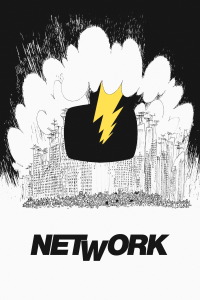
Review of Network (1976) by Logan M — 09 Aug 2016
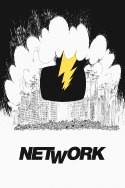
So you always thought you had what it took to be a network TV star, eh? You believed in a certain kind of spoiled freedom that could never bring you a bad day? You thought you had the guts to be a network producer? You thought you could sling mud and never stop to have a conscience? When one stops to think where corporate media has gone, one should try to imagine what the players behind the scenes might look like to get a picture of how different the world they live in is from the viewers' playfield; it's the difference between an MLB star and a town softball player. Sydney Lumet exposes this branch of the ruling class in a film that pits young versus old, freewill versus discipline, exploitation versus morality, capitalism vs. all the other isms. It exposes the audacity in humanity's struggle for power, as well as the inevitabilities.
The first 10 minutes are so bold that they give the sense of being an hour and a half into any other movie; a backsliding old news anchor, Howard Beale (Peter Finch), announces he's going to commit suicide live on national TV after having enough of the world's newfound direction. From there the phones are ringing, the networks are talking; one of TV's most prominent and respected anchors has gone mad. But the film viewer is seeing more than what the society in the film sees, and coming from a point of empathy for old-school liberal newsmakers, bombarded by a new generation of anarchic corporate media, we quickly understand why Beale's closest friend, and the head of UBS' news division, Max Schumacher (William Holden), wants to give Beale a chance to rectify before retiring. Beale's second chance on-air becomes a follow-up to his first spiel, the path of madness catching the eye of a spunky, hot, fresh, young producer from the programming division of CCA-UBS's corporate conglomerate, Diana Christensen (Faye Dunaway). One night Beale walks on-stage in his pajamas, soaking wet from the rain, and announces on TV that he wants everyone to stick their out a window and yell, "I'm mad as hell and I'm not gonna take it anymore!" Max sees and hears the screams of real people responding to Beale, further uneased by his defeat. Corporate media brainwashing is complete and the machine keeps rolling, having the audacity to snatch a communist party along its path. Enter the death of news and the birth of sensationalism. Diana has a plan to exploit Beale's rants and raves for ratings; she's out to please the moneymakers in the corporation. Beale accepts this opportunity to be a philosophical preacher, getting sucked into a consumer-demand concept that's designed like a late-night TV stage. Now we watch the fast descent of what Max would consider "decency" in media's influence.
Paddy Chayefsky's script was an intriguing cinematic exploration for Lumet. Whenever watching the higher classes battling onscreen, it manifests fear and paranoia into its average middle-class viewer, sensing how we are rocked back and fourth by opposing ideologies, such as we see between Max and Diana. It's this opposites attract love affair which keeps America running. But in this film, the fighters of common decency are losing, outnumbered by capitalists, and the audience sees and feels their reactions to loss, whether it be Beale screaming like an evangelist preacher or Max successfully seduced into Diana's deceptive sexuality. Most of the old men are rebellious to characters younger than them, yet at a certain point are revealed susceptible to the poisonous spunk generated from their liberated youthful opponents. That ever-attractive artistic trait called irony is present. Beale's character on TV gains viewer popularity by making enemies with the very people empowering him to be there. Max finds himself "in love" with the very woman destroying his career, a woman who hustles him and reveals his corruptible side, that he'd leave his wife of 25 years to be involved with what's destined to only be a crush. I'm always personally interested to see a 'sleeping with the enemy' love affair, one that's sparked by self-rebelling addiction. Max is that hero you want to see hold his ground, but he's also a helpless, tempted pawn in Diana's power game. By the time they're making love, she's already beaten his career, but she herself is attracted to her defeat of him, only temporarily. This is a film written with absolute search for truth.
Sexuality wins. Greed wins. Lumet taps into the real desire and corruption within people, the itch for tasty poisons, and shows why it stains idealisms. Such is revealed when the communist spokesperson Laureen Hobbs (Marlene Warfield) is faced with a profitable offer from Diana to air a reality show about her cause. Hobbs tries to hold her ground, but before too long she's complaining to her party superiors about the achievable self-fulfillment over the preached righteousness of collectivity. Like Hobbs, Max tries unsuccessfully to maintain his ethics, but with Beale bought and sold he's down an ally, having to painfully watch a friend empowered by his delusions of grandeur and drunken loneliness. And Diana is relentless in her pursuit to suck them all dry, encouraging the idea that Beale is genuinely spiritually imbued.
Its amazing watching this film in the year 2011 and thinking of how concepts discussed in 1976 were prophetic; terms like "corporate conglomerate" and "recession" were not as popularly used then as they are now, and it shows Chayefsky had an intellectual ability to predict a future we should've taken warning to. The recession shows powerful people profiting, that a recession could be advantageous, also a concept foreign to the common associations of recession-depression at the time. Another unique element for this time is conspiracy theory, something much more practiced in today's YouTube generation, but startling to viewers at the time. Beale is often screaming about such theories, but Lumet doesn't belittle the audience watching the film, as even the modern YouTubers do. In Lumet's intellectually sound way, he belittles the live audience watching Beale in the film, using a particular shot from behind Beale that blatantly shows stage lights in frame, shaping a flare around Beale's body that suggests a conscious perspective of how a camera and television are such loud, demanding tools of attention, all while hearing him scream that he's a "liar" and an "illusion." If there's a lack of correctness Chayfesky had in predicting this scenario, it's the assumption that Beale's squealing of corporate conspiracies would remotely fluster the corporate execs. In reality, corporations have had the last laugh on the preachers, creating a mad sense of silliness for their existence while the network stars themselves play into the sly humor; remember, when Universal and NBC were merging under the GE banner, how much Conan O'Brien would reference the merger with a certain sort of common misery about his job? His humor cleverly spoke to the heart of middle-class America and was cause for lighthearted laughter, effectively downplaying the reality of the power shift. But when UBS executive Frank Hackett (Robert Duvall) is yelling at his fellow UBS team, and the room breaks into verbal battering and finger pointing, we're given a stronger sense of optimism than is present in reality, optimism in the sense that these greedy capitalists may have a fail point. Yet being that it's a threat driven by the almighty dollar, it remains consistent with the caricatures. Diana is the voice of reason amongst vampires, reason defined as nailing a coffin to Beale's murdered career; we're being buttered for an elaborate joke about "killed ratings," and poor Beale will have to suffer the joke. Before this happens, Ned Beatty steps in to deliver the performance of a lifetime as Arthur Jensen, a former salesman turned corporate hypnotist whose manipulation quickly grinds into Beale's trigger points, walking into a rarely accessed executive board room, akin to the gods of Valhalla as Jensen himself points out. The powerful room is darkened, giving Jensen a spotlight to now speak to Beale as Beale speaks to his audience, a reverse psychology imprinting Beale with a newfound peace for all he's been ranting about. But turning Beale against his radical ideology turns his audience to another channel, and thus Diana's plan to fix the situation is of ultimate devilry, total lack of humanity, and all around zero business ethics: kill the problem.
Pretty much everything we see in Network happens in reality, making this not a mind blowing or life changing film, but confirming feelings of fear and pessimism towards a greed-controlled world and the personal damage it can cause. Max Shumacher's damage was being obsessed with a woman tied to the capitalist code, his 25 year marriage thus turning to shit, allegorically tying to the backdrop of societal damage and zombified viewers obsessed with envy channeling through airwaves. Like network and cable television alike, the structure of Chafesky's script is to move from one audacious moment to a further audacious moment, as the evolution of TV has suggested, reminding the audience that these people will stop at nothing.
This review of Network (1976) was written by Logan M on 09 Aug 2016.
Network has generally received very positive reviews.
Was this review helpful?