Review of Nashville (1975) by Oaks B — 17 May 2009
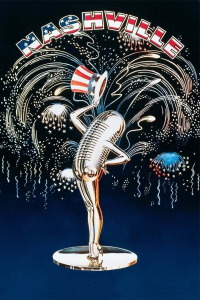
Widely regarded as one of Robert Altman's very best films and one of the best films of the 1970s, "Nashville" could perhaps best be described as a fully American tapestry of a film. Weaving together no less than two dozen characters and featuring a full hour of music, "Nashville" gently unfurls over a five-day period in Nashville, TN, the country music capital of the world. During this time we get a glimpse into the lives of the stars and the hopefuls, industry types and politicians, groupies and town inhabitants, and various historic locations of the city itself.
On the broadest level, "Nashville" is a look at the country music industry and particularly, the facets of the American idea of and focus on the concept of "celebrity." Some of the characters are known country music "stars" (invented for the film) and many others, like Barbara Harris' vagabond Albuquerque and Gwen Welles' deluded Sueleen Gay, are hopefuls, attempting to navigate through the rough and often unforgiving terrain of the music industry. Real celebrities Elliot Gould and Julie Christie are brought in at points in cameos playing themselves (a sly wink from Altman, as they were the stars of "MASH" and "McCabe & Mrs. Miller" respectively, Altman's most highly regarded films to that point). Additionally, the most prominently celebrated characters within the film are based on real country stars: Barbara Jean and her husband-manager Barnett can be linked to Loretta Lynn and her husband-manager Doolittle Lynn, Tommy Brown to Charley Pride (the only African-American performer admitted to the Grand Old Opry), Keith Carradine to Kris Kristofferson, and the feuding folk trio in the film to Peter, Paul and Mary, to name a few.
There is a thematic tie-in to politics in the film, as one of the plotlines weaved into "Nashville" involves the presidential hopeful of a start-up political party, Hal Philip Walker of the "Replacement Party," who we never see but hear in speeches transmitted via megaphones on a van that travels around town. On a slightly deeper level, the film could be seen as commenting on the link between celebrity and politics - couldn't it be said that politicians, in their quest for social prominence, are only seeking a slightly different sort of celebrity? Country music, with its innate topical emphasis on traditional moral value systems, not to mention its patriotic and religious sensibilities, was an excellent choice with which to explore this link. To boot, the first musical number in the film is a patriotic ode to America centering on the verse "We must have been doing something right to last 200 years." The fact that Tennessee has, in all but one case by the time the film was made, always voted for the winning presidential candidate is mentioned several times. God and religion are also prominent themes of interest throughout the film, as they are prominently recurrent subjects in country songs, providing another link in the film's metaphorical view of the "country" of the USA as a whole, one of the most deeply religious in the world. In a section taking place during a Sunday morning, Altman gives us glimpses into the characters' various religious lives by taking us through the different churches and congregations around town - a fascinating aspect of this film which not only gives us intimate looks into the aesthetic and musical backgrounds of these different sects (of Christianity, all) but giving these fascinating characters immediately recognizable markers of their backgrounds and one assumes, subtly inherent alliances and perspectives.
At its core, "Nashville" is an emotional film whose strength ultimately hangs on the wide spectrum of its characters' hopes and desires. Like other Altman films, there is not any sort of typically pointed story structure going on here but an emotional progression from one scene to the next and from the beginning through the climactic ending. The music does wonders to compliment and color the characters' inner lives as well, directly and indirectly throughout the film. At the Opry, Henry Gibson's fancily dressed, middle aged showman Haven Hamilton sings a song about bringing a love affair to a close: "For the sake of the children, I must say goodbye," goes the song. Later in the film, in one of its most stunning and complex scenes, Lily Tomlin's character Linnea Reese, a gospel-singing mother of two deaf children, has slept with Keith Carradine's Tom Frank, a narcissistic and womanizing celebrity who beds several of the female characters (while playing his own album on the stereo) but instead of objectifying Linnea as he has with others, he regards her with genuine interest and admiration. He asks her how to say "I love you" in sign language and then signs it to her, which is the only time we see him express anything of the sort to any of his lovers. She gets up to leave earlier than he'd like, and he phones another lady admirer in front of her in an attempt to wound, but she is unresponsive and leaves. For the sake of the children, she must say goodbye; a real emotional connection continues to elude this lonely man.
Stylistically, "Nashville" is pure Altman: the large ensemble cast is no surprise here, neither is the overlapping dialogue nor the director's refusal to adhere to anything resembling a traditional three-point plot structure. Three characters seem specifically present to further the plot: Geraldine Chaplin as the kooky BBC documentarian Opal serves as something of a surrogate for the audience, exploring Nashville from the point of view of an industry outsider, and Shelley Duvall and Jeff Goldblum's characters (a skinny, outlandishly dressed California groupie and a motorcyclist who performs magic tricks) act almost expressly as visual threads sewing together the subplots, wandering the landscape of the film and making appearances almost at random. Elsewhere, Hal Philip Walker's speeches employ Altman's attendant use of diagetic voiceover via broadcast, and in fact, all of the music in the film is performed by its characters and thus completely diagetic, which adds to the naturalistic feel. More than any Altman film that I have seen to this point, "Nashville" successfully navigates through often stark changes in tone, juxtaposing tragedy with comedy, and this works on a naturalistic level because the film doesn't dramatize the lives of these characters, it simply reports them. Altman's camera is objective; we the audience are given the freedom to react naturally to the events therein.
A true reflection of people we experience in real life, some of the characters of "Nashville" are not what they may seem on the surface. Haven Hamilton, for example, comes acrost as a somewhat oily and demanding country star at a first glance, but reveals himself to be a good man despite his star posturing: when Barbara Jean and he are shot at the end, he responds in the right way, ushering her to help and sharing words of perseverance and hope with the audience as his arm bleeds from a gunshot wound. Considering his short stature and hairpiece, Haven's pompous demeanor and flashy bejeweled wardrobe could likely be an overcompensation for his own insecurities and a reaction to the pressure of maintaining a public image as a country music celebrity. Altman delights in giving us clues - some more readily visible than others - as to the relationships between these characters' inner lives and their outer appearances.
This subtlety in creating multi-layered and tangibly human characters is easily identifiable as one of Altman's primary goals as a filmmaker, and with "Nashville" he succeeds to such a degree that the film is undeniably heart-rendering. Not every character in "Nashville" may be exactly likable in a traditional sense, but in Altman's vision neither do they deserve your contempt: we all have our motives and our desires, our objectives and the ways through which we achieve them, and the ways we cope with our stresses and disappointments. Nashville could very well be Altman's most human film, and because of that it may also well be his best.
This review of Nashville (1975) was written by Oaks B on 17 May 2009.
Nashville has generally received very positive reviews.
Was this review helpful?