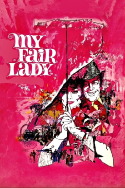
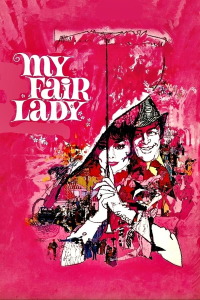
Review of My Fair Lady (1964) by Dean M — 17 Sep 2010
My Fair Lady is a faithful adaptation of the stage musical, incorporating most of the songs and all of the major plot points, with a few licenses taken here and there. The adaptation is so faithful, Harrison reprises his role as Higgins, a role he originated on Broadway with Julie Andrews playing Eliza. Thus, he may well be the perfect choice for the irascible Henry Higgins, a character offensive to the modern idiomatic relationship between the sexes, if such a thing exists. He was able to play the anti-woman professor with stalwart wit and no-nonsense obstinacy, until the looming possibility of losing Eliza begins to dawn upon him, and then Harrison depicted the slow-melt of Higgins' icy heart perfectly. The only problem with this performance is that Harrison employed speaking-singing more than straight singing for the predominance of his musical numbers, a fact which worked in some of his solos, such as "Why Can't the English?" and "An Ordinary Man" but which ultimately failed, undercutting necessary emotion, in key pieces like "I"ve Grown Accustomed to Her Face." Watching the film, it begs the question as to how Mr. Harrison chose to perform the role on Broadway, where singing is as necessary as breathing.
Of course, Mr. Harrison speak-singing all of his numbers is far better than over-dubbing Audrey's voice for the majority of Eliza's solos. When Hepburn's singing voice was deemed "inadequate," she was dubbed by singer Marni Noxon. Old clips of Audrey doing some of the actual singing show that while her voice may have been unrefined to an extent and in need of technique, she added character to the numbers that did not exist in Noxon's more technically apt renditions. The inclusion of Noxon's vocals, while pretty in their own right, made Audrey's wonderful facial characterizations seem surreal and a bit out of sync with the rest of her character and the film. At the very least, Audrey should have been allowed to vocalize more of the strictly Cockney songs (other than "Just You Wait"), while Noxon sang the more traditionally vocal songs such as "The Rain in Spain" and "I Could Have Danced All Night," soprano pieces with which Audrey might not have been able to to achieve the full vocal range in pitch.
Aside from these minuscule flaws, My Fair Lady is an enjoyable film. Directed by George Cukor, he made good use of the tailor-made Edwardian estate constructed for Higgins' home by staging much of the action upon and around the home's inherent levels, such as inset staircases. The choreography was not particularly complicated but generally matched the time period depicted. Overall, the film succeeds because of the charm of its leads and supporting performers, particularly of Hyde-White and Holloway, and because of the attention to detail paid in technical elements, such as the art direction (the backdrop of what is supposed to be Tottenham Court road in the 1910s is quite something to behold) as well as the beautiful costumes. The costumes for Eliza, in particular, are breathtaking. In fact, the film won several Oscars for technical achievements in art direction, cinematography, costuming, and so on. Oh, it also earned statuettes for Best Picture, Director, and Actor.
Ultimately, My Fair Lady is as pleasant as Pickering's afternoon tea or as lovely as rain in Spain that falls mainly on the plain. The only problem with the film, other than the overdubbing and the idea of Higgins' as a character - and Harrison's lack of willingness to use melody in most of his musical phrasings - is a concept that was inherent to the original musical version but not to the original Shaw play. In Pygmalion, Eliza does not ultimately return to Higgins after his final show of lacking appreciation for her willingness and her efforts to facilitate her own transformation. In fact, the relationship Shaw constructed between Eliza and Higgins is not meant to be romantic, as is implied in the film, but is meant to be one of mutual respect and friendship, which the two parties earn from each other in different ways before Higgins, through the faults of his inherent nature, withdraws that respect. Shaw's Pygmalion is, in many ways, the superior story where Eliza's character is concerned. Still, that Cinderella component creeps into the stage musical and into the film, right down to Higgins' obsession with his slippers; as such, it's hard not to be drawn into such a romantic notion. If nothing else, the Lerner and Loewe melodies and lilting score derived from those melodies are beautifully constructed and catchy and have the ability to hook the viewer as much as any other single element of the film.
This review of My Fair Lady (1964) was written by Dean M on 17 Sep 2010.
My Fair Lady has generally received very positive reviews.
Was this review helpful?