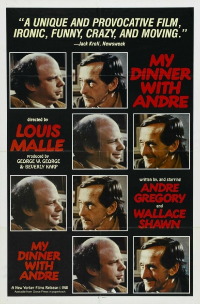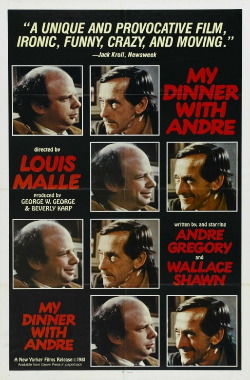
Review of My Dinner with Andre (1981) by Adam G — 18 Aug 2009
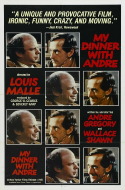
Recently I made a resolution to own and review more Criterion editions of films and I?ve made plans to purchase one a month. This month?s is Louis Malle?s ?My Dinner with Andre?, though attributing it as the property of its director would do a great disservice to screenwriters Andre Gregory and Wallace Shawn, who also play the film?s main characters. It had been a few years since I?d seen it, and while it unfolds in a simple and unforgettable format ? two men sit in a restaurant and talk ? I had forgotten exactly what about their discussions had made it such a fascinating oddity in the back of my mind.
The film opens with shots of Wally traveling across New York City to meet Andre for dinner. Wally is a meek and nervous playwright who spends his days performing the errands of the playwright who hasn?t yet had a success. He has a girlfriend and worries about paying his bills. Andre is a former colleague and close friend of Wally?s. Once a successful theater director, Andre all but disappeared from the country and the two haven?t seen each other for years. Stories have been circulating about Andre?s recent strange behaviour and emotional instability. A friend insists that Wally meet with Andre, who was discovered weeping against a wall after viewing an Ingmar Bergman movie. ?He had been seized by a fit of ungovernable crying,? Wally explains, ?when the character played by Ingrid Bergman had said, ?I could always live in my art, but never in my life.??
Andre appears excited and refreshed as the two men sit down to dinner in a fancy restaurant. After pleasantries are exchanged, he begins to tell Wally stories about his travels to Tibet, northern Scotland and the Sahara, relating his strange experiences abroad while Wally sits in awe, never quite knowing what to add. Indeed, for the first half of the film, Wally sits nearly silent, offering only small bits of insight and trivia that cannot possibly be latched to Andre?s wild tales of being buried alive and traveling with 40 non-English speaking Polish thespians into a forest as an exercise to rediscover his interest in the theater.
Eventually, however, the crux of the conversation comes about and the playing field is evened. Andre has been desperately trying to figuratively wake himself up from what he views as a life of tedium and mechanical action. Wally opens up more and more as they discuss themes of loneliness, love, art, existentialism and what it means to live a worthwhile life. The conversation flows eloquently and the men seem to always be dancing close to a series of great discoveries before they move on to new territory. Small, humourous bits of irony are injected when the waiter approaches at certain moments. The conversation feels free-flowing, but there is a precise attention to detail that envelopes its audience.
What makes the conversation especially fascinating are the obvious character differences, both in their physical appearances and their thoughts on existence. Wally enjoys his comfortable life. He likes a cold cup of coffee ready to sip when he wakes up in the morning. He enjoys his electric blanket and reading the autobiography of Charlton Heston. Andre believes that humanity is becoming too attached to its comforts and that they are becoming pushovers politically as a result. As his arguments bring Wally out of his shell, we admire Wally for his honesty and simple way of expressing himself, while Andre?s observations continue to amaze.
Andre?s stories put the film on the level of many an action blockbuster. His dialogue is delivered with the focus and attention to detail of a storyteller that has an entire room hanging on his every word. Images of his descriptions leap to the mind and build an impression of Andre?s world better than special effects ever could because they are presented with the passionate belief of a man who has just found religion. The film?s screenplay was pieced together by the men based on conversations the two shared in life and recorded. Beginning with a 1,500 page script, the film was carefully pared down to its essential themes by Shawn, Gregory and Malle.
?My Dinner with Andre? is as current in its exploration of human connection today as it was 30 years ago, and that?s a scary fact to admit. So many of us get older and find it nerve-wracking or even a waste of time to sit down with another person and have an honest and direct conversation about how we are living our lives, more than likely because we?re afraid we?re not getting it right. Life is the most fascinating and most important topic of conversation there is.
Perhaps we are afraid of talking about life because it is inevitably entangled with the subject of death. The modest Wally observes: ?If I understood it correctly, I think Heidegger said that if you were to experience your own being to the full, you would be experiencing the decay of that being toward death as part of your experience.? If we are able to live only in art, our guaranteed fate in life will take us by surprise, slowly and tragically. There is no shame in trying to understand it.
This review of My Dinner with Andre (1981) was written by Adam G on 18 Aug 2009.
My Dinner with Andre has generally received very positive reviews.
Was this review helpful?