Review of Murder by Decree (1979) by Mel V — 15 May 2005
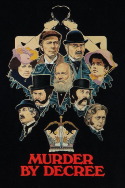
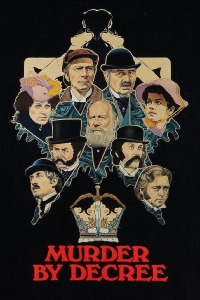
[i]Murder by Decree[/i], directed by Bob Clark ([i]Black Christmas[/i], [i]A Christmas Story[/i]) from a script by John Hopkins, takes a popular ?what-if? scenario, Jack the Ripper vs. Sherlock Holmes (based on pure conjecture given Sherlock Holmes?s status as a fictional creation), combines that scenario with period production design (the grimy backstreets of London's East End) and atmospheric cinematography, adds credible, charismatic performances by Christopher Plummer as Sherlock Holmes and James Mason as Dr. Watson, into an intelligent, suspenseful, if flawed, film examination of the abuses and corruption inherent in unchecked, autocratic power.
Whitechapel, 1888. Anyone with even passing knowledge of late-Victorian England will immediately connect the place and time with the horrific murders, still unsolved, of several, lower class women (most of them prostitutes) by a serial killer dubbed at the time as ?Saucy Jack? or ?Jack the Ripper.? Over the last hundred years, speculation over the Jack the Ripper?s identity has centered on several suspects, but given the crude forensics and limited resources of the period, Jack the Ripper?s identity will remain just that, speculation. Not surprisingly, the Sherlock Homes vs. Jack the Ripper scenario was actually filmed once before, [i]A Study in Terror[/i], in 1966 with John Neville essaying the role of Sherlock Holmes. Jack Hopkins? literate script borrows heavily from a then popular book on Jack the Ripper, [i]The Ripper File[/i], by Elwyn Jones and John Lloyd. Hopkins used their research and speculation, developed around a royal conspiracy, and added Sherlock Holmes as the central character. In fact, writer Alan Moore ([i]The Watchmen[/i], [i]V for Vendetta[/i]) developed his graphic novel, [i]From Hell[/i] (later turned into a film with Johnny Depp in the lead role) around a similar royal conspiracy, pitting Jack the Ripper against a fictionalized version of the real-life detective who investigated the murders.
[i]Murder by Decree[/i] opens in mid-terror reign, with Holmes on the sidelines (actually at the opera house), questioning Scotland Yard?s decision not to ask for his assistance. In a subtle plot development that will have important ramifications later in the film, Watson?s pro-monarchical bent finds expression at the opera house, where radicals attending the opera boo the Prince of England. Watson helps to shout them down, much to Holmes? surprise. Moments later, the Ripper has claimed another victim. Followed by several, rough-looking men, Holmes invites them into his home. They ask for his assistance in solving the murders. Even as he ponders his decision, Jack the Ripper claims another victim. Holmes, fascinated by the challenge, but driven by obligation and duty, takes the case.
Arriving at the scene of the crime, Sir Charles Warren (Anthony Quayle), the head of Scotland Yard warns Holmes off the case. Holmes, of course, chooses otherwise. Suspecting Warren of duplicity (in part because Warren has ordered the removal of words written in chalk in an alleyway near the crime scene), Holmes surmises that Warren is a member of the Freemasons. As Holmes puts it, while knowledge of the Freemasons? existence isn?t in doubt, their rituals, their goals, and aims certainly are. Holmes naturally seeks a connection between the dead women, all of whom frequented the same tavern, as well as consulting with Robert Lees (Donald Sutherland, soporific), a medium who claims to have knowledge of the murders. Lees, however, proves to be a dead end (he?s warned by mysterious parties not to disclose any information to Holmes). Holmes, indomitable in [i]Murder by Decree[/i] as he is in Arthur Conan Doyle?s novellas and short stories, continues his investigation. The clues, inevitably, lead to Mary Kelly (Susan Clark), a local prostitute who may be the key to the Ripper?s rampage. Holmes hopes to protect her from the Ripper and the men behind him. Wits and deductive reasoning aside, Holmes must eventually confront one of the men responsible for the murders in hand-to-hand combat on a deserted, fog-bound wharf.
Although, for the most part, tautly paced, [i]Murder by Decree[/i] stumbles, first with the unnecessary inclusion of Robert Lees, a superfluous character that adds nothing to Holmes? investigation (the second scene with Lees also affords Holmes the curious opportunity to employ a dodgy disguise to gain entry into Lees? residence), and later, in the post-climax denouement, with Holmes allowed to make an impassioned speech before a secret meeting of high-ranking officials. It allows Holmes a chance to spell out his case against the Ripper, his associates, and a (tenuous) connection to the government officials, while agreeing, for poorly motivated reasons, to keep this information from the press and general public. The speech turns into a poorly timed, underwritten, and ultimately, unsatisfying sermon. Coming so close to the end of the film, viewers will be either bored or restless, not what Clark or Hopkins intended. Still, despite its missteps and minor flaws, [i]Murder by Decree[/i] proves to be one of the most entertaining films to use Arthur Conan Doyle?s singular creation.
This review of Murder by Decree (1979) was written by Mel V on 15 May 2005.
Murder by Decree has generally received positive reviews.
Was this review helpful?