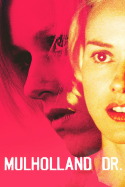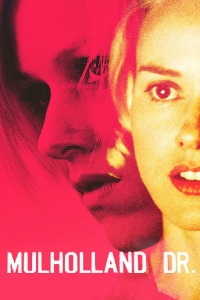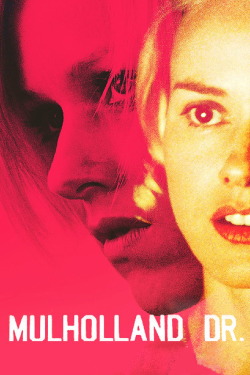
Review of Mulholland Dr. (1999) by Ben R — 18 Feb 2015
I've never been the best at understanding movies. I mean, I'm a big fan of them, and probably understand them thematically more than a lot of other people, but sometimes, I'll admit, I get confused about certain implications of a scene, or a plot twist, or just what's happened dramatically in the film. One need not know particulars about property and water ownership to enjoy Chinatown, but I'll admit that I got a bit tripped up trying to understand all the real estate stuff that was going on.
Mulholland Drive is a movie I was warned beforehand I would likely not understand. The first three quarters or so - it's kind of hard to tell how much of the movie was devoted to each section since it's weirdly structured - I understood everything that was going on, and though I couldn't yet tie everything together or solve the mysteries, I had faith that they would be solved and I would understand them. It was easy to juggle the various plot lines. But then that last quarter happened, and nothing was as it seemed to be, and I felt the familiar sensation of not understanding what was going on. So I can understand why people don't get it. I felt like I only had a vague idea of what the ending meant. Afterwards, though, I read some plot summaries online, and I realized that I DID understand the dramatic situation. Things I felt unsure about turned out to be right, so I'm actually hardly confused about the movie. Most of it can be summed up in a sentence: a woman named Diane is depressed after failing professionally and in her romantic life, so she constructs a complex dream, a sort of fantasy of what she wished was going on. Most scenes that don't seem to have a specific psychological function in the dream are simply side effects, other pieces from her life given random configuration in her brain, just like dreams actually work.
Upon first finding out that the first two hours of the movie were a dream, I was a bit disappointed. There's always a danger when there's a big twist like that, because you get really invested in the plot, and the twist upends all of that. There's a part of me that wants to forget about the fact that it's all a dream and just find out why those mobsters(?) wanted Camilla Rhodes to get the part in the movie, or to find out Rita's true identity. Characters like the Cowboy were really interesting, and there's a certain degree of disappointment when you realize that there aren't going to be real answers to the questions posed at the beginning, within the context of this constructed narrative. We accept narratives in film as if they're real things that are happening, so in turn, we except the narrative within the narrative. It violates that implicit trust we have to upend that.
Mulholland Drive is different, though, I decided after some deep thought. First of all, there's tons of foreshadowing throughout, with Betty even saying she's in "this dream place." The telegraphing is set from the first scene, in which a weird, psychedelic jitterbugging scene is shown, and there's an odd camera hovering over a sleeping figure (we later find out is Diane). This foreshadowing throughout is critical, because what first appears to be "okay, really? That came from nowhere" turns to "surprising but inevitable.".
The other big thing is that the first two hours are a pretty remarkable representation of a dream. There are plots that go dropped, and sequences interrupting the main story in odd ways. The viewer thinks these are subplots at the time, but you can imagine in Diana's head the way random scenes would be stuck between her main dream, just like real dreams. There are weird hallucinations, sexual fantasies, and semi-important characters who we later realize Diane may have met once and then repurposed for her dream. As an example, in the dream narrative, the main character is Betty, and she sees a waitress with the name Diane. In real life, this is flipped, and the waitress's name is Betty. So when Diane falls asleep that night, the first alternative name to call herself is Betty, since she vaguely remembers that name from somewhere. It's kind of brilliant. The main story may be more complex than an average dream, and more vivid, but it's probably the closest I've come to seeing a movie that actually depicts a dream in a pretty realistic way. That, ultimately, is what makes the ending of Mulholland Drive a spectacular twist instead of a cop-out.
This review of Mulholland Dr. (1999) was written by Ben R on 18 Feb 2015.
Mulholland Dr. has generally received very positive reviews.
Was this review helpful?