Review of Mr. Smith Goes to Washington (1939) by Paul B — 08 Aug 2009
Disenchantment, hopelessness, and eternal vigilance in the face of corruption.
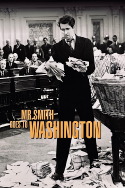
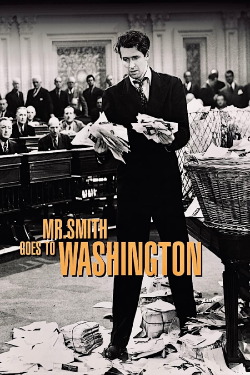
In my experience so far, I find it pretty rare indeed for a single performance to (1) dominate almost an entire film, and (2) be good enough to recommend that film all by itself. Typically, I'm more interested in spirited interaction between two intriguing characters, or more. There has to be something in the movie to distinguish it from a long speech or sermon. Capra's 1939 masterpiece is something of an exception. It does have a few more characters than the lead, but they exist to help or oppose Jefferson Smith; from the moment he appears he is the focus of the movie. In this one case at least, the character of Mr. Smith, and the performance in that role by James Stewart, are easily sufficient to make this one of my favorite movies of all time.
It's hard, or even impossible, to discuss the role and the performance separately. Stewart personified his character so much that he could hardly get a chance to play anything but variations on the same person for the next decade. He has become an archetype in cinema history, and one can just as easily say that Mr. Smith has become an archetype. The down-to-earth mannerisms, the initial naivete that celebrates certain principles and that, given pressure to abandon them, grows into an unflagging determination to keep them--Smith/Stewart is what we call the Everyman, a hero for ordinary people, the kind of hero that can be found anywhere if we look hard enough.
Lest anyone unfamiliar with the material think that this character is some sort of one-dimensional preacher or saint, it is worthy to note that Mr. Smith moves through an intensely well-developed character arc. The course of the movie is a test of his inner strength, and there are in fact many moments when it appears he might fail. Without giving too much of the plot away, let it be said that he has grown up embracing heroes: the historical heroes of American politics, the men that so many other young Americans have admired as well. Smith also has at least one hero who's still alive: Joseph Paine (played by Claude Rains), the U.S. senator from "his state" (the precise location kept vague to make it universal [or at least universal insofar as America is the universe]). When Smith gets the chance to see this man's heroism at first hand, naturally he finds reasons to be disappointed. Even more so, he finds reasons to be truly shocked. Faced where a situation where he can take his stand for what's right--if only that--or to walk away, the stakes prove to be very high for either possibility.
Stewart's performance is impressive on many levels. He manages the early comic scenes with the beautifully awkward demeanor of a man who's honestly not trying to be funny, but it still is funny. As the film progresses, he shows the noteworthy ability, even at a young age, to dig deep into his own soul and pull out the motivation for the most passionate anguish imaginable. Capra knew his actor was on fire, so he trains the camera on him and simply lets him work. The character and the actor mesh so amazingly that it's hard to keep from thinking that we're actually seeing Stewart himself, at least in some way. The Sidney Buchman screenplay allows this deeply felt and genuinely virtuous man to utter some of the most beautiful statements about America and her government that I've ever heard. His speeches are poetic and moving, no matter how often the people in the movie fail to listen.
What Capra accomplished with this film was to show what might happen if an ordinary citizen were to be admitted into the culture of Congress. The disconnect between one and the other seems to be just as much of a threat today as it was then. What's remarkable is how angry the message is. In the movie, the villains in Washington are horribly vicious; they literally stop at nothing. Capra had a tendency of, shall we say, putting more nuances into his heroes than his villains. But the extreme nature of the corruption here serves a good purpose. It allows the film to go above the politics of right and left, so that it can ask the question: where good and evil are not murky at all, will we still choose the good? Mr. Smith's awesome struggles speak to all of us. They warn us that liberty really is fragile; even the best people, through nothing so much as inaction, can jeopardize it entirely. Perhaps the only hope is that this archetype will inspire others to speak up when necessary.
This review of Mr. Smith Goes to Washington (1939) was written by Paul B on 08 Aug 2009.
Mr. Smith Goes to Washington has generally received very positive reviews.
Was this review helpful?