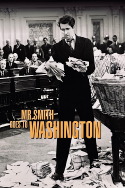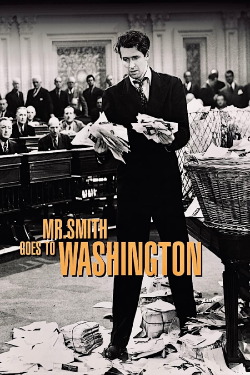
Review of Mr. Smith Goes to Washington (1939) by Edith N — 30 Dec 2009
All Things to All Men.
As I think I've said, I've only taken one film class in my entire academic career--The History of the Twentieth Century Through Film. And I'm reasonably sure that this was the first movie we saw in it, though it might have been the second. I don't think I have my syllabus anymore, so I can't check. The point, though, is that, even that early in the class, we were forbidden from analyzing movies as Christ metaphors on the grounds that it was too easy. So instead, we discussed it as [i]Star Wars[/i], which is just coming at a Christ metaphor from another angle, really, but one person mentioned it and the rest of the class jumped in. Our history teacher was just angry because he couldn't deny it. This is because, in the end, Jefferson Smith (Jimmy Stewart) is whomever you wish to make him. Joe Kennedy thought he gave America a bad name, but fascist dictatorships wouldn't show the film because it showed that, in the end, democracy really does work. Every political movement of pretty much every stripe can claim Jeff as one of theirs. No party's name is mentioned in the film; it's just in terms of "the Taylor Machine." However, I suspect that everyone assumes Jeff Smith was of their own party.
Sam Foley, Senator from some state which is never named, was dead to begin with. He ends up choosing our titular Mr. Smith as his replacement; the assumption seems to be that he'll serve out the end of Foley's term and get dumped in favour of a member of the political machine of Jim Taylor (Edward Arnold), just as Governor Hubert Hopper (Guy Kibbee, also from [i]Babes in Arms[/i]) and Senator Joseph Harrison Paine (Claude Rains) are. Jeff feels kind of valueless standing there, just doing what Paine tells him to, so he, with the help of Clarissa Saunders (Jean Arthur), writes a bill which will create a boys' camp, to be paid back by donations from boys all over the country. Only the Taylor Machine intends to put a dam there which will create a great deal of money for Taylor and his lackeys. Therefore, they must destroy Jeff, which means framing him for wanting the sale only to make a profit from the hard-earned nickels and dimes of the nation's boys. (The fact that he'd have made a profit either way is not addressed.) This leads to the famous filibuster scene.
Annoying but expected is Jeff's unspoken assumption that it will only be boys who profit from the camp, only boys who are needed to. It will be those boys who will sit behind the desks of that Senate. This despite the fact that, at the time, Hattie Caraway of Arkansas was an elected member of that august body. (There are no women in Capra's Senate, or, if there are, they're never shown.) It is boys who must learn about other boys of other circumstances. Boys will be leading the nation someday. Now, I'll freely admit that, as a child, I'd little interest in the camping Jeff so firmly believes will unite the nation. However, I very much wished to go into politics, actually. (This was before I realized that the United States would never elect a mentally ill person, or at least not any time soon. Nor, in my case, should they.) Doubtless Jeff could have, had he spent a little time at it, found a dozen or more girls who would have done just as well in politics as any boy he championed. It's really very vexing, and no one else seems to notice.
Probably this is because it's arguably Capra's best film. Now, the more Capra I watch, the less I really care for him as a director. There are several of his movies which are quite good, and [i]Arsenic and Old Lace[/i], which is at least entertaining, and I've not seen much in the way of his World War II stuff, but there is a reason the term Capra-corn was invented. However controversial the film was at the time, though, it has matured into one of the great classics of cinema. When we think of elected officials we want to have, we think of Jefferson Smith. (I'll accept that he didn't go to the Jefferson Memorial instead of Lincoln, because it hadn't actually been built yet.) We're afraid they're all Senator Paine, though. The idea that most of them fall somewhere in the middle is something people never do seem to consider.
Really, what I find astonishing about the film is that the Taylor Machine gets away with some of the crap they do. The Senators of the time were, apparently, not best pleased with how they are portrayed in the film, and the press corps was downright irate. However, the police of the fictional state might well have been worried about their portrayal more so than anyone else. Bad enough that Taylor apparently controls every venue of communication in the entire state, or at least so much so that an "opposition" papers are able to be entirely discredited to the extent that no one even considers believing them. Worse, though, that members of the Machine are able to destroy little boys' wagons and turn fire hoses on people holding demonstrations in support of Jeff. This is, bluntly, closer to the behaviour that was shown in those very fascist nations about which detractors of the film were concerned. No one seems to remember those bits, either, simply because the ending is so very dramatic. We just forget all the things which are left unresolved at the end, because it is such a powerful ending for all that. You've got to love Jeff Smith, just as Saunders does and as the press corps in the film--and Senate president Henry (Harry Carey)--end up doing as well.
This review of Mr. Smith Goes to Washington (1939) was written by Edith N on 30 Dec 2009.
Mr. Smith Goes to Washington has generally received very positive reviews.
Was this review helpful?